
Meri Nazar Se Dekho
When the first act of Meri Nazar Se Dekho ends – abrupt, almost jolting – it hits you: Mohit, the main character you’ve been following, isn’t real.
You’ve become acquainted with him through the humdrum daily life of his parents – learning about his birth, school, friends, pastimes, even what he said this very morning. Yet, he is but a figment of imagination.
The two central characters – the real ones – do such a convincing job of conjuring their non-existent son that, for a full hour, you’re certain he’ll walk in at any moment.
Bobby Mallick as Shalini and Rushi Dave as Abhimanyu sustain the illusion with such precision and emotional depth, that it never once feels strained.
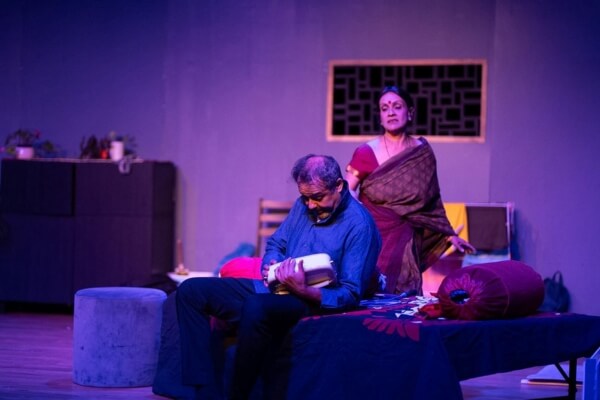
It would be simplistic to think of playwright Prashant Dalvi’s play as grieving the loss of a child – or at least an extreme case where the grief becomes pathologized. Even as a commentary on the pressures on a woman to have a child, across the physical, psychological, sociological and philosophical, it falls short. This is something else. It is about the pathology itself, the mechanics of denial.
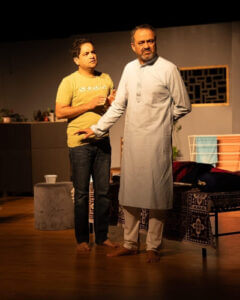
Abhimanyu explains to his friend Sameer (Saurabh Datar) who has cottoned on to the situation, why he allowed the creation of this fully simulated environment. If it works as a coping mechanism, why not? When reality becomes too painful to face, we retreat into the moral simplicity of imagination – and in our cocoon, we stay protected.
Deep down, Abhimanyu knows this may serve in the moment, but cannot hold in the long run – and so he agrees to seek help.
The ultimate path to clarity unfolds as a drama within a drama. It resolves in brutal fashion – Abhimanyu overwhelmed in his transference, and consolation coming from a surprisingly calm, collected, and clear-sighted Shalini.
With that shift in perspective, it becomes clear that this was the play’s concern all along: the act of seeing. We interpret the world from within our own frames, often reshaping make-believe into lived reality.
To some extent, we all construct these private worlds. We inhabit our bubbles, defending them – sometimes vociferously – against anything that might rupture our carefully held truths, whether around politics, climate, race, or any other issue.
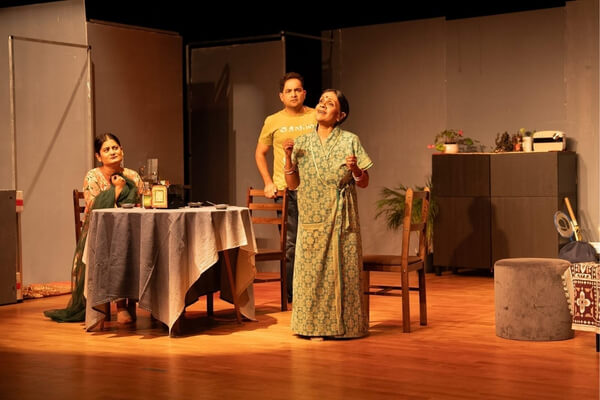
“Look at it through my eyes,” we seem to be saying in our WhatsApp threads and social media spats – meri nazar se dekho – as if perspective alone could make truth singular.
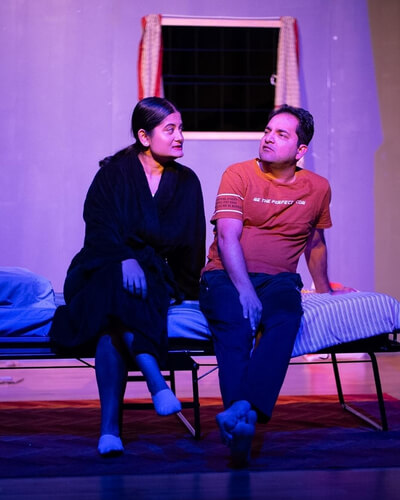
Director Shashi Dandekar renders this shift through a distinctly stylised lens, shaping each moment so the illusion builds – and unravels – with controlled elegance. He is well supported by a cast of seasoned performers in this Prekshaa Arts production. Bobby Mallick is assured as the loving mother and devoted homemaker, although she allows moments of fragility, volatility, and eerie disquiet to seep through brilliantly. Rushi Dave navigates the emotional dissonance of presence and absence with quiet control – breaking down spectacularly at the ghastly end. (It was clear to see the toll this took on him, at the curtain call only minutes later).
Saurabh Datar’s Sameer, the persuasive force, is a circuit-breaker – may we all have a Sameer in our lives. Rajshri Roy’s Aparna stands in for society: observant, sympathetic, yet ultimately retreating from engagement.
Set design here stands out for its inventive and effective use of the full performance space, while lighting is handled with good control, accentuating pivotal moments and creating impact. If anything, the set changes might benefit from a slightly brisker pace.
In the end, this play lingers in that fragile space between presence and absence, where what isn’t there can feel as real as what is. In this, it becomes a telling comment on our social moment.










 The way forward