


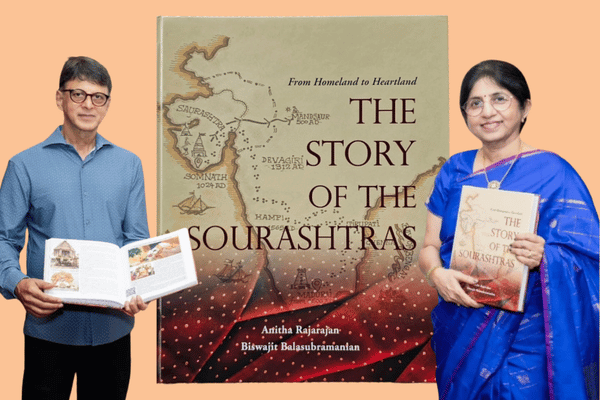

From Homeland to Heartland
“This book is more than just history,” says Anitha Rajarajan. “‘It is a return to our roots — a gathering of voices, memories and traditions that celebrate everything that makes us uniquely Sourashtra.”
In a conversation with Sydney’s Indian Link, Anitha speaks about her recently published coffee-table book, From Homeland to Heartland: The Story of the Sourashtras, co-authored with Biswajit Balasubramanian.
Rich with stories of migration, weaving, language, food and faith, the book traces the remarkable journey of a community that quietly shaped parts of South Indian culture while fiercely holding on to its roots.
For centuries, Sourashtra’s history survived through oral tradition – carried across generations through language, weaving, and customs that families continued to protect. For a community that journeyed from the western coast of India to Tamil Nadu over a thousand years ago without losing its identity, preserving memory has become a way of preserving history itself.
Designed as a coffee table book, From Homeland to Heartland: The Story of the Sourashtras is enriched with colourful photographs, illustrations and humorous cartoons that visually trace the Sourashtran journey. What sets the book apart is its tone – far from being a dense historical account, it brings history alive through illustrated maps, archival photographs, anecdotes and cartoons, making it accessible and engaging. “We wanted younger generations to feel proud of their heritage, while also making the story engaging for non-Sourashtras,” Anitha explains cheerfully. “History does not always have to wear a serious face.”
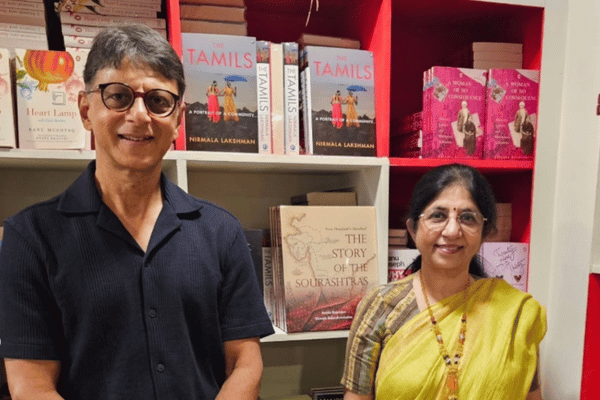
Researching for the book became an emotional journey in itself. “We quickly realised that research is not confined to libraries or archives,” Anitha reveals. “It meant travelling through narrow lanes, knocking on doors, making endless phone calls and listening patiently to stories people had carried for decades. In many ways, we found ourselves retracing the journey of the community we were trying to document.”
That journey began in the Sourashtra region of present-day Gujarat. Known for their expertise in weaving, dyeing and trade, the Sourashtras first migrated in search of stability and opportunity, eventually settling in Malwa under the Gupta rulers in the 5th century AD. But repeated invasions changed the course of their history. The destruction of the Somnath Temple by Mahmud of Ghazni in 1024 AD became a major turning point, forcing many families to move to Devagiri in present-day Maharashtra, then a thriving textile centre. Later, following Alauddin Khilji’s invasions, the community migrated again to the Vijayanagara Empire, where their weaving skills earned royal patronage and prosperity.
After the decline of the Vijayanagara Empire many Sourashtra families moved south once more in search of peace and stability. Invited by King Thirumalai Nayak, skilled Sourashtra weavers settled in Madurai and were granted land around the palace. Over time, Madurai became the cultural heartland of the community. At one point, Sourashtras are believed to have formed nearly one-third of the city’s population, contributing significantly to its thriving textile economy and commercial growth.
“Weaving was not just our profession – it was our identity and our strength,” says Anitha. “Wherever we travelled, our craftsmanship helped the community survive, settle and flourish.”
One of the strongest surviving symbols of that legacy is the Sungudi saree of Madurai, celebrated for its intricate tie-and-dye work. The technique closely mirrors Bandhani from Gujarat, creating what Anitha calls ‘a living thread connecting us to our ancestral roots.’
View this post on Instagram
Language, too, became a powerful link to the past. With roots in ancient Souraseni Prakrit, the Sourashtra language remains one of India’s oldest surviving spoken languages. Though it disappeared from Gujarat over time, it continues to survive in Tamil Nadu, preserved by the community for more than a millennium. Along the way, it absorbed influences from Marathi, Kannada, Telugu and Tamil, reflecting every stage of the community’s migration journey.
The book also highlights the community’s contributions beyond textiles – in education, philanthropy, cinema and India’s freedom movement.
Today, Sourashtras have expanded far beyond weaving – into medicine, business, technology and the arts across the world. Yet despite centuries of migration and adaptation, they have managed to preserve their language, customs and cultural identity.
As the conversation draws to a close, one thing becomes unmistakably clear – From Homeland to Heartland is not merely the story of a migration, but of resilience itself. The Sourashtras blended seamlessly into every land they settled in, contributing richly to local culture and economy while still holding tightly to who they were. Like sugar stirred into coffee, they dissolved effortlessly into the fabric of society, adding sweetness and strength without losing their essence.
READ ALSO: Bihar to Biennale: Western Sydney artist takes heritage to Venice