


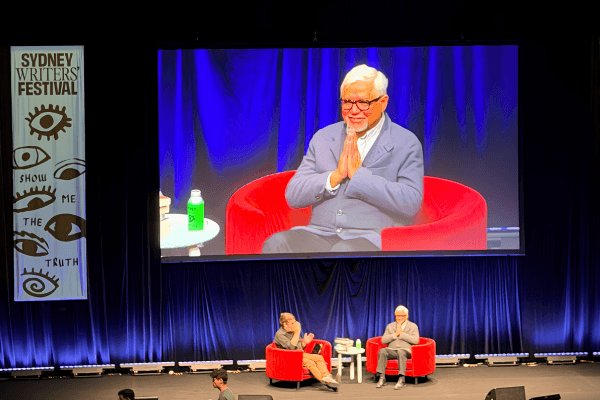

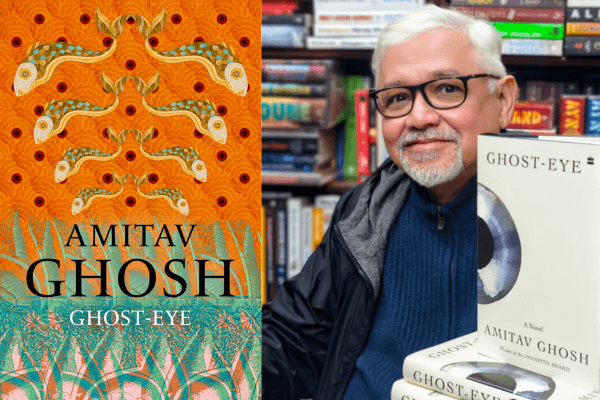
Celebrated writer Amitav Ghosh’s conversation with Michael Williams at the recently concluded Sydney Writers’ Festival was a masterclass on a variety of levels. It was set in the backdrop of Amitav’s latest novel Ghost-Eye, about a young child who has memories from a past life (discovered after she asked for fish for lunch despite being born in a strictly vegetarian family), but the discussion spanned his entire body of work of some 20 publications.
The takeaways were many – from wonder, curiosity, data collecting, storytelling, language, and intellectual humility, to the willingness to admit that the world is far stranger than we think.
Here’s a list of learnings from the Amitav Ghosh way of seeing the world.
1. Make room for mystery
“You have to be a bit weird (to be a writer),” Amitav Ghosh laughed. “A little ‘woo-woo’. Normal people don’t do it.”
It was surprising honesty from one of the world’s most respected novelists.
He was talking about his latest work Ghost-Eye and its themes of past lives, imperceptible worlds and realities that lie beyond rational explanation.
It was his way, also, of introducing us to how the new work, different from his usual, came about – from a motivation to explore what cannot be fully understood yet.
It’s not we who choose the myths that guide our lives, he writes in the book. It’s they who choose us.
Rather than dismissing the mysterious, Ghosh seems interested in what happens when we take it seriously.
Don’t believe in reincarnation? Cynical about traditional ecological knowledge? Take a moment to listen to a believer. Think of it as an exercise in perspective-taking or listening to a differing point of view – something we ought to be doing more of in the contemporary world, you’ll agree.
2. Ground yourself before you imagine
Its spiritual and metaphysical questions notwithstanding, Ghost-Eye emerges from the same practice that has shaped the Amitav Ghosh we have known for four decades: observation.
He described himself as “a very empirical person” whose instinct is still to carry a notebook, listen to people, keep “stacks and stacks of notes”, and accumulate experiences before ideas take shape. Whether researching the Sundarbans in The Hungry Tide or the opium trade in The Ibis Trilogy, imagination always began with immersion.
Ghosh traced this habit back to his days as a journalist during India’s Emergency and later as an anthropology student living in an Egyptian village.
“Talking to people always comes first,” he said. The story follows later – sometimes years later.
View this post on Instagram
3. The most interesting truths often live between opposites
Across the conversation, Ghosh repeatedly resisted binary thinking. He is fascinated by the meeting point between seemingly contradictory ways of knowing – science and spirituality, reason and wonder, modern ecology and indigenous knowledge. Much of Ghost-Eye exists in precisely that space. In exploring past-life memories, it does not reject science. Instead, it asks what happens when reality proves larger than the frameworks we currently use to understand it. For Ghosh, the tension itself is productive.
The lesson here: resist simplistic either/or thinking.
4. Old language can teach you how to see amitav ghosh ghost-eye
Some of Ghosh’s happiest moments as a writer seem to happen in archives. While researching The Ibis Trilogy, he spent years reading nineteenth-century letters, journals and ship records, delighting in their multilingual vocabularies and sprawling sentences. He spoke almost wistfully about older English, filled with Persian, Hindi, Tamil and Portuguese influences. Reading those texts was not merely historical research; it reminded him that language was once stranger, richer and less standardised than it often feels today.
For writers, there is much to be learned simply from listening to how language once moved.
5. The footnotes are where the stories are
One of Ghosh’s gifts as a writer is his ability to follow obscure trails through archives and journals.
“What’s very important in my work is the engagement with the history of science,” he said. “I wrote a book, for example, about Ronald Ross. Sir Ross, an English scientist who lived mainly in India, is credited with discovering the malaria parasite’s life cycle. Studying his field notes, it turned out – amazingly – that all the major connections in his results, all of them, were made for him by his Indian servants.”
The lesson – remarkable stories often hide in the margins of history, waiting for someone curious enough to look.
6. Sometimes you need to ‘uneducate’ yourself amitav ghosh ghost-eye
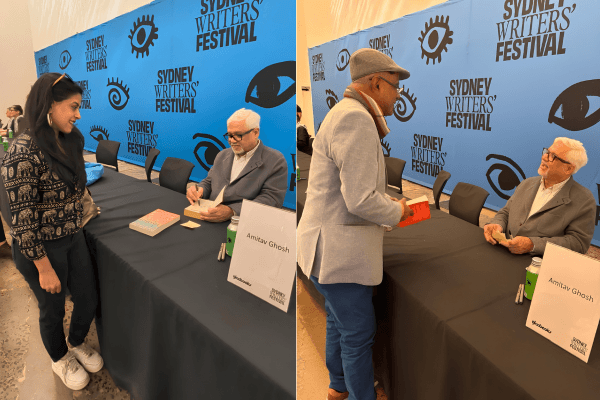
The most memorable moment of the session came near the end, when Amitav Ghosh reflected on writing Ghost-Eye. Educated to become part of what he called the “expert class”, he eventually realised that expertise alone cannot explain the world, let alone its mysteries. Writing books like The Great Derangement and later Ghost Eye required him to loosen some of those inherited assumptions and become open to other ways of seeing.
Ghosh has not shied away from using ecology to challenge ‘educated’ thought. By privileging ‘expert’ knowledge for far too long, have we lost other kinds of valuable knowledge in preserving our natural world?
“I had to ‘uneducate’ myself,” he said.
It may be the most Amitav Ghosh lesson of all, that wisdom sometimes begins where certainty ends.