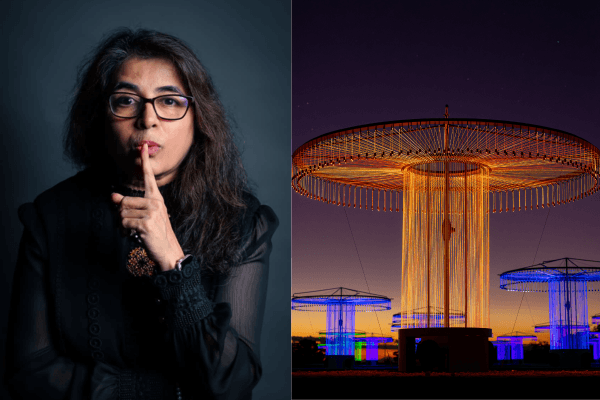

Emmy-winning British-Asian composer Nainita Desai is no stranger to weaving musical journeys. But being invited to create Tessellation, a 30-minute score for Bruce Munro’s Fiber Optic Symphonic Orchestra (FOSO) installation in Mildura would be her most personal odyssey to date.
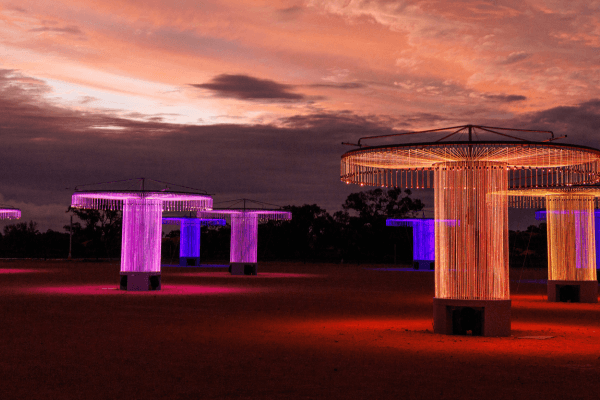
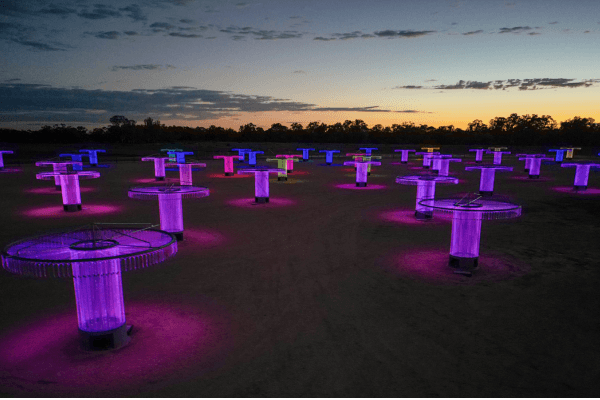
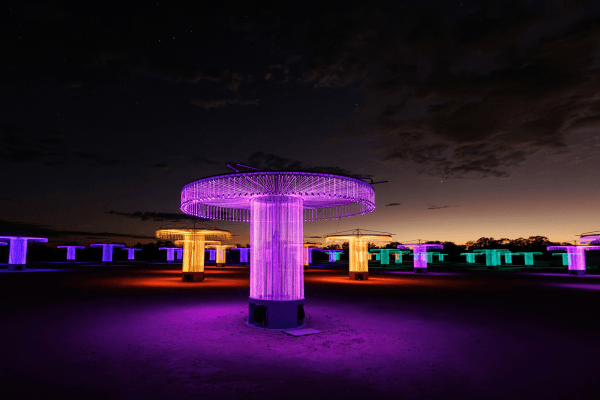
The latest immersive light art piece from Bruce Munro, best known for Uluru’s Field of Light, FOSO constitutes eighty colourful fiber‑optic light columns arranged like an orchestra pit, which pulse and flicker in time with Desai’s compositions.
Delicate strings and melodic vocals twinkle, while resonant, earthy brass sounds and percussion hits glow; sometimes colours bloom slowly with sustained notes, and sometimes they flash dizzyingly with dots of instrumentation.
‘A conversation between light and sound’

Inspired by synaesthesia, a neurological phenomenon causing many people to ‘see’ sound, Nainita Desai was deeply aware of the relationship between light and sound.
“I thought of orchestration almost as mixing pigments: individual instruments have their own distinct hues but combining them creates entirely new shades and textures,” Desai says.
“I wanted audiences to feel that the sound and light belonged to the same expressive world, rather than experiencing one as an illustration of the other.”
The result is a vivid, evocative landscape where light and music dance together, and chords coalesce into colours.
“While writing, I constantly imagined the visual choreography: how colours might flow into one another, how rhythms could ripple through the columns and how instrumental textures might move across the installation. Musical motifs overlap, transform and recombine, much as Bruce’s visual forms and colours interact,” Desai says.
“It became a genuine conversation between light and sound. The music wasn’t simply added to the installation afterwards; the physical and visual character of Bruce’s work informed the music from its earliest stages.”
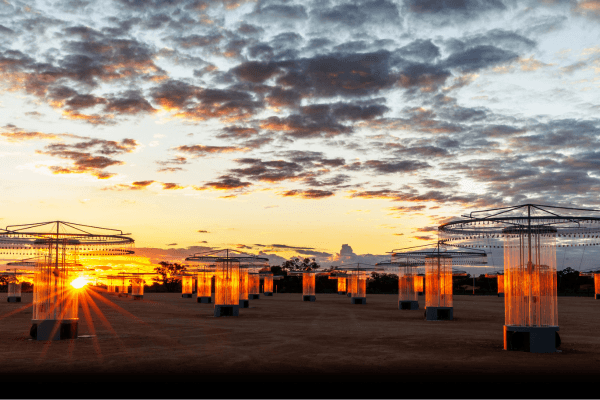
Spanning 220 metres across the arid, ancient Perry Sandhills, audiences can walk through the FOSO installation and experience it from different positions, meaning Desai also had to compose ‘spatially’.
“I imagined motifs passing between different instrumental groups, rhythms rippling across the installation and layers revealing themselves differently according to where someone is standing,” she explains.
“The audience’s movement becomes part of the composition because each person creates their own route and their own sequence of encounters.”
Equally, FOSO’s location at the confluence of the Murray and Darling rivers, and the existing nocturnal bush soundscape influenced the mood Desai created.
“The openness of the landscape called for space, resonance and moments of stillness. At times the music is energetic, exhilarating and uplifting; at others, it becomes reflective and contemplative, allowing people to notice the sand, the darkness, the illuminated structures and the larger natural world surrounding them,” she says.
The mathematical dance of self-discovery
From a childhood spent watching Bollywood movies and absorbing everything from Spanish Flamenco to Indian classical sounds, Nainita Desai has always felt at home orchestrating exhilarating, emotional voyages.
“As a film and television composer, I respond instinctively to the emotions within an image. I’ve always been visually inspired, translating what I see on screen into music that heightens the feeling and enriches the narrative,” says Desai, who has composed for everything from BAFTA-winning game Immortality to Emmy-winning film The Reason I Jump.
But without a storyline to respond to, she drew from her past for Tessellation, composing nine movements inspired by her lifelong interests in mathematics and Indian classical rhythms.
“The piece became a voyage of artistic self-discovery, bringing together many of my lifelong passions…I was especially inspired by the idea that beauty emerges from patterns,” she explains.
From the Fibonacci sequence to the Golden Ratio, Desai says her fascination with the sequences, proportions and geometry latent within nature underpinned her work on Tessellation.
“The score incorporates these ideas not as an academic exercise but as an emotional one. I wanted to explore how repetition, transformation and symmetry can affect the way we feel,” she explains.
“The music moves between moments of tension and release, complexity and simplicity, chaos and order. In many ways, it reflects the cycles and patterns we experience throughout our own lives.”
She feels the two-and-a-half years she has spent on Tessellation have given her a renewed connection to both nature’s rhythm and her own, and hopes audiences will find their own such patterns within FOSO.
“I hope visitors experience a feeling that they are connected to something larger than themselves — the hidden structures and rhythms that exist throughout nature and human life,” Desai concludes.
“Ultimately, I hope people leave with a sense of beauty, possibility and connection. Even if they don’t consciously think about mathematics, music or nature, I hope they feel the emotional resonance of those ideas and carry that feeling with them after they leave.”
Tickets for the Fibre Optic Symphonic Orchestra (FOSO) and the complementary installation Trail of Lights, are available now.
READ ALSO: Indian Ink’s ‘Balloon Dog’ is Tagore for our trying times