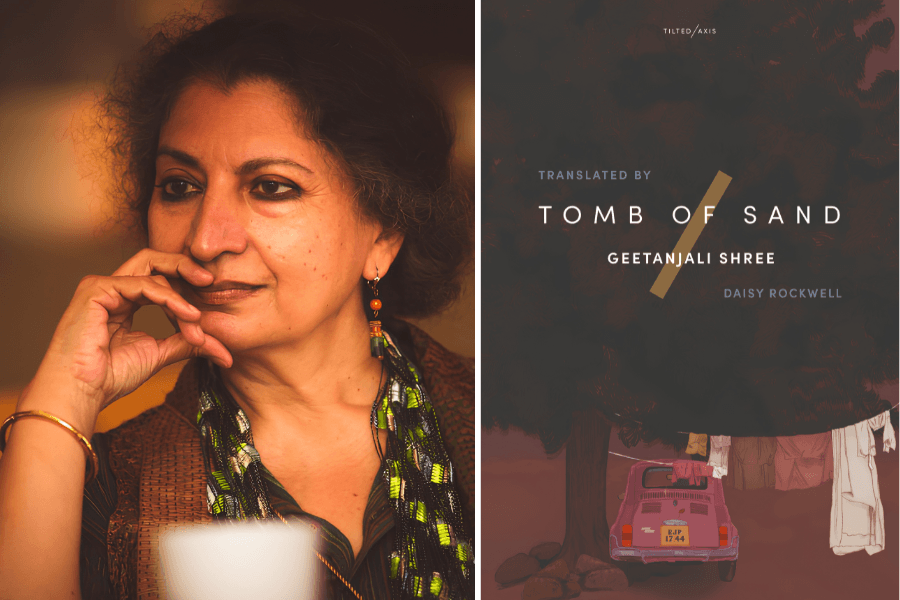
Geetanjali Shree
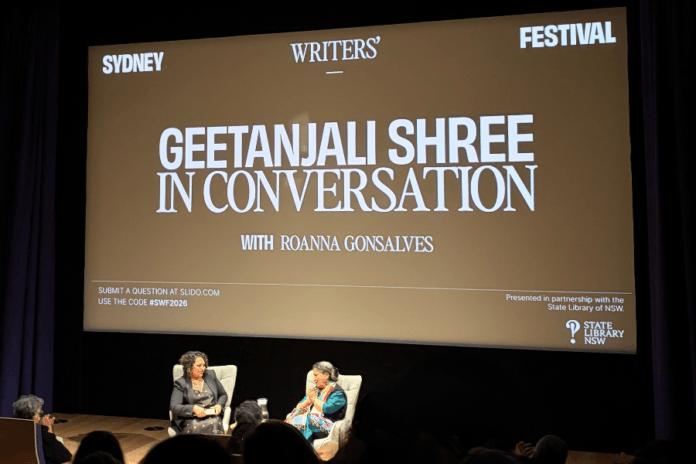
When Geetanjali Shree took to the stage at the Sydney Writers’ Festival in late August to discuss her acclaimed novel Ret Samadhi (Tomb of Sand, translated by Daisy Rockwell), the conversation travelled well beyond the book – into language, borders, identity and the expectations placed on women and writers alike.
Geetanjali made history in 2022 when she became the first Indian author to win the International Booker Prize for the novel. At its centre, Tomb of Sand is a confronting novel following Ma, an 80-year-old woman reeling from the loss of her husband. Other protagonists include Beti, Ma’s daughter who isn’t one for patriarchal standards herself, juxtaposed with Bade who is portrayed as more traditional. Ma’s grief and subsequent depression give way to a paradigm shift in her way of life, sending her on an incredible journey. She finds herself in Pakistan, reliving the traumatic India-Pakistan partition of 1947 while breaking the conventionalist barriers older women are often put into.
Interviewing Geetanjali Shree was Dr Roanna Gonsalves, who made an incredible interviewer, being a celebrated writer herself.
When Roanna asked about Geetanjali’s creative process, her answer came down to one key word: “intuition.”
Rather than seeming like a meticulously prepared story, Geetanjali spoke about being inspired “from an image of an older woman, who eventually became Ma”.
“Rather than the story coming to me, I just followed Ma through it,” she said.
Hearing Geetanjali describe such a personal and intuitive creative process brought us closer to Ma, almost as though we too might encounter her in everyday life. It offered a rare insight into how authors create the characters we come to know and love – and perhaps explains why Tomb of Sand feels at once so natural and captivating.
We were not simply following an author’s words on the page but accompanying Ma on her remarkable journey.
That journey took on a new immediacy when Roanna invited Geetanjali to read from the novel. She chose a passage from Ma’s transformation: no longer retreating from the world, she’s now venturing into a dangerous part of the border between India and Pakistan.
If she were to fall, she did not wish for it to be face down, wherever the bullet came from, wherever it hit, she would fall straight back and lie supine on the ground regally, her eyes filled with sky.
That single line was testament to the fact that Ma was not your ordinary 80-year-old; she was a defiant adventurer in life’s journey who had resurfaced with a vibrant lease on life.
It also showed how allegorical undertones followed the text – Ma was crossing actual and metaphorical borders.
Roanna followed with questions about the novel’s use of Partition and the Wagah border setting. Geetanjali’s response followed the same intuitive pattern from before. “It wasn’t something I thought of before, it just happened”.
This creative strategy set the evening into a broader discussion about plurality and geographical borders that we set for ourselves, inviting conversations about identities. This intersection of identity and borders is navigated not only by the characters in the book, but by its readers too.
As Geetanjali read from both English and Hindi versions, it was like seeing the story come alive as it was intended to, with two linguistic dimensions taking shape, stimulating conversations on translations. “No word has an exact synonym, and no word has just one meaning,” Geetanjali shared with the audience, explaining that if a translation allows the essence of a story to remain intact, it has done its job.
This allowed for an homage to other beloved pieces of literature that perhaps we may not be able to read without the art of translations, like Kafka and Dostoevsky.
Beyond its revolutionary themes in terms of linguistic playfulness and border-crossing, Tomb of Sand is a story about a woman absolutely smashing patriarchal expectations, as her daughter follows in her footsteps.
Roanna inquired behind the meaning of the recurring mention of bells and whistles in the novel. Geetanjali explained, “They represent the whistles released by a pressure cooker and the sound of a doorbell.”
What followed was a meaningful discussion about patriarchal expectations of women, and how female authors often write around domestic duties.
The conversation shifted easily from thoughtful to playful, with Geetanjali sending the room into laughter when asked which of the book’s human protagonists she most identified with.
“I’m more of the Crowess, really,” she replied.
Indeed, literature is not something only to study and appreciate but a source of connection, curiosity and shared delight.
The session closed on a heartfelt note, with Geetanjali offering candid advice to an aspiring young female author.
“There’s no one rule that fits all. It simply is something you have to figure out yourself as you go.”
Perhaps that’s the real pleasure of encounters like these: literature steps off the page, and readers meet not only the work, but the mind and lived experience behind it.