Lakshmi Ganapathy: I want to start by congratulating you on ‘The Jungle and the Sea’; the night I saw it, there wasn’t a single person still sitting for the applause.
You’ve described it as a companion piece to ‘Counting and Cracking’ because you had ‘too much to do’ in the first show. How do you feel like the two pieces complement each other?
S. Shakthidharan: ‘Counting and Cracking’ is written in honour of those who tried to stop the war from happening…my great grandfather was one of those people. It’s a play about a family caught inside the politics of division, a country in the crosshairs trying to reach back to what they know to be true – that we have more to connect than divide us – but ultimately failing.
‘The Jungle and the Sea’ is written in honour of those who found a way to maintain their dignity while the world is falling around them; it came out of countless hours spent with survivors of the war in Sri Lanka and their stories. Once the politics of division is played out, what’s the pathway back to justice, reconciliation? And how does one do that while maintaining one’s dignity and pride?
Lakshmi Ganapathy: Another commonality across those plays is the centring of family units with missing members – why do you choose to focus on them?
S. Shakthidharan: What’s really fascinating to me about the Sri Lankan community is we’ve been through all this grief, but no one grieves in the same way. When these events happen to a community, one of the first roadblocks to processing and finding justice is people arguing over whose response is more appropriate or allowed. Taking a step back and going, ‘it’s okay for everyone to respond to this differently’, opens space for us to listen to each other and find a way forward together.
Inside every Tamil family, you’ll find disagreements. I love the way a family can show the same events affect everyone differently. The family is tasked with how to keep love alive, and if a family can find a way to keep love alive in the most difficult circumstances, it’s a realistic way to give us hope maybe a community or a country can do the same.
Speaking of community finding a way to heal, there’s a point in ‘The Jungle and the Sea’ where Kishan (Dushan Philips) and Lakshmi (Emma Harvie) have a conversation about leaving behind the past – Kishan says there are so many truths, Lakshmi says, ‘we will tell all of them’. Considering we’re only just investigating the true level of atrocities of the war, what does that line mean to you as a playwright?
The idea of telling all the truths, I think, is something that’s only really possible through theatre. It’s an essential component of finding justice; the roadblocks are the people who say there’s only one truth.
Any sense of processing, grief, needs to be listened to with reverence – that bit we’re a little okay with. The next step is harder – the person who listens with reverence then needs to turn to their neighbour and listen to their truth with reverence. How do we share our truth in a way that opens more space to hear our neighbours?
How do we uncover the truth of what led to those mass graves, at the same time as making those people who dug them come forward to the courts to present evidence of why they did it, so we can talk about this factually? It’s difficult. There has to be a process by which different groups who never normally talk to each other come together with a shared goal; that’s what those lines mean.
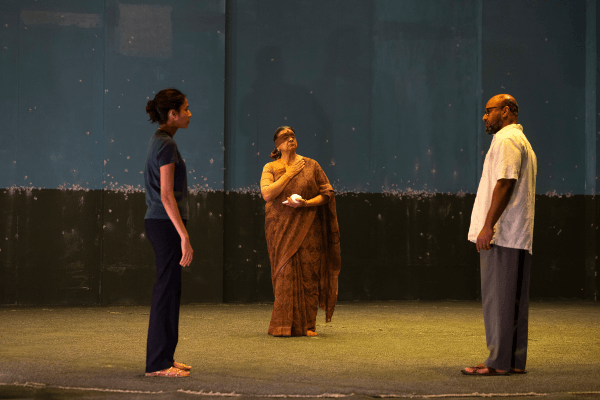
The Jungle and the Sea
Gowrie (Anandavalli) and Siva (Prakash Belawadi), the oldest characters, are both blind for most of the play; what is it about this motif that spoke to you?
The easier path to take is to be wilfully blind when these horrible events happen in a particular country. But as the play explores, the more we are wilfully blind, the more we are unprepared for when the forces of division turn themselves upon our own lives and our own community. The best thing we can do is look at what happened in Sri Lanka with an open heart and mind, not only to help those communities find justice, but to learn from it, to be better prepared for the way the politics of division might wreak havoc in our own countries, communities, and families.
There’s a second layer to the blindfold – as much as we should honour and prize our elders for the hard-fought wisdom they’ve learned, we also have to hold them to account for the limits of their ability and understand we have to continue where they left off. Our elders in Sri Lanka couldn’t stop this division; many of them used it to gain more power. ‘The Jungle and the Sea’ is a story of the kids picking up the pieces in the face of their elders’ failures.
Blinding also feels like a very biblical or mythological device; in the Mahabharata, King Dhritarashtra is blind. How did the Mahabharata and Antigone, ancient stories of war, help you tell this story of war?
I think the real events in Sri Lanka during the period of history the play follows are actually not believable. Writing about them from a lens of naturalism and humility got me halfway in a beautiful way, but it wasn’t enough.
What my community went through beggars belief; I was sitting there and thinking about how to honour the unimaginable, and when I read Antigone and went back to the Mahabharata, I realised inside those epics is a way to write the unimaginable.
Through those epics, I felt like I had permission to reach into what seemed like mythological elements but actually fit how unprecedented and extraordinary the situation these people find themselves in are. To write and craft theatre through ancients gave me permission to honour the epic-ness that I don’t think I could give to myself on my own.

The depictions of violence in ‘The Jungle and the Sea’ are theatricalised, abstracted – how did you arrive at this language for violence?
Mainstream and social media tend to focus on these violent images; it’s a superficial shortcut to what actually happens in these communities racked by violence. We have these buildup of images in our head where we’re like, cool, ‘this means death, this means war’. It’s a very convenient way to go, ‘yeah, I get it, and I’m going to move on back to my lunch’.
Instead of thinking of the global majority as statistics, brown people as helpless and victims of forces that are bigger than us and ‘it’s a great pity what can you do’, I’m more interested in what it means to deal with the ramifications of violence, what it means to have lost so much and still keep going. That means stepping away from the media-like images of violence and death and finding a theatrical language that takes us into the feeling of loss or battling against forces greater than you.
Secondly, there are things that are good to revisit and there are things that aren’t. The events of the end of the Sri Lankan Civil War are still contested, even though we know what happened; when that history is not accepted properly, we are not given the proper opportunity to grieve.
This means that it’s useful to sit in a dark room and be given that opportunity if you want to have it. It’s not useful to be forced to confront images of people dying or being hurt again. There’s no benefit to that – I don’t like productions that glorify that for their own purpose. We wanted to step away from that but still give people the opportunity to dwell on loss or grief to find their own pathway through it. It’s very delicate, tender.
At times, it feels the characters make a strong choice, and at other times, it feels like there is a choice playing out upon them. How do you see fate or the ‘hand of God’ as a force in this play?
There’s so much talk of fate and destiny in the Mahabharata; to remind us we cannot control life, and we don’t know what’s going to happen tomorrow. It’s so unlike Western thought, where it’s all about what are your goals, work hard, achieve what you want to achieve…Life doesn’t work like that.
At some point, everyone realises their choices are not actually what brings them meaning, and you surrender to the fact you can’t control anything. Inside that surrender comes a new feeling, which is an ability to listen to and process every second of life as it happens and appreciate it and be grateful for it.

In ‘The Jungle and the Sea’, there’s this relentless force of history – through this ever turning revolve, through the Sri Lankan government which keeps changing their lives at a whim, through these images of the Tamil community in the north who build homes, lose them and rebuild them again. As the play keeps going against all that relentlessness, they find a different kind of energy, a different kind of way of looking at the world: what’s happening now? Where is my yes that I can say yes to? Through that I will keep going.
It’s this beautiful way of reasserting the individual or the community against the most powerful forces of the world – you can stare them down and there’s a way through. It’s humble and it’s small, but it’s possible.
What’s important about that is to not think of one big grand act, but small ways in our own lives to defy the forces that try to control us. If all of us find small ways to find agency…a million people doing that in different parts of the world over time does have a massive effect.
There are major time and location jumps between the acts as well as two intervals in the show. How does manipulating theatrical time help you with telling this story?
I think inside the heart of the play is a way of looking at the world where there’s never a single story and perspective. This idea of storytelling where a protagonist overcomes a challenge and succeeds can make for an interesting story but is a lie…There’s probably an act of denial because we’re too scared to accept how life really works.
To have these three acts revolve around similar incidents from different perspectives immediately puts forward the idea that however you experience a certain set of events in time is not how someone else does. Life is about knowing how they do it and being able to be vulnerable with showing how you have experienced it, that mix of vulnerabilities is the only way we move forward.
It’s also fun theatrically because it’s actually three different plays; Acts 1, 2, and 3 are three different forms of theatre. Embedded in that spiritual philosophy of embracing multiple perspectives is a theatrical philosophy of showing those multiple perspectives not only in dialogue, or costume, but in form. [To that extent], the beginning and the end of the show are embedded in this wordless space that brings it all together, I think.
Finally, there are acts of kindness in ‘The Jungle and the Sea’ that backfire – what hope do the kind have at stopping a war? Is kindness an undesirable quality in a warzone?

I think the argument for kindness we can believe in and pin real hope on has to be one that is not sentimental. We have to face down the fact that sometimes our kindness can be abused by those in power, to look at that with all the shame and fear that brings and inside that pit of despair, choose to be kind again.
Unless kindness comes from that deeply unsentimental place of knowing it’s the right thing to do, it is a hokey idea. But if we bring it through the fire, find a way to always forgive ourselves and continue to be kind, then it becomes one of the most valuable ideas we can have in the world. It makes the kindness sharper because we can be judicious about how to use it and with whom and where.
A battered, weary person who is kind is what I’m interested in, not an innocent who does it easily.
The Jungle and the Sea, written and directed by S. Shakthidharan and Eamon Flack, is on from August 14 to September 12 at Melbourne Theatre Company’s Sumner Theatre.
READ ALSO: S. Shakthidharan: ‘Theatre unlocks our generational silence’