


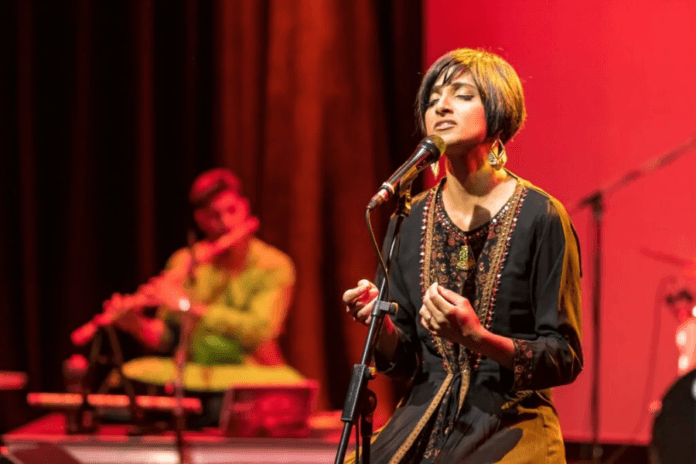
At an Ayurvedic hospital in Kerala, alone, desperate and deflated, Menaka Thomas began writing songs.
For years, music had been something she inherited. She had grown up in an Australian home filled with the sounds of India, learning Carnatic music from her mother, Vijaya Visvanathan, from the age of five.
But in Kerala, as she struggled with an eye condition that had begun when she was 21 and progressively damaged her vision over the next 13 years, something changed.
Words and melodies began arriving, which she recorded on an old iPhone.
“I never imagined anybody else would hear them,” she tells Indian Link.
Eventually, her eyes began to recover, and those private songs became her first album, My Eyes Can See. What began in a period of vulnerability would open another chapter in Thomas’ life — one increasingly concerned not just with performing music, but with connecting people to themselves, to one another and to their heritage.
That idea of connection now sits at the heart of the Brisbane-based Indian-Australian musician’s work.
Menaka was born in Australia in the early 1980s, after her parents migrated from India in the 1970s. Music was a constant in their home: the sound of the shruti or tanpura, her mother’s early morning Carnatic classes, and a seemingly endless stream of classical music, shlokas and bhajans.
“That’s what gives me a sense of home,” she says, smiling.
Her mother taught her to listen — to hear something internally before producing it — and introduced her to the devotion and spirituality beneath Carnatic music.
It was a lesson that mattered particularly because Menaka often sang compositions in Indian languages she did not understand.
She learned music could move her even when the literal meaning of the words was unfamiliar. Today, when performing for audiences who may not understand the language of a song, she invites them to simply “let the music wash over them” rather than worrying about understanding every word.
Where Sound meets Story
That same philosophy is reflected in her heritage workshops.
In Where Sound Meets Story, which she recently presented at Darwin Festival, Menaka Thomas does not tell participants what their heritage is supposed to sound like. Instead, she asks them to consider the sounds that connect them to home, history, and memory.
For one person, it might be a traditional song. For another, it could be the sound of a grandmother’s kitchen, music played by their parents in the car, a particular language, instrument or place.
“Sound and music can give us extraordinary access to memory, and memory gives us access to emotion,” she adds.
The workshops often begin with people thinking about their individual histories, but Thomas is fascinated by what happens next. As participants share their stories, seemingly disparate lives begin to reveal common threads — an emotion, a relationship, a memory, longing or belonging.
People can enter a room feeling separate from one another and leave feeling more connected, she says, “not only to the people around them, but to themselves”.
It is also why she is determined to make music accessible to people who arrive convinced they cannot sing or have no rhythm.
Rather than trying to persuade participants that they are secretly talented, Menaka asks them to acknowledge the inner critic.
She describes it as “bringing up a chair” for the voice of judgement and critique.
She has that voice too, she admits. But once people realise they are not alone in their self-doubt, the pressure to prove they are “good” at music begins to disappear.
“Music is such a fundamental human form of expression,” Menaka says. “I don’t think somebody should have to earn the right to participate in it by first proving that they’re a good singer.”
View this post on Instagram
Music sets you free
Her belief in the power of music to bridge difference has also shaped her collaborations with Indigenous Australian artist Uncle Glenn Barry.
In Maal (One Spirit), a children’s workshop created for BrisAsia Festival with Barry and Japanese koto player Takako Haggerty, voice, movement, yoga, song, story, art and play became ways for children to encounter different cultural traditions.
The aim was not to erase differences or suggest that cultures are interchangeable. Instead, children were encouraged to approach difference through curiosity.
Carnatic training gave Menaka Thomas a strong listening ear, vocal flexibility and an instinctive understanding of melody. Contemporary voice studies at Queensland Conservatorium taught her about breath, vocal health and performance technique—and, unexpectedly, helped her find the freedom to stand and move.
Having spent years singing Carnatic music seated on the floor, she recalls initially being too frightened to stand when she moved into contemporary and fusion music. She graduated first to a chair, before eventually discovering how movement could deepen her relationship with music.
“The voice is really a whole-body instrument, so use the whole body,” she advises other young singers.
Menaka Thomas
There remains a tension, however, between the traditions she inherited and the freedom to experiment. Menaka sometimes wonders whether her music should sound more Indian or contemporary. But she has learned that obsessing over those labels can take her away from what she is actually trying to express.
“Freedom is an important word for me,” she shares.
Her Carnatic heritage, she believes, does not disappear when she experiments. It remains embedded in how she hears and understands music.
That’s the lesson she wants to pass on to young Australians of Indian heritage. Menaka Thomas does not want them to feel obliged to recreate somebody else’s relationship with culture, but to be curious enough to find their own.
“You can honour where you come from without having to recreate somebody else’s version of it.”
READ ALSO: Chords and colours coalesce in Nainita Desai’s ‘Tessellation’