


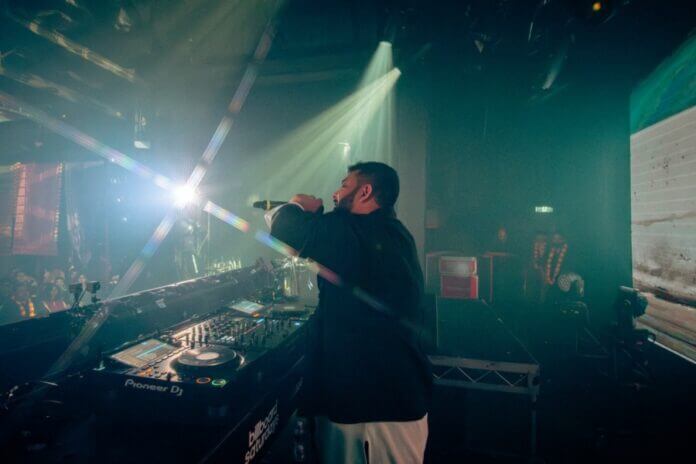

Ritviz
So, what exactly is a kurta saree dance party? I didn’t know either.
Not until I found myself standing under a canopy of marigolds at the entrance, watching half the crowd walk in looking like they were headed to their cousin’s mehndi rather than a concert. For a second, I wondered if I’d got the venue wrong.
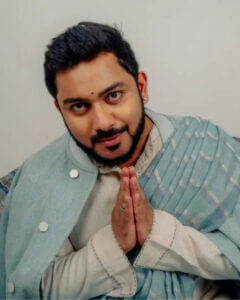
Ritviz explains the confusion, once you know a bit about him. If you’ve been anywhere near the last decade of Indian internet pop culture, you’ve probably heard him without clocking the name. Ritviz Srivastava is a school dropout who dove headfirst into music, taking his Hindustani classical training straight into a DJ deck. His breakout came from winning Bacardi House Party, a music contest organised by Nucleya, which then got him picked up and put on the map through AIB’s YouTube channel. Since then he’s built a discography that sounds like nostalgia and the future had a very specific, very danceable baby. Production that runs on the DNA of old Bollywood and folk melodies, dressed up in electronic music built for a festival stage. All genres at once, and none at all.

The venue itself had gone all in on the theme. Neon strobes slicing through Rajasthani umbrellas. Sarees strung up like it was someone’s chaotic, glamorous idea of a monsoon wedding. And the crowd matched the brief with unsettling precision. Kurtas paired with sneakers, sarees worn with leather jackets, and an alarming number of people with cigarettes hanging out of their mouths. Before you worry about my lungs or my life choices, no – these were phantom cigarettes, the chalky sugar sticks that made every millennial and elder Gen Z kid in the room regress about twenty years in under a second.
Genius bit of nostalgia bait, and it worked on everyone, myself included, because my inner seven-year-old apparently cannot resist a free candy cigarette even in a room full of adults trying to look cool. I think I had about seven, and snuck a little stash out.

I tried to fit in with a Fab India kurta, layered with a 5$ scarf, and Adidas sneakers. I think mum was happy but questioned my choices (and my life decisions). The whole night was essentially a masterclass in making unlikely things work together, and my scarf situation was just a small, personal contribution to the theme.
The lineup leading into the main act was clearly curated with intention. The opening slot, filled by Electric Korma, an Australian band singing seventies Bollywood hits, landed beautifully. They deserve their own write-up entirely, so I’ll just say it worked, it set the tone, and if the whole night was a fusion experiment, they were basically an electric korma of a set in themselves, so to say.
Once Ritviz got on, the room had already been warmed up into something close to feral, and the sets stopped making sense in the best way. Liggi arrived with a dholwali on stage backing it, because obviously a synth drop needs a live dhol to really seal it. Meherbaan pulled things down to a slow burn for about four minutes, just enough for everyone to remember they had knees. And if you are wondering what a full room banging their heads to a tabla beat looks like, you should have been there for DHA. Then there was Mimi, a love letter to his mum briefly taming a room still riding a musical high. Udd Gaye did send the room somewhere upward and outward, and Baraat did exactly what its name promises, turning the entire floor into one collective procession that needed no actual couple to justify the dancing.
View this post on Instagram
If I’m being fussy, a couple of tracks got enough airtime through the set that they started to blur into each other, and I’d have happily traded a repeat for something we didn’t get at all. Teenage Sound never made an appearance, and I missed it. Then again, if you’re the kind of person who can put Sage on loop indefinitely, you’re not exactly owed sympathy.
The real chaos, and I mean that as the highest compliment, was everything stitched in between: AR Rahman blending into Daler Mehndi, Mohammad Rafi making unlikely sense next to Travis Scott (Fein on a bhangra beat), Panjabi MC showing up like an old friend at the world’s most eclectic function, and some very deliberate Divine energy in the mix too (for the boomers in the house, Divine is the Gully Boy rapper, not a religious epiphany, though by that point in the night you could have expected anything). Genres, decades, and continents had blurred into one long groove.
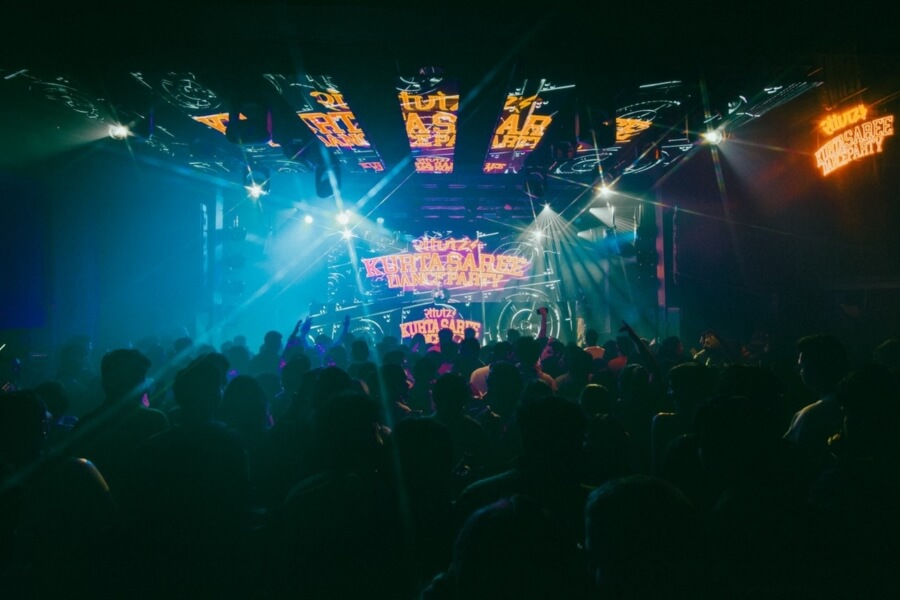
By the time the set wound down, sweaty, marigold petals under our feet, candy cigarettes long dissolved, the night had settled into something that felt like a very well-organised, very fabulous baraat. Desi to its bones, dressed for an international dance floor.
Fusion, done properly, isn’t about mixing things for the sake of it. It’s about making the mix feel inevitable. And it did.
This was, on paper, a dance party. In practice, it was a wedding, a rave, and a fever dream, stacked on top of each other, and somehow that combination made complete sense by the second song.
So, what is a kurta saree dance party? Apparently, it’s this. And I’d happily crash it again.
Read Also: Into The Unknown: Eight musicians and one growing sound