
What does a Rabindranath Tagore story from the 1800s have to do with our current debate over immigration?
A lot, according to Indian Ink Theatre co-founder Jacob Rajan.
“It took me on a real emotional rollercoaster, and the ending had me in tears. Then I discovered it was written 130 years ago, yet everything it was talking about was still happening in the world,” says Rajan.
Though just six pages long, Tagore’s ‘Kabuliwala’, the tale of a Pashtun dry fruit seller visiting Calcutta who gets filially attached to a five-year-old from a middle-class family, is ‘ripe for retelling’.
“The othering of people, the way we treat migrants, it’s so sadly prescient in terms of what’s happening in the world right now,” Rajan notes.
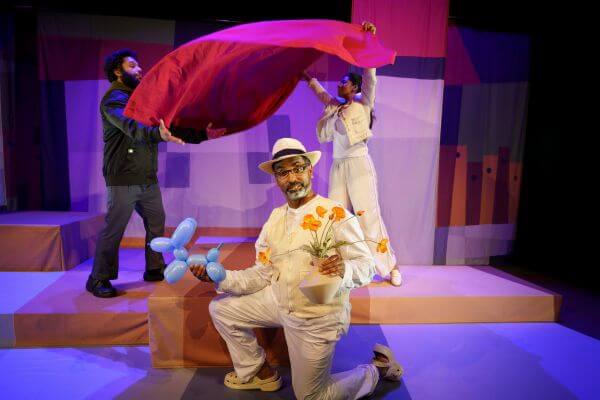
‘Kabuliwala’ forms the inspiration for the NZ-based company’s latest production Balloon Dog, which translates Tagore’s tale of shared humanity to 21st century Auckland.
The Pashtun fruit seller is reimagined as a Gujarati migrant worker, and the family dynamic refreshed for contemporary resonance as a multi-generational, single mother and grandfather unit.
But Balloon Dog steers clear of politicisation, eschewing direct commentary on migration and othering for a tender, familial story. A play choosing gentle compassion is radical in a time where the issue of immigration is mined for shock and anger.
“Theatre is an engine for empathy. That’s what it does best,” Rajan says.
“I don’t believe this is an issues kind of play – it’s still fundamentally about being human, about really seeing people.”
Rajan did hear many harrowing stories from migrant workers he interviewed during the research process, but he prefers to gently transport, rather than jolt audiences towards its message of kinship.
“What we were trying to do in this play was engender empathy for the situation. We didn’t want to do something so horrifying that people couldn’t even look at it,” Rajan notes.
“It’s really about the relationship of these two sets of Indians – the ones established in this country and this newcomer and how that sort of mash up changes both of them. That’s what was in the original story, and that’s what we’re trying to honour in this one.”
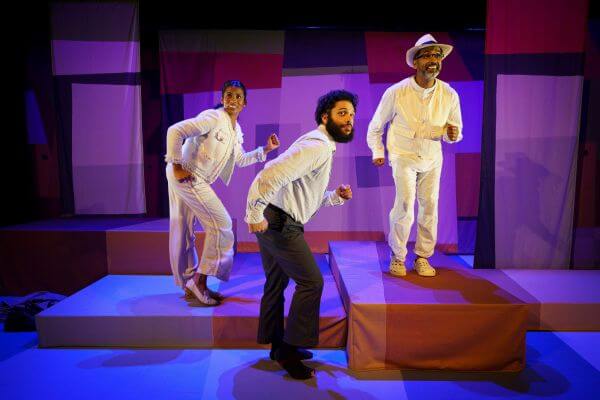
The company create this compassionate space through masks, live music and puppetry, presenting audiences with the rare permission to imagine and play.
Inspired equally by South Asian folk theatre and commedia, mask has long been a signature tool in Indian Ink’s arsenal, encouraging audiences and actors away from intellectualising the work, and towards honest connection.
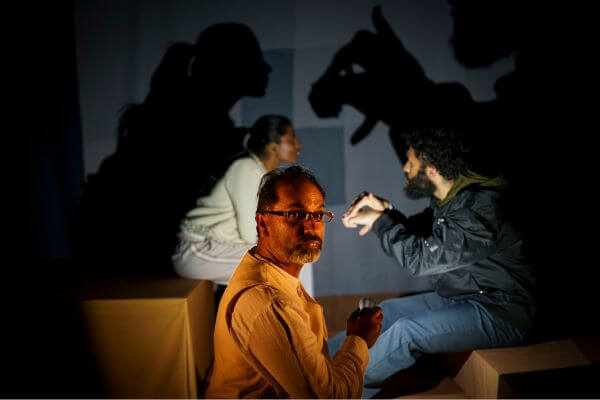
Jacob Rajan
“They’re (audience) are laughing at [us], and then they’re laughing with [us], but then they’re loving us,” says Rajan on the rationale behind the company’s use of mask.
“They go on that journey of going from something that’s seemingly grotesque or ugly, to actually recognising the humanity in those people.”
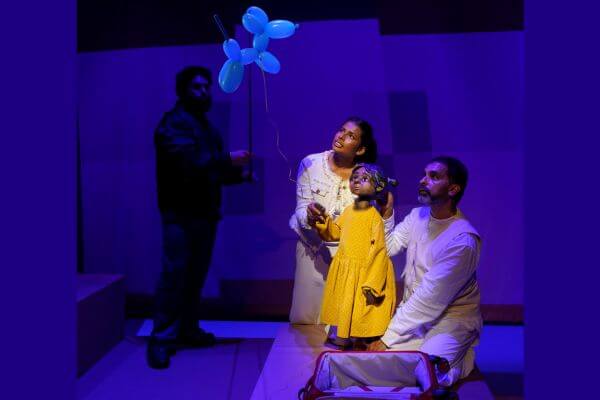
One particularly imaginative use of theatricality in Balloon Dog comes in the portrayal of the five-year-old Mini – not done with a child actor but shared across the ensemble as a reference to the innocence contained within us all.
“We’ve conjured that child through shadow, through music, through chorus, all of these theatrical devices that make the audience imagine their own five-year-old little girl. It’s so much richer for that imaginative work the audience is doing,” Rajan reflects.
It’s Tagore for our trying times, dissecting immigration and parenthood through the disarmingly joyous and communal style Indian Ink has perfected over their 30 years.
“We call it the serious laugh. We open the audience’s mouth with laughter to slip something serious in – it’s Trojan horse stuff,” Rajan explains.
“The people with the big teeth are larger than life and it’s very funny, and then suddenly the rug gets pulled out from you, and you’re having some big feelings.”
Though often thought of as a company bringing cultural representation to stages around the world, Jacob Rajan says Indian Ink’s work will always be about a fundamental humanity that transcends borders.
“Really, we’re a couple of old guys trying to figure out how to live a good life; all the plays are dealing with things ultimately that are to do with being a good person, being a human,” he says.
“Western journalists will leap on the Indian themes, and I struggle to know what an ‘Indian theme’ is. There’s an Indian context, but the themes are universal – they’re speaking to what it means to wrestle with living responsibly in the world.”
Balloon Dog makes its Australian premiere at the Sydney Opera House playing 24 – 28 June, followed by a season at Illawarra Performing Arts Centre playing 1 – 5 July.
READ ALSO: Review: The Supposed to Be at RISING, Footscray Community Arts