



Imagine if you could clone yourself and live the life you always wanted to before you succumbed to migrant family pressures? the supposed to be
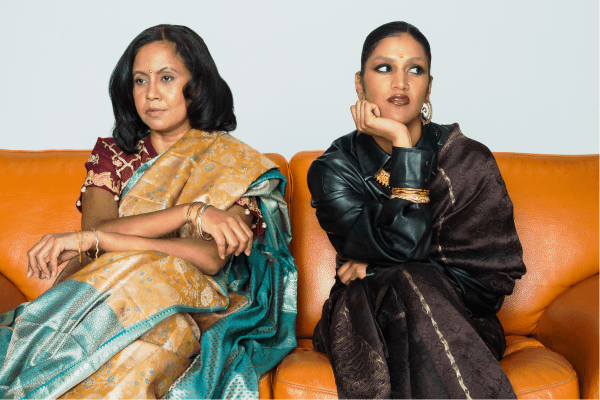
That’s the premise of The Supposed to Be, 2025 NSW Literary Prize nominee Chenturan Aran’s latest play showing at Footscray Community Arts as part of Melbourne’s RISING Festival. Kavitha, a tired corporate executive who once harboured dreams of NIDA greatness, meets her clone Kaye, who has realised these dreams as an OnlyFans star and the lead of b-grade soap opera ‘Bondi Brown’.
The play opens with some intriguing ethical questions about meeting your clone, something we are told is against the rules in this world, but sadly, these promising ideas are left unexplored, the science fiction element of the script largely forgotten a third of the way in.
Instead, the play becomes a Groundhog-day-esque exploration of memory and migrant guilt, where an interaction between a young Kavitha and her mother is repeated to mine clues as to what led to their relationship deteriorating. This sits alongside a send up of the creative industry’s fixation with ‘real’ migrant experiences, a charged mother-daughter quarrel reminiscent of Girls Will Be Girls, and some naughty online shenanigans.
It’s a lot to do in one play, and therein is this piece caught up in its own ‘supposed to bes’, attempting to be a cogent science fiction, satire, metatheatre and family drama; concepts enough for an individual play themselves, but here squashed together and incompletely explored despite the 105-minute runtime.
There is promise in Aran’s honest and pointed writing, with many moments of sharp hilarity. The play skewers tokenism as Kaye suffers through the casting process for ‘Bondi Brown’, and it successfully critiques ethnic fetishisation through a sequence involving possibly the most outlandish prop to grace the Footscray Community Arts stage, a ‘vag-ankle’ (don’t ask).
The Supposed to Be review
Equally, the Tamil women we see in this play are written tenderly and authentically, in all their chappal-throwing, fruit cutting complexity, and Aran captures the unique mix of love and frustration that only your relations can evoke with great aplomb.
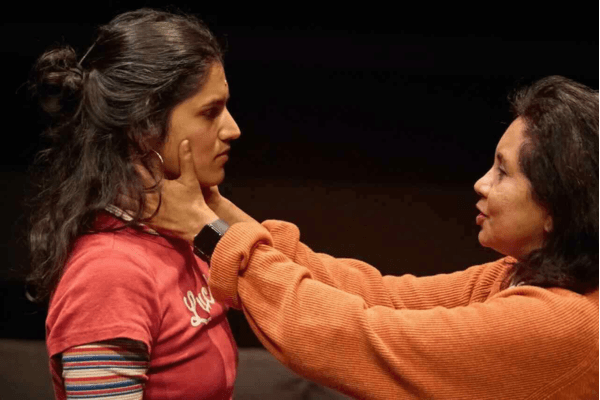
This sometimes bickering, sometimes hair-oiling mother-daughter dynamic between Kaye and Kavitha is rendered very realistically on stage, a credit to Michele Perera and Sarah Fitzgerald’s performances. But the production, under Isabella Vadiveloo’s direction, doesn’t find the pace and dynamism the work seems to call for, leaning instead into a contained, filmic style that leaves many of the script’s witticisms fizzling out.
This is compounded by the set, an austere black bench and sofa that the actors often appear to be negotiating rather than inhabiting, and which offers little to stimulate the audience’s imagination. Equally, a black and white projection of the two actors stretching and performing mudras is a confusing addition. However, Hari Sivanesan’s compositions which fuse Konnakol with futuristic drones and beeps are well engaged, enhancing the mood without being too obtrusive.
It’s wonderful to see an almost entirely South Asian team at RISING, and the passion behind the project is unmistakable. With some refinement to the script and direction choices, The Supposed to Be has the potential to match that passion with a fully realised production.
READ ALSO: Love, Actually: ‘Five Arrows’ by Christopher Gurusamy