


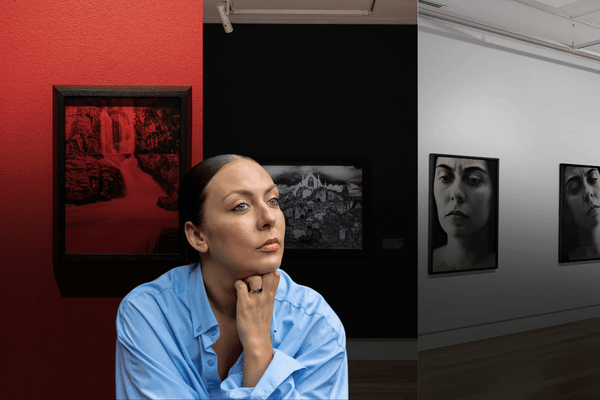

Hayley Millar Baker
For artist Hayley Millar Baker, some of her strongest memories of India now live in stories.
Stories told by her grandfather, who migrated alone from Moradabad in Uttar Pradesh to Australia in the 1950s. Stories about family members who remained in India, others who moved to England, and histories shaped by migration, colonialism, and separation. Stories she now holds even closer after his passing.
“My grandfather passed away in 2025, but we were very close, and I relished his stories of India,” she told Indian Link. “Now that he is gone, I keep them close to my heart.”
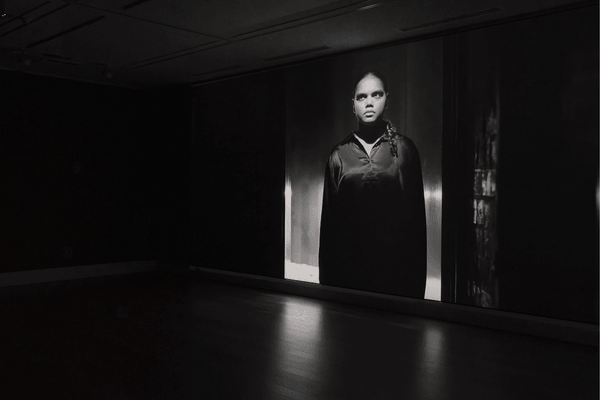
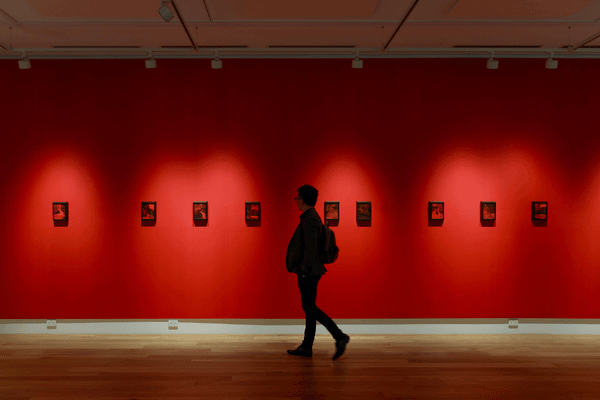
Those memories – inherited, fragmented, emotional, and deeply personal – sit quietly beneath the surface of ‘Selected Works’ [from May 9 till June 14], Millar Baker’s ongoing exhibition at Melbourne’s Wyndham Art Gallery. This exhibition brings together photography, moving image, archives, and self-portraiture to explore ancestry, identity, memory, colonialism, and belonging through the lens of her Gunditjmara, Djabwurrung, Anglo-Indian, and Brazilian heritage.
View this post on Instagram
In a rare and significant gesture toward multicultural accessibility, the exhibition is also hosting a Hindi-language tour by guide Jasmeet Sahi – an unusual offering in Australian contemporary art spaces and one that speaks directly to the exhibition’s layered South Asian connections.
The intersection of culture and cuisine
For Millar Baker, identity has never existed in neat categories.
“As I’ve gotten older, I definitely feel culturally ‘between worlds’ as an Anglo-Indian,” she reflected.
Growing up in Australia surrounded by Indian diaspora friends – many of them Anglo-Indian and Fijian Indian – she says she did not initially think deeply about hybridity or cultural complexity. That understanding evolved later, particularly as she began unpacking the colonial histories that shaped Anglo-Indian identity itself.
“It’s something that’s often discussed at the family dinner table,” she said.
Today, she and her husband – himself an Anglo-Indian Australian whose family migrated from Allahabad – are consciously passing those histories onto their two children.
“The kids learn Hindi, we eat a lot of home-cooked Indian food, and we make sure the kids are confident in their cultures,” she shared.
Food remains one of her strongest emotional links to India. As a child, she was the only vegetarian in the household, and her father would regularly cook her his special aloo curry – still one of her most cherished memories.
Exploring Anglo-Indian and Indigenous histories
But beneath these intimate family stories lies a larger exploration of colonialism and displacement, themes that recur throughout ‘Selected Works’.
“The parallels are very strong,” she said, speaking about the intersections between Anglo-Indian and Indigenous histories.
Millar Baker, born in Naarm/Melbourne, carefully distinguishes the vastly different violences of colonial histories, noting that Australia’s colonisation sought to violently erase Aboriginal people, leaving deep intergenerational scars. Yet she also sees Anglo-Indian identity as shaped by another form of colonial disruption – one rooted in displacement and hybridity.
And so, while family histories form an important thread throughout ‘Selected Works’, the exhibition is equally concerned with Indigenous ways of remembering. Many of the works explore continuing culture, spirituality and the importance of maintaining connections to Country, ancestors and community in the face of colonial disruption.
Today, Baker has built a national reputation for works that challenge official versions of Australian history.
View this post on Instagram
These layered histories increasingly shape both her artistic practice and personal life. Though deeply connected to her family’s stories, Millar Baker admits there are still parts of her Indian ancestry she hopes to reconnect with more directly.
“One thing I have yet to do is travel to India with my husband and kids,” she shared, smiling. “I would love to take the kids to the places where my family and my husband’s family lived, to the schools they attended, and to see their houses.”
For now, much of that connection happens through archives, photographs, oral histories, and inherited memory – recurring motifs throughout her work.
“I love collecting family stories, photographs, data, and archives,” she continued. “I’m deeply interested in remembering those who came before me, in understanding how they shaped who I am today, and in honouring their lives.”
Stop, look closer and immerse yourself
Ask which particular artwork in the exhibition felt especially personal for her, and Millar Baker picks the most confronting series: ‘In Life, In Death’, seven large-scale self-portrait photographs created shortly after Australia’s failed Voice referendum in 2023.
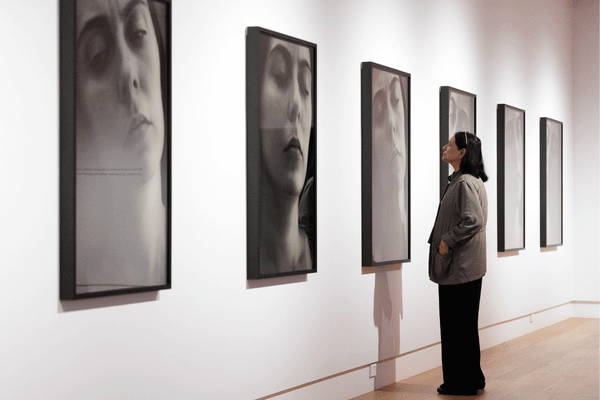
“It felt like colonisation all over again,” she remembered. “Australia voted ‘no’ to allowing us, Aboriginal people, a voice within the government.”
The works were also shaped by witnessing the beginning of the war in Gaza, which intensified her reflections on ongoing colonial violence globally.
“Those self-portraits are connected through so many webs of trauma from colonisation, past, present, and, sadly, probably future,” she explained. “But ultimately, their message is that no matter the pain caused to the spirit, we are supported by generations of strong and loving ancestors.”
Ultimately, Millar Baker hopes audiences leave the exhibition thinking not only about her family’s histories, but also their own.
“I hope audiences consider the stories of the people whose land they occupy, including how they came to be there, where they are from, and the stories that connect to mine – acknowledging what has been done and exploring where we go from here.”
READ ALSO: Bihar to Biennale: Western Sydney artist takes heritage to Venice