



nikita gill hekate
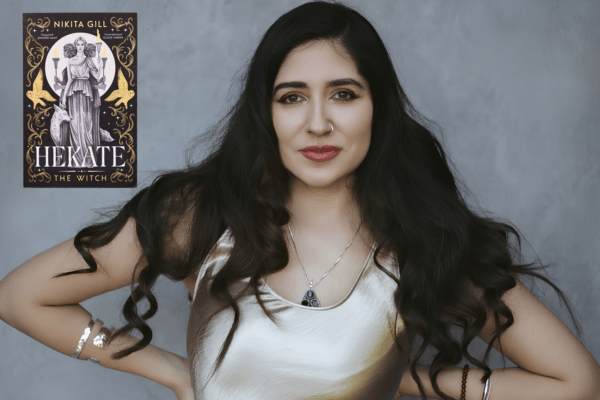
“A woman they cannot control, whether Goddess or mortal, is a dangerous woman,” writes Nikita Gill in Hekate (2025).
At the heart of this Irish-Indian writer’s work broadly, are so-called ‘difficult’ women reclaiming and redefining their power.
In Hekate, we encounter the Greek goddess Hekate, a ‘dangerous’ woman reimagined instead as a symbol of feminine power, healing and self-reclamation.
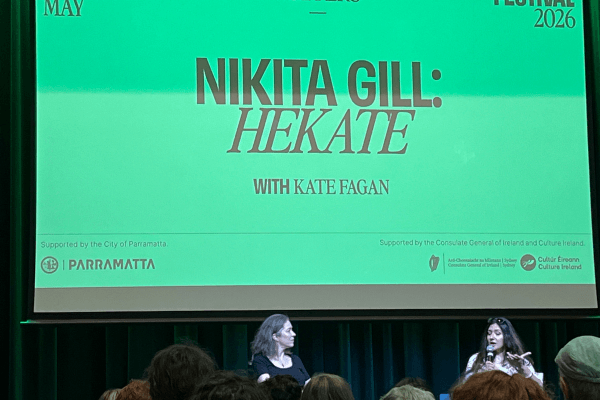
Speaking at the Sydney Writers’ Festival recently, Gill reflected on why she was drawn to Hekate for her latest work.
“Personally, I found that the single most interesting part of Shakespeare’s Macbeth, was Hekate’s very brief appearance as one of the three gender-bending witches,” Gill revealed. “Essentially, she was the first witch, and the genesis of modern witchcraft. I simply became fixated with her.”
For a young Gill, the possibility of this alternative femininity – dark, witchy and unruffled in its non-conformity – proved deeply compelling.
Hekate’s story in Greek mythology unfolds against the backdrop of a brutal ten-year war between the older Titans and the younger Olympian gods for control of the cosmos. Revered as a powerful guardian of earth, sea and sky, Hekate is forced to summon her divine powers, transforming grief and trauma into unwavering strength, to bring the devastating conflict to an end.
Time and time again, Hekate chooses to fight for herself, transforming her ‘dangerousness’ into unbounded liberation.
Gill’s Hekate emerges as an electrifying, charismatic and fiercely feminist retelling of the goddess of magic and the underworld.
OPTING OUT OF THE PATRIARCHY nikita gill hekate
Powerful mother figures and the sublimity of maternal instincts are interwoven into Hekate’s story. From the goddess’s tight attachment to her own mother Asteria and placing her on a pedestal to her less-felt bond with the mother who actually raised her, Styx, Gill’s retelling gives due importance to these strong, resilient mothers.
View this post on Instagram
“I feel overprotective of them,” Gill confessed, “and my own tough relationship with my mum adds on to deep concern towards mothers. I believe that Hekate too carries that overprotectiveness within her – for it is her instinct to guide and protect that drives her untamable and bold persona.”
It is only justified that a retelling of an empowered woman such as Hekate should stand in defiance of patriarchy. Gill achieves just that: her verse, emotionally direct and accessible, subverts from the male-dominated mythological tropes.
Challenging the common dismissal of female anger as hysteria or villainous, Gill composes Hekate’s rage as a politicised driving force in self-discovery. “The patriarchy views independent women as uncontrollable and dangerous, when in fact they dislike admitting their insecurities,” Gill expressed. “Hekate’s independence and refusal to shrink to the expectations of Mount Olympus terrifies the ruling male gods. It is this self-ownership that propels her strength.”
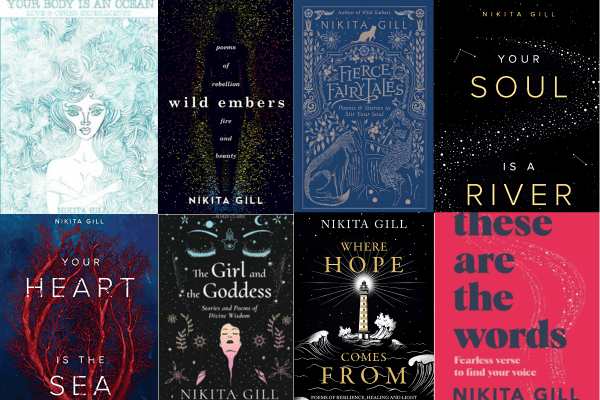
In this regard, Hekate is a continuation of a body of work in a literary landscape where women are no longer confined to the margins of male-centred stories but instead occupy the centre of their own complex and powerful narratives.
THE ALLEGORY OF SEARCHING FOR HOME
“We are all closer to being refugees than we are to being billionaires,” Gill remarked, “and that’s an idea that was relevant during both Hekate’s time and unfortunately, present times.”
The child of Zeus and Asteria, Hekate was forced into a world of war at a young age, leaving her without her parents and in a tiresome pursuit of belonging – a vicious trauma that seeped deep into her bones.
“It was really important for me to show what happens to women who are on the losing side of these wars; it doesn’t matter if you are a goddess or not, if you are on the losing side, you are enslaved,” Gill pointed out. “So, Hekate’s mother crossing the waters illegally to give her child to strangers in hopes of saving her is, sadly, a phenomenon that repeats itself far too many times in our world.”
Two poems in Hekate – one at the beginning and one at the end – speak of home, creating a full-circle journey through the goddess’s search for belonging; a longing that quietly echoes the dreams of many asylum seekers.
ONTO ANOTHER FEARED YET REVERED GODDESS
Now, if Hekate in any way reminded you of the Goddess Kali, you’d be pleased to know that Gill is currently writing a book on the Hindu goddess of time, death and destruction.
Kali is visualised with an incredible iconography of being blue-skinned, many-armed, with her eyes wide and her tongue out, displaying her fangs. Her visage sits, to this day, at the entrances of homes and city gates as a vital household protector – in the same fashion as shrines called Hekataia in Ancient Greece.
Sharing her adoration of the Goddess Kali, Gill gushed, “She is genuinely so cool. She wears the skulls of her enemies as a necklace and their limbs as a skirt. There is so much to her story, and writing this book has been so, so special.”
Gill’s forthcoming retelling of Kali is already shaping up to be something deeply significant – a rare and thrilling moment in which a Hindu goddess steps powerfully into the landscape of contemporary English literature.
Read also: Top 10 books of 2025 by Indian authors