


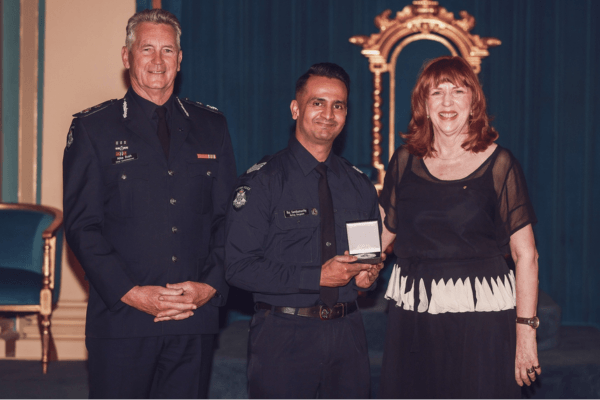

What drew you to policing?
Acting Sgt Rajesh Sambamurthy: Back in 2012, there was a gang rape case, Nirbhaya. That was a spark for me; were I in the job at that time, doesn’t matter whether in India or Australia, maybe I could have made a little bit of difference.
I didn’t know then the process to get in. I had to lose weight. I had to do lots of other things. Being from a different background, not knowing what’s going on, it’s not that easy.
People I knew said: ‘it’s not easy for you to join’ and stuff like that, but I thought it was a challenge and I took it up. I’ve been in the job for about eight years now.
What’s a day in the job look like?
I’m part of a proactive policing unit. Prior to that, I was working as a frontline duties police officer. Sometimes you are assigned to watchhouse duties, sometimes to van duties. When you’re on the watchhouse, you’ll get phone calls, you write reports and emails. If there are any triple zero calls, then we triage. We come to the counter, take reports and statements and things like that. Sometimes people walk in for arrests, and you process them.
But when you’re on the van responding to triple zero calls, every day is different. Sometimes you’ll get a simple job like a noise complaint, which turns into a difficult job. There could be stabbings, lost wallets; I’ve dealt with lots of family violence offenders and victims.
View this post on Instagram
Rajesh Sambamurthy
Put it this way – when people are calling triple zero, it’s probably one of the worst days of their lives. When people are walking away from danger, you’re walking towards the danger. That is a challenge.
Now, in the proactive policing unit, I go to universities and community engagements and do Zoom meetings and things like that. As a crime prevention officer, we liaise with the victims of bigger offenses and see how best we can assist them.
What has policing taught you about people?
People are desperately looking for a little bit of help and difference. They don’t need big time help or anything, but when they are in a situation which is really demanding, they just want someone to say, ‘hey, you’ll be all right, we are there to provide you with assistance’. Those are the comforting words that they look for.
If you can do service to that role and provide the best possible support from your end according to your ability, that really solves the problem then and there. Of course, you can’t provide solutions to every individual. But if you can do your best, I think that’s pretty much what is required at that point in time.
View this post on Instagram
What kind of person makes a good police officer?
I would say you’ve got to be a jack of all trades. You have to have a decent amount of fitness because every day, you’re putting on about 10 to 12 kilograms of equipment. You should be a good communicator; not extraordinary, but at least able to manage a conversation. Then it’s things like good emotional balance, which is why you go through lots of different stages during the interview as well. If you have skills in different areas and a bit of life experience, that’s all that matters.
What’s the strangest incident you’ve dealt with?
There’s a funny incident – at that point in time, it was scary for the victim, and for us the spider senses were tingling.
I was at Forest Hill Police Station working night shift. We had a triple zero call and we responded within 30 seconds because we were close. A woman came out of the house with the kids saying she was having a glass of water at two o’clock in the morning and saw this guy hiding behind the curtains in her son’s bedroom. Rajesh Sambamurthy
So we waited outside the bedroom, asking him to come out. My offsider was keen to go in. I said just wait for a bit; we will assess from here. There was no response or anything, we did all the police challenges, nothing happened.
My offsider went in and moved the curtains, and there was no-one there. Because it was winter, the hot air was blowing from the vent and it was creating an illusion as if someone was hiding behind the curtain. It turned out to be nothing.
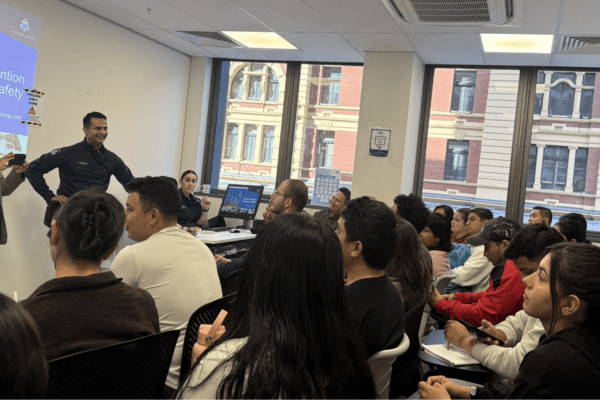
The woman freaked out saying ‘I shouldn’t have called triple zero, am I going to get charged?’ We said, no, it’s a legitimate call. We also thought we had someone behind the curtain. Anyway, it turned out all right after that.
What’s a split-second decision you’ve had to make on the job?
I was working at Moonee Ponds, and the highway patrol unit arrested an offender. We arrived at the location before they could start doing the search on him.
The offender was huffing and puffing. I gave him my Ventolin to assist him. He kept reaching to his groin area, and he was not letting us do anything. We had to make a split-second decision to go hands on. We were in the middle of the freeway; he was wrestling with us. Someone had to spray him and take him down and then we arrested him.
We ended up finding a pen pistol in his groin area. Luckily, we were able to cuff him and de-escalate the situation; fortunately, the offender did not get injured or anything. But if we didn’t take that decision at that point in time, then it could have turned into an ugly situation – you never know what could have happened after that.
View this post on Instagram
How do you think the community perceive your job, and how has your work changed that?
Sometimes we get the bouquets, sometimes the brickbats. That’s unfortunately the nature of the job.
I’ve been in the proactive policing unit for two years; I just love this job. I talk to a lot of people and they thank us for the information that we provide. I don’t take it as a personal thanks. It’s for the organisation; that’s the way I look at it. Rajesh Sambamurthy
It’s a highly respectable job, but sometimes you get people that call us names and things like that, even if you’re just walking to get coffee or whatever. Again, I don’t take it personally; it does affect you at that point in time, but I look at it as they hate you being a police officer because they’ve had bad experiences before or whatever.
We try and change that experience if we can, and we treat them as human beings. Maybe they had a bad day, it’s not them. Wear the uniform, do the job with pride.
Answers have been edited for conciseness and clarity.
READ ALSO: Victorian Multicultural Awards for Excellence: South Asian Links