


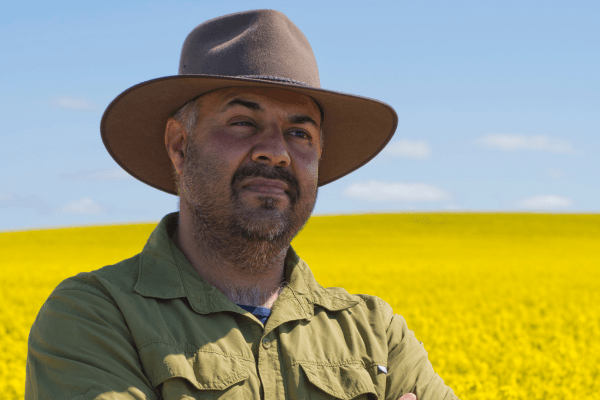

When Prof Harpinder Sandhu and his research team at Federation University Australia set out to build GrainSupp, they were not thinking about India.
The goal was simpler, and far more urgent in Australia’s context: fix the broken visibility in grain supply chains.
But what began as an Australian solution to trace grain from paddock to port is now being adopted for one of the world’s most complex agricultural ecosystems – India.
From paddock to plate, 🇦🇺 innovation meets 🇮🇳 impact. Prof. Harpinder Sandhu’s AI-blockchain tool, GrainSupp, supported by @AusIndiaCentre, is being adapted for India – empowering smallholder farmers, and strengthening food security & trade. https://t.co/Q4W0NHRxi1 pic.twitter.com/xUcjAVf1gE
— Philip Green OAM (@AusHCIndia) March 29, 2026
What is GrainSupp3.0?
GrainSupp3.0 is a digital traceability system that fuses blockchain and artificial intelligence to create a tamper-proof identity for every grain batch.
“It tracks grain from farm to consumer by combining blockchain record-keeping with AI-enabled capture of policy and regulatory requirements across the supply chain,” explains Sandhu, an agricultural scientist.
At the farm level, every detail – from crop type and inputs to harvest conditions – is recorded and verified. Once validated, it is time-stamped and stored on a blockchain ledger, creating what Sandhu describes as a “trusted digital identity for each grain batch”.
As the grain moves through storage, processing, and export, every transaction and quality check is added. AI flags anomalies, while blockchain ensures the record cannot be altered.
GrainSupp was built for Australia to address a key gap – fragmented, paper-based systems that fail once grain leaves the farm.
“GrainSupp was created to address a gap in Australia’s grain supply chains where verified farm-level quality, provenance, and compliance data could not be reliably preserved and shared beyond the farm gate,” Sandhu tells Indian Link.
That gap becomes even more critical as export markets demand proof – not just of quality, but of origin, sustainability, and safety. Traditional systems, he notes, simply are not equipped.
It is this mismatch between demand and documentation that has now pushed GrainSupp towards India.
“The decision to bring GrainSupp to India was triggered by a convergence of strategic, market, and policy factors,” he shares.
View this post on Instagram
All roads lead to India through GrainSupp
India’s agriculture, while globally significant, is marred by fragmentation, informal transactions, and inconsistent quality verification. At the same time, the country is rapidly digitizing its agri systems, creating what Sandhu sees as a timely opportunity.
“GrainSupp3.0 delivers trusted, low cost traceability suited to smallholder dominated systems,” he adds. “The timing is further shaped by strengthening Australia–India trade relations under ECTA and growing demand for transparent, verifiable supply chains for grains, pulses, and value added products. Support through the Maitri Grant Program of the Centre for Australia–India Relations has also enabled deeper collaboration, making India a logical next market to adapt and scale GrainSupp beyond its Australian origins.”
To adapt, Sandhu’s team is removing complexity out of the system.
“GrainSupp is being modified… by prioritizing simplicity, affordability, and inclusion,” he says.
In practice, that means farmers will not interact with the technology directly. Instead, engagement will flow through Farmer Producer Organisations (FPOs) and Farmer Producer Companies (FPCs), avoiding the need for individual digital onboarding or new infrastructure.
This intermediary-led model is key to scaling in India, where digital literacy and connectivity vary widely.
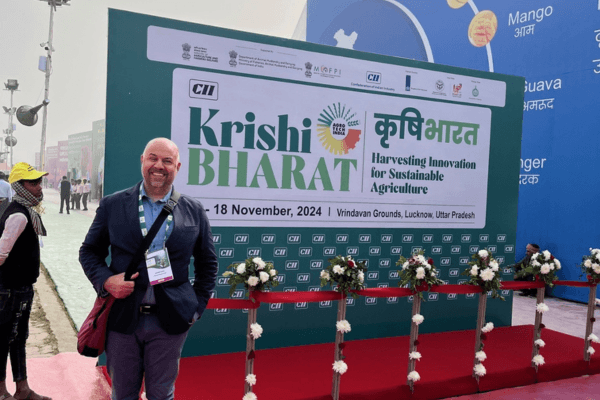
Small solution, big problem : GrainSupp
The impact, Sandhu feels, will be significant.
By enabling verified traceability, GrainSupp could allow Indian farmers to move beyond anonymous bulk selling and into premium, certified markets.
“GrainSupp3.0 can help Indian farmers secure better prices and stronger bargaining power by enabling verified access to premium domestic and export markets,” Sandhu informs.
He, however, feels the biggest hurdles in implementing GrainSupp in India are not technological.
“The biggest barriers… are institutional and behavioural,” Sandhu points.
India’s multiple overlapping systems – mandis, procurement networks, traders, and cooperatives – make coordination difficult. Equally challenging is trust: convincing stakeholders to adopt a system that changes long-standing trade practices.
Still, Sandhu is hopeful, and feels that this model can open doors for other Australian AgTech innovations to India.
“Yes, this project can serve as a practical model for exporting other Australian AgTech innovations to India,” he says.