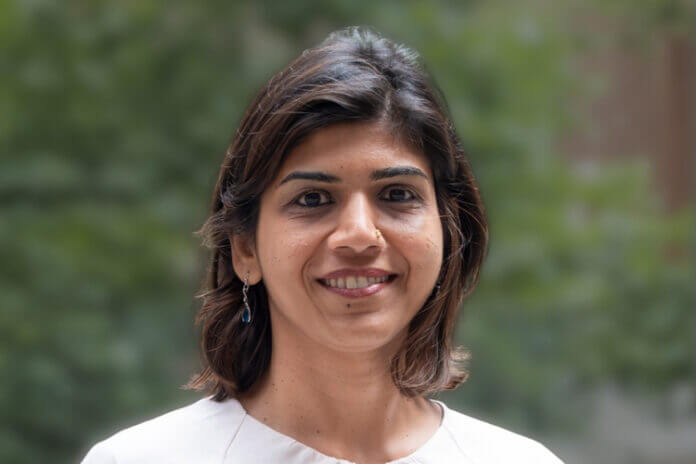

Ambika Vishwanath
For Ambika Vishwanath, the link between climate and security did not begin in a policy paper or a conference room. It began in Madras, in southern Indian, where sporadic water cuts offered an early lesson in how environmental stress can affect everyday life. Today, as a Maitri Fellow, she is exploring that same connection on a much larger scale – examining how climate change is reshaping security across the Indo-Pacific region.
The founder of the female-led think tank Kubernein Initiative, Vishwanath’s work spans water security, governance, gender and foreign policy. Through her Maitri Fellowship, she is exploring how climate change is increasingly affecting issues once seen as separate from climate, from food and water supplies to economic stability and national defence.
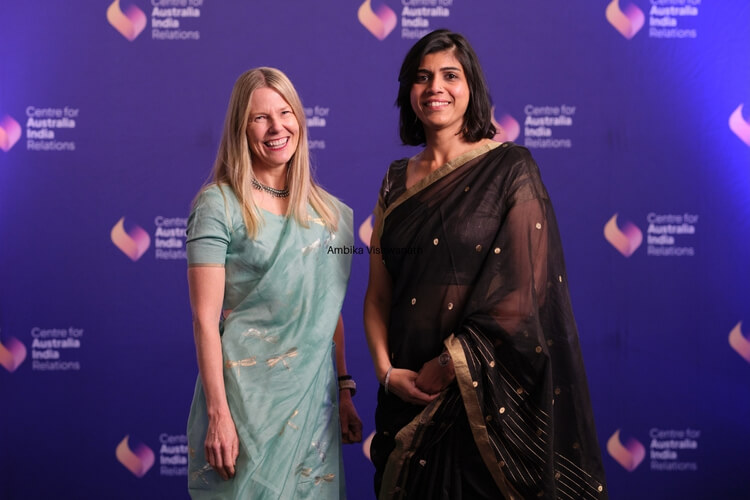
“Climate and security are inextricably linked,” she told Indian Link.
For Vishwanath, the relationship runs in both directions. Climate change creates risks to societies through its impact on water, food, health and livelihoods, while security institutions themselves contribute significantly to emissions.
“A lot of changes in the climate are a result of rising emissions over the last several decades, where we know that highly industrial countries have been some of the highest polluters,” she said, adding, “Security and defence establishments are also huge polluters, and as conflict continues to increase and play a role in our geopolitical calculations, the likelihood of security and its contribution to climate change will continue to increase.”
India and Australia as a team
These overlapping challenges, she believes, create a unique opportunity for Australia and India to work together.
“Countries like India and Australia that experience similar and different risks and have unique experiences have an important role to play in this debate,” she pointed out.
Both nations are already grappling with climate-related threats, from extreme heat and flooding to pressures on agriculture. According to Vishwanath, each country has valuable lessons to offer the other, whether through traditional and Indigenous knowledge systems, technological innovations or adaptation strategies.
“Both nations can jointly champion approaches that place human and environmental security at the centre of policymaking as bilateral partners, but also as part of minilateral institutions such as the Quad or multilateral institutions such as Indian Ocean Rim Association (IORA) or International Solar Alliance (ISA) or others,” she continued.
View this post on Instagram
The Indo-Pacific region
One region where that cooperation is becoming particularly visible is the Pacific.
While climate cooperation may not yet command the same political attention as defence or trade, Vishwanath points to practical initiatives already underway.
“In the Pacific for example, much of the engagement between India and Aus, has a strong climate focus – from responsive action like joint Humanitarian Assistance and Disaster Relief (HADR) activities to joint financing for small scale adaptation projects,” she explained.
“This is where the crux of action lies especially in today’s climate where financing and action on climate change is so limited and in some countries considered an unnecessary expense/policy action.”
She acknowledges that policymakers in both countries have not fully embraced climate action as a strategic imperative. However, she sees signs of progress.
“While I would say the policy makers in both countries might not have fully grasped the fact that strong action on climate change, strong focus on short term adaptation – but also long term mitigation that is not only focused on renewables but on wider mitigation strategies – is both good business and useful for economic security, there are strong indications towards this,” she added.

A blossoming partnership
Beyond policy, the fellowship has also given Vishwanath insights into how Australia and India view one another.
“There is no doubt that the bilateral relationship is growing stronger…we heard Minister Wong say at the recent Quad FM meet that she and Dr Jaishankar have now met 28 times.”
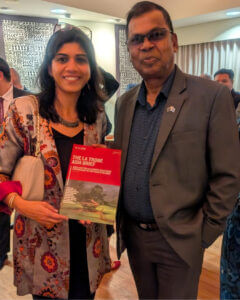
Having spent several years in Australia working in foreign and strategic policy circles, Vishwanath believes awareness of India has grown considerably, aided by a rapidly expanding diaspora and stronger institutional links.
“The knowledge is good,” she said of Australia’s policy community.
“The Maitri program is another great avenue that aids this understanding and building of ties.”
The reverse, however, remains a work in progress.
“The level of knowledge of Australia in India is still lower and we definitely need to boost that,” she advised.
Whether analysing climate risks, resolving conflict or shaping foreign policy, Vishwanath believes better outcomes come from bringing more voices to the table.
“This means anything from understanding the root causes of conflict, maybe a water or a violence lens was missed out, or bringing in new voices to analyse a situation. So inclusion from a thematic, geographic, gender or any other perspective.”
Learn more about Ambika Vishwanath here