



The Indian monsoon arrives with its unmistakable soundtrack: the whine of mosquitoes, and the seasonal spike in malaria and dengue that follows.
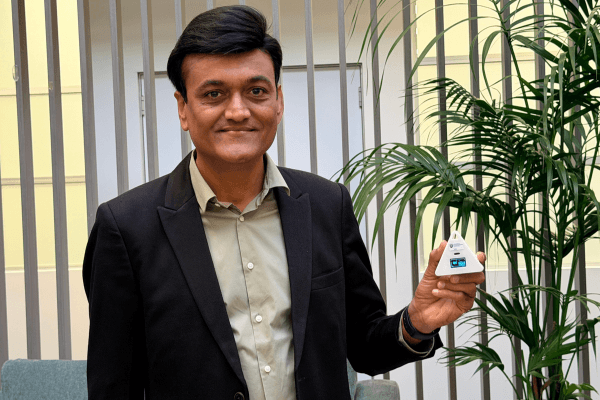
But Associate Professor Dr Kiran Trivedi, Head of Computing at University of Wollongong India, has found a way to thwart the pesky insect by harnessing the very sound which they’re loathed for.
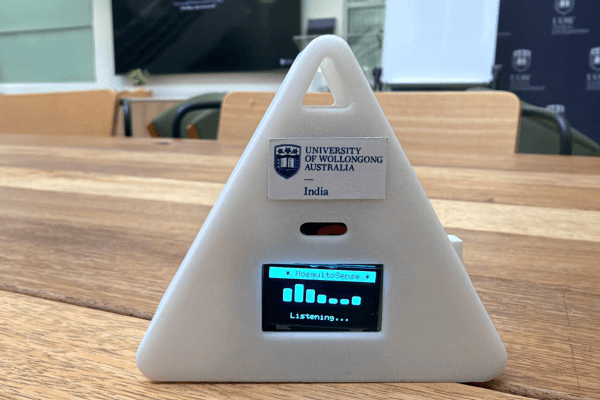
Dr Trivedi has created a handheld device that can detect disease-causing mosquitoes by the sound of their wingbeats, simplifying the process of tracking malaria and dengue outbreaks.
“Every mosquito has a fingerprint, a specific sound pattern, like how every human has a different voice,” he explains.
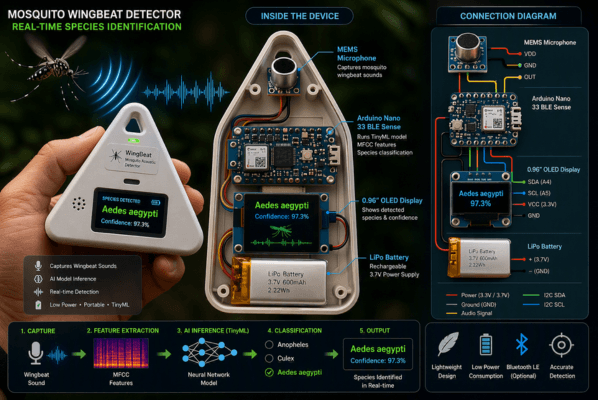
Powered by Tiny Machine Learning (TinyML), the device records the mosquito’s wing buzz through an onboard microphone, then uses its convolutional neural network to classify which mosquito species made the noise.
Delivering results within mere seconds, and at 88.3 per cent accuracy, the device is a revolutionary, low-cost alternative to traditional laboratory-based mosquito surveillance methods.
The sound of a mosquito borne disease
Malaria is transmitted by the Anopheline mosquito, while dengue is carried by the Aedes mosquito – each year, these mosquito-borne diseases cause over 700,000 deaths worldwide, particularly in children under five.
Existing methods of controlling mosquito-borne diseases require water samples or trapping and testing for parasites or viruses, or installing measures like insecticidal nets, vaccinations and genetically modifying mosquitoes.
Dr Trivedi is one of a growing number of people tackling the issue using technology rather than biology, something he sees as his imperative to humanity.
“Every human on earth is trying to make life easier; 100 years ago, we used to walk from one place to another, then we made vehicles and now aeroplanes,” he explains.
“I always try do something new and creative. My aim is always to align with sustainable development goals of United Nations, to make a better society.”

TinyML is an emerging field which enables AI to be powered internet-free and by low power microchips rather than resource intensive cloud servers or datacentre. In this case, Dr Trivedi’s device uses an Arduino Nano microcontroller, a simple chip often used for devices like digital clocks, fitness trackers, or small moving robots.
Not only does his device streamline the mosquito borne disease detection process, but it costs less than Rs 5000 to make, making it highly viable for developing nations and rural communities with limited resources.
“The best part of this is how it can be helpful globally – usually once lots of people are affected with a disease, we start acting on the mosquitoes, but here, as soon as the sound is detected, governments can take action, before any outbreak starts,” he elaborates.
Dr Trivedi hopes to enhance the detector to work with smart home devices to alert households when mosquitoes are nearby, and even create heat maps showing where and when they’re most active.
At this stage, his biggest limitation is the Arduino’s onboard microphone, which picks up a lot of background noise.
“If we can have a microphone which is highly sensitive to the mosquito sounds, then the device efficiency and rate of capturing the correct sound would be improved,” he explains.
“Right now, it’s in the development phase, but the prototype is ready.”
From birds, to babies, to mosquitoes
Based in UOW’s GIFT City campus, Dr Kiran Trivedi has been working on small machine learning devices since 2020. He first used a version of his mosquito tool to classify bird sounds and identify baby needs from their cries, the latter inspired by a visit to his paediatrician brother’s neonatal ward.
But Dr Trivedi knew he’d have to do more than that for the UN’s International Telecommunications Union Hackathon – that’s when he found Oxford University’s database of mosquito sounds.
“To send my entry to this hackathon, I need to have something where I can create an impact; during that time, there were a lot of mosquitoes in my cabin where I was sitting. I thought these if mosquitoes are all different, it means that there should be a difference of their wing sound also – just an assumption,” he recalls.

Dr Trivedi’s assumption paid off; out of thousands of entries, his mosquito device won the 2021 Hackathon competition, ‘Designing a Sustainable Future using ICTs’.
He has since gone on to tweak and present the invention at the UN’s AI For Good summit in Geneva earlier this year. However, he stresses that the heart of the technology is something very easy to grasp.
“Funnily, sometimes when you do some AI projects it’s like going to an Indian restaurant – you look at the menu, paneer tikka masala, paneer butter masala, any sabji, the gravy remains same,” he explains.
“[No matter what data set], it is all about processing of the data, creating the architecture for an AI model, deploying the model… the whole process remains same. It’s all about your creativity, how you are taking it forward.”
READ ALSO: Burning Questions: Vijay of UWS studies forest fires across two worlds