


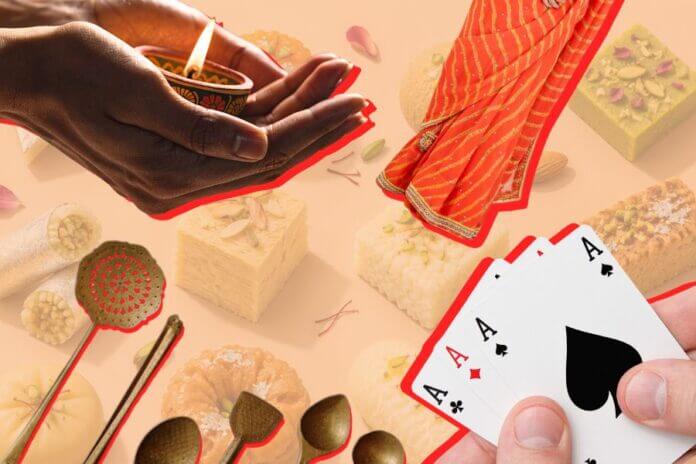
Some are treasured heirlooms, others everyday objects that take on special meaning once a year. From prayer plates and recipe books to playing cards and blood donations, ten readers share the objects that define their Diwali celebrations – and the memories, traditions and personal stories they hold.
CHILDHOOD DIWALI
Recipe book
Harsheni Maniarasan
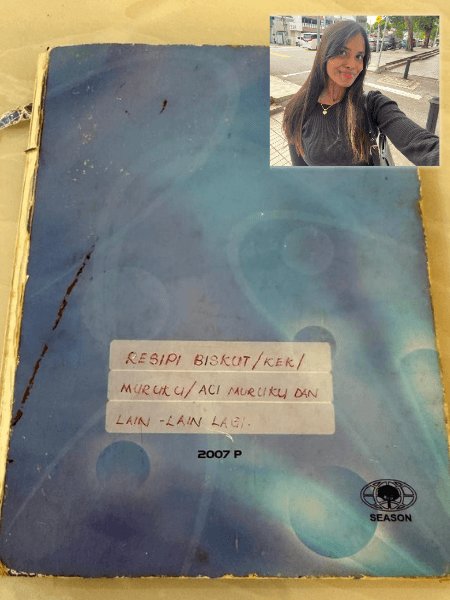
Every Diwali, my Malaysia-based pathi brings out a threadbare blue notebook containing generations of family recipes. Its yellowed pages, filled with handwritten instructions, hold everything from peanut and suji cookies to murukkus and flower-shaped aachi murukkus.
For my cousins and me, spotting that notebook on the table was like winning the lottery. Delicious treats were coming, and portion control was going out the window!
The notebook predates my birth. As children, we watched my amma and periamma carefully follow its recipes. Eventually, we donned our own aprons, learning to recreate Pathi’s signature treats.
Today, those pages hold more than recipes. They’re filled with memories of baking together, sharing jokes and enjoying the warmth of family.
Even now, I can picture myself on the swing at home, a plate of sunflower-shaped pineapple jam tarts beside me, savouring the flavours of Diwalis past.
SENSORY DIWALI
Fragrance
Nidhi Sampat
Thirteen years in Australia, and every Diwali I still miss home. Not just the people, but the feeling. The light, the warmth, the familiar scents of a house preparing for celebration.
For years, I searched for that feeling here. Eventually, I began recreating it.
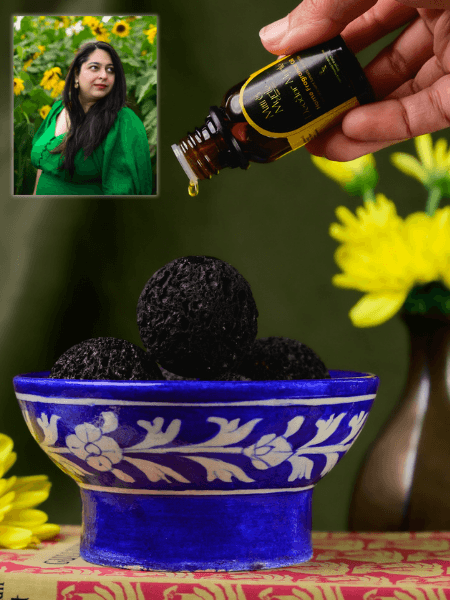
Mitti & Myrtle is an Australian scent studio I built around two landscapes – one inherited, one inhabited. The scent ‘Deodar Myrtle’ holds both. Deodar is the inherited: sacred Himalayan cedarwood and black pepper, warm and grounding, the scent of family and memory. Myrtle is the inhabited: anise myrtle, lemon myrtle and buddha wood from the Australian bush we now call home.
It’s my favourite fragrance.
To me, this essential oil diffuser represents two homes coming together, rather than choosing between them.
This Diwali week, as the fragrance filled my Australian home before my guests arrived, it brought back that ghar wali feeling.
Home isn’t always somewhere we return to. Sometimes, it’s something we create.
NEXT GEN DIWALI
Giving, reimagined
Manan Luthra

Growing up, Diwali meant new clothes, endless mithai and the excitement of family gatherings. I still love it all, but as I’ve grown older, I’ve started thinking differently about what it means to celebrate.
Diwali is about bringing light into people’s lives. So I decided to make that idea a little more practical. Now around Diwali, I book an appointment to donate blood, plasma or platelets to the Red Cross Lifeblood. I’ve encouraged my friends to join me too. We follow it up with a meal together, so it has become our own little Diwali tradition.
I’ve also found other ways to give back, from volunteering with an organisation I care about to reaching out to someone spending Diwali alone.
I haven’t given up the diyas, the sweets or the celebrations. I’ve simply added another ritual.
For me, that’s what Diwali looks like: keeping the traditions, but finding new ways to share the light.
SOCIAL DIWALI
Pack of Cards
Sanjeev Sachdeva
Diwali is the one time of year when a weeknight is no excuse to stay home. Work tomorrow? School lunches to pack? Too bad. There’s a Diwali party to attend!
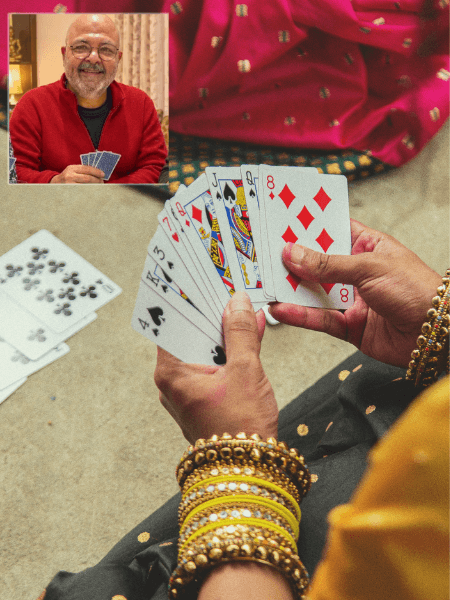
In my family, Diwali means friends, food, laughter and, inevitably, taash. The playing cards come out, the stakes are mostly symbolic, and everyone suddenly becomes a fiercely competitive card player.
There’s always someone explaining the rules, someone accusing someone else of cheating, and someone who’s far more interested in the snacks than the game.
The food keeps coming, the music gets louder, and the evening stretches well beyond anyone’s sensible bedtime.
Over the years, our Diwali gatherings have become a tradition of their own. Friends have become family, children have grown up together, and the same old jokes somehow remain funny.
My pack of cards may be ordinary, but the memories it deals out every Diwali are anything but.
SPIRITUAL DIWALI
Homemade Prayer Book
Rajni Anand Luthra
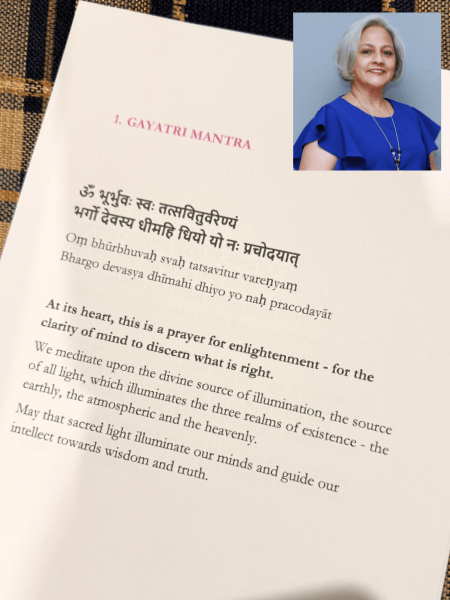
When my Australia-born children were little, they would sit bewildered through our annual Diwali puja (worship), listening to Sanskrit prayers they couldn’t understand. I wanted them to participate, not merely observe.
So I made a prayerbook explaining the rituals, the significance of Lakshmi and Ganesha, and the meaning of the prayers we recited.
It included the Gayatri Mantra, Ganesh Shloka, Lakshmi Gayatri Mantra and my favourite, the beautiful Shanti Paath.
Each Diwali, I would recite the Sanskrit verses while the children took turns reading the English translations. Suddenly, the ritual became accessible, meaningful and, I hoped, spiritually resonant.
That tradition continues to this day. Both now young adults, they join our Diwali puja virtually from wherever in the world they happen to be, reading their parts.
I’d like to think they’ve discovered what I hoped to share: the simplicity and universality of prayers seeking enlightenment, wisdom and peace.
WORKING DIWALI
Sweetmaker’s Tools
Helly Raichura
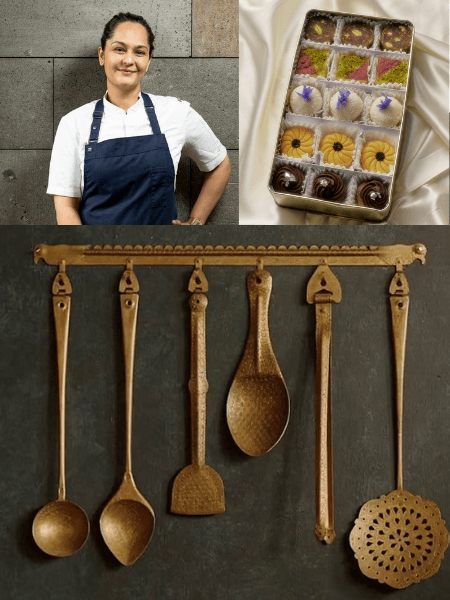
Every Diwali, while everyone else is getting dressed up and preparing to celebrate, I’m in the kitchen at my restaurant Enter Via Laundry, surrounded by trays of mithai.
And I wouldn’t have it any other way.
My favourite Diwali object is my mithai mould. It’s a small, unremarkable thing, but in my hands, it transforms a simple mixture of milk, sugar and nuts into something beautiful.
In a fine-dining restaurant, presentation is everything. But there’s something especially satisfying about making traditional Indian sweets. Each piece carries memories of home, family gatherings and childhood Diwalis.
The days leading up to Diwali are among our busiest. There’s barely time to sit down, let alone celebrate. Yet I love knowing that something we’ve made will find its way onto someone’s festive table.
For me, Diwali isn’t just about the sweets we share with our own families. It’s about the joy of helping other families celebrate theirs.
INHERITED DIWALI
Puja Platter
Aparna Dave
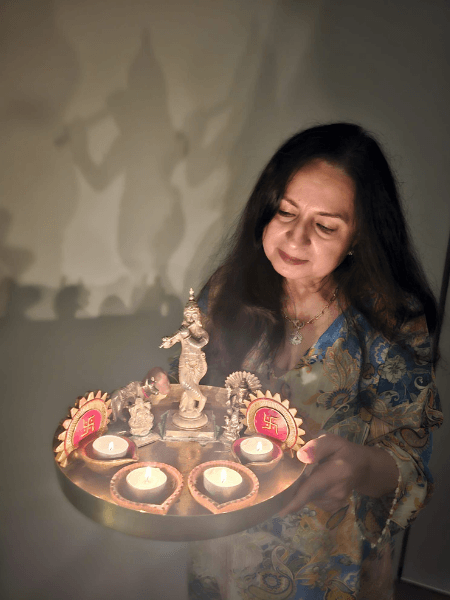
My favourite Diwali object is my puja thali, a family heirloom passed down by my mother in Mumbai. Made of kaansa, a traditional Indian bell metal, it holds the deities and lamps for our worship rituals.
On it sit silver ornaments, earthen diyas and idols of Lakshmi, Ganesha, Krishna, Nandi and Saraswati. Each is precious, not just for its spiritual significance, but because the idols were passed down by my mother-in-law, who passed away recently.
In the days before Diwali, I polish the thali and ornaments, decorating them with fresh flowers and leaves from my garden. Each evening, I light the lamps and offer prasad – fruit, sheera (halwa) or other sweets.
On Diwali night, the lamps move to our doorways to welcome auspiciousness into our home.
After the festivities, the thali and ornaments are cleaned, wrapped in tissue, and stored in airtight containers until next year.
ARTFUL DIWALI
Rangoli Powder Box
Sujatha Hukkeri
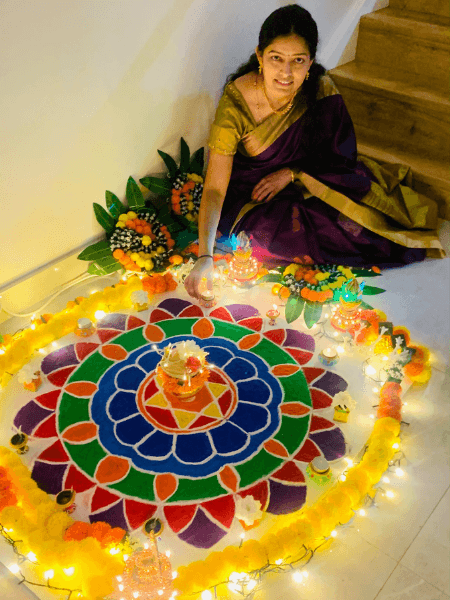
As a child, I made rangolis with powders my mother kept in a compartmentalised craft box. I learnt by watching her and our neighbours, practising designs in my notebook.
I still cherish my childhood memories of waking up early, cleaning the front yard, sprinkling water and creating beautiful Rangoli patterns with my mother.
Rangoli is more than decoration. It symbolises prosperity, positivity, happiness and welcoming Goddess Lakshmi into our homes.
Moving to Australia, my powders lived in their packets in old biscuit tins, then graduated to plastic containers and glass jars. Today, I use squeeze bottles, perfect for creating fine lines and intricate patterns. My patterns have grown more intricate and colourful.
As I’ve grown older, I’ve realised that rangoli is a beautiful connection to our culture, family and roots.
Its designs may eventually disappear, but the happiness, memories and traditions remain forever.
Some traditions are meant to be lived, cherished and passed on.
MINDFUL DIWALI
Clay Diyas
Torrsha Sen
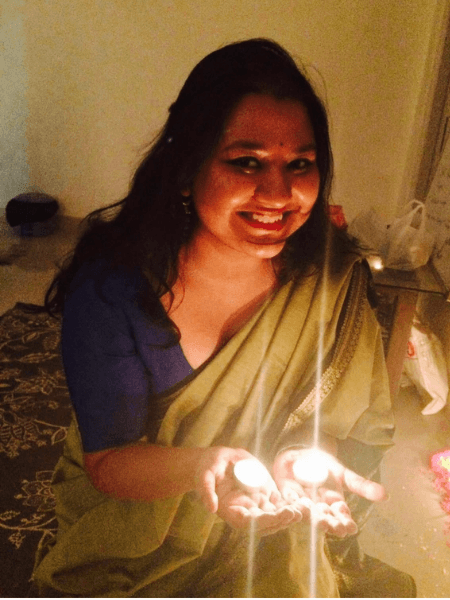
Every year after Diwali, my mother washed our clay diyas, dried them in the sun and packed them away in an old shoebox. As a child, I thought it was thrift. Now I think it was wisdom.
My first Diwalis as an adult, away from home came from the shopping centre: plastic lanterns, battery-operated fairy lights, and mithai in boxes inside more boxes. By the next morning, the recycling bin was overflowing and the celebration felt oddly hollow.
So after a few years, wisdom dawned upon me, and I went back to the shoebox and practically everything sustainable. My diyas are terracotta and a little chipped. Each evening for Choti and Badi Diwali I refill them with oil and cotton wicks I roll myself. Sweets go to the neighbours in paper boxes. Gifts are put in recycled brown paper to be handed out.
None of it feels like a sacrifice. It feels closer to the festival I grew up with, when nothing was made to be thrown away.
RADIANT DIWALI
Mum’s saree
Ekta Sharma
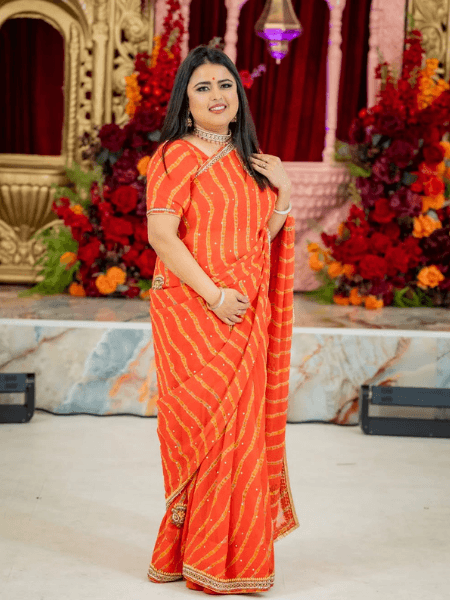
Every Lakshmi puja, one of my fondest possessions makes its annual appearance: the orange Rajasthani lehariya saree that my mum gifted me 12 years ago.
It had been hers before it became mine, and there’s something special about wrapping myself in a garment that once belonged to her.
Its fiery orange and red hues seem to capture Diwali itself – the glow of diyas, the warmth of family and the joy of celebration.
There’s a funny story behind it, too. I brought it to Australia completely unaware that I had neither a blouse nor an underskirt to go with it! It took another trip to India, months later, to complete the outfit, and that’s where I finally wore it for the first time.
Today, it drapes beautifully, its colours as radiant as ever. Look at me in the photo – you can tell I feel like a million bucks, wrapped in Mum’s love.
Read more: How to launder a laddoo