


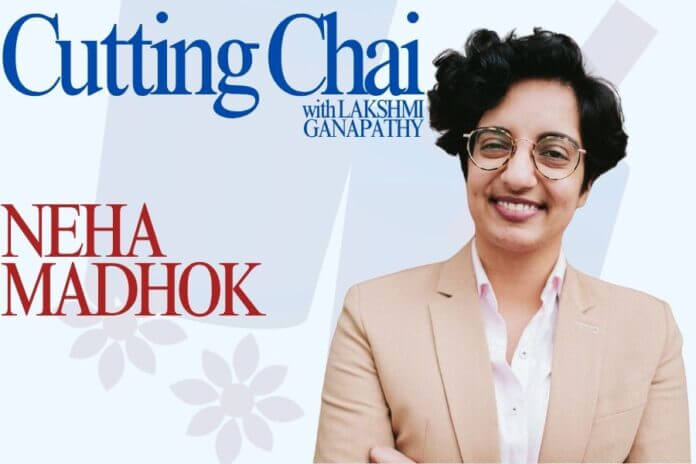
Cutting Chai with Lakshmi Ganapathy is a monthly series of bite-sized interviews with prominent South Asians showcasing their career and personality and celebrating their South Asian Australian identity. Neha Madhok Indian Link
With the Victorian election imminent, we spoke this month to Neha Madhok, community organiser and co-founder of Democracy in Colour, an organisation working to dismantle systemic racism and build the leadership of people of colour in movements for justice.
Lakshmi Ganapathy: We’ve seen a rise in threats towards politicians, including the Helen Haines incident. How did we get here?
Neha Madhok: The pathway to where we are now – acts of violence towards politicians – has been brewing for a few years. In Australia, we have primarily had peaceful political action, and that’s the envy of the world. What has changed is the way political extremism is being expressed. You can trace it back to 2016 when the algorithm came in. At the same time, there was an offline movement as well. For the first time in our lives, Nazis were publicly and openly organising in Europe and North America, a British MP was shot, and then there was the election of Trump. Those things together have led us to this point and have been growing for the last decade.
People are, understandably, also really upset, experiencing inequality we haven’t seen in our lifetime. I’m a millennial – our entire life, we were promised if you just work hard, you’ll get what our parents had. That’s not how it works. We try to do things the way our parents did, and we don’t get the same results. I completely understand, then, why young people are revolting all around the world. Why wouldn’t you?
So we have this huge existential crisis across the West where people are going, I don’t know what my future looks like. At the same time, you’ve got these algorithms, people spending more time on their own and on screens, and they’re getting riled up. Of course that combination is going to lead to violence; that doesn’t excuse the horrible thing that happened, but it explains how we got here.
View this post on Instagram
Neha Madhok
Lakshmi Ganapathy: Why are people so frustrated with politics and how do we fix that?
Neha Madhok: Since the Rudd-Gillard era, we’ve seen what a lot of political commentators are calling ‘managed decline’; if you look at the primary vote for Labor and the Liberal Party, it’s basically this downward cliff. Simultaneously, around the world we’re starting to see the minor party votes increase. More so we’ve been seeing it on the right, but slowly we’re starting to see it with say, the Greens. The real reason behind this is people feel both the major parties have not done enough to deal with the problems at hand.
There are many diagnoses for this, but the way I look at it is, both parties have operated on three-year election cycles, and they’ve just been trying to win to the next election rather than the long-term leadership we saw from prime ministers in the ’80s and the ’90s. During the native title debate, instead of just copping it from the community, Paul Keating was happy to lead. He was saying, this is the right thing to do, this is why I’m doing it. He went on to talkback radio – which back in the ’80s, was where you went to have a political conversation – and he spoke to voters and he let them yell at him. Can you imagine Anthony Albanese or Angus Taylor doing that?
We are no longer seeing leadership from our governments. We’re seeing governments who are happy to follow. They want advocates, people in the community to go do the work of building a majority behind an issue, and then they’re happy to tick box and say yes. Otherwise, they’re happy to do what people call ‘tinkering around the edges’… the government will announce, we’re doing XYZ – I often see the state government announcing ‘300 new homes that are social housing’ – and you go, yes, but I know that in the community, the need is somewhere closer to 3,000 or 300,000.
View this post on Instagram
That is where people are getting frustrated because the solutions they come up with are relatively small, for a small group of people, when the solutions need to be large scale, systemic, nationwide.
Lakshmi Ganapathy: You’ve said it’s important to ‘get curious’ about why voters are drawn to parties like One Nation. What’s that look like in practice?
Neha Madhok: The first thing you want to do is get offline and actually talk to people that you know. The chances of changing someone’s mind through a comment debate online is very low, because the people commenting are either already very rusted on or they’re bots.
People don’t do talkback radio or read the news anymore but still need to get their information from somewhere and make their decisions. Increasingly, we’re seeing people doing that based on people they know. Particularly those drawn to the far right (we’re seeing this in all the research that’s coming out) trust people they know. That gives all of us an amazing opportunity to change hearts and minds immediately – we all know people, we all have family, friends, colleagues. Have these conversations face to face or on the phone – you want to be able to get tone and body language.
Most importantly, it has to be a conversation between two people who want to find shared understanding. That comes from when you actually care about the other person. The reason our political debate has become like this is because we’re not looking each other in the eye and saying these things. It’s easy to say they’re horrible and deserve awful things when you’re not looking at a fellow human being and trying to find understanding with them.
Neha Madhok Indian Link
View this post on Instagram
Lakshmi Ganapathy: What’s something you’re currently listening to/reading/playing/watching?
Neha Madhok: I’m currently reading Desi Girl by Sarah Malik; picked it up from the library last weekend and I’m three-quarters of the way through. It’s the story of a working-class girl from Western Sydney who had the exact same life experience as me, but Muslim – she went to a public school, got into UTS, did a communications degree. [It’s about] the experience of racism and being South Asian in Australia.
Lakshmi Ganapathy: What’s a word that you like in a South Asian language, and what does it mean?
Neha Madhok: I’m going with a simple one because I’m hungry – roti. It can mean literally roti, it can mean a meal, it can mean khaana, it can mean everything. It’s how your parents show you love, by making you round rotis by hand.
Lakshmi Ganapathy: And finally: Soan Papdi or Papdi Chaat? Neha Madhok Indian Link
Neha Madhok: Papdi Chaat. I don’t like crumbly [food].
READ ALSO: Cutting Chai with Neha Kale