


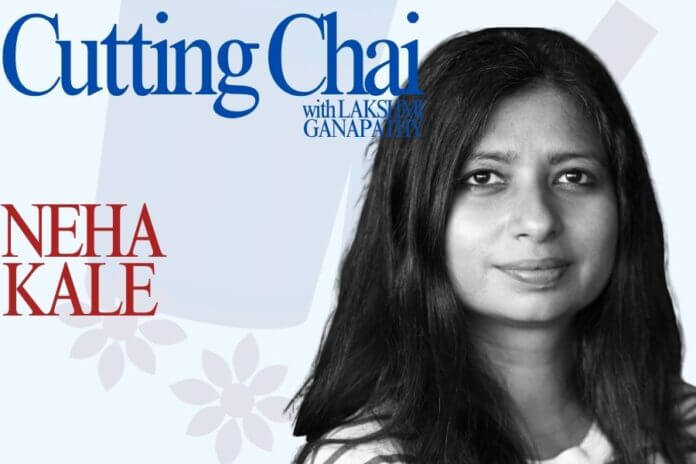

Cutting Chai with Lakshmi Ganapathy is a monthly series of bite-sized interviews with prominent South Asians showcasing their career and personality and celebrating their South Asian Australian identity. Neha Kale
This month, Lakshmi chats with Neha Kale, a Walkley-nominated writer, journalist and art critic who has written for publications including The Guardian, The Sydney Morning Herald, and The Saturday Paper. She released her debut book Foreign Return: On Art and Inhabitation in September.
Lakshmi Ganapathy: Your book blends art criticism with memoir – how does art helps you understand or frame your own life experience?
Neha Kale: I’ve always been really interested in art; I loved drawing as a kid. I’ve written about art for most of my professional life, but I didn’t study art history. I came to it from a love of the visual, I think. In the book, I’m really interested in what art can do or say that language can’t, and what language can say that art can’t.
I realised a couple of years into writing it…[my book’s] grappling with absence, and how objects and artworks can serve as placeholders or help me fill in these gaps of what I’m searching for.
Also art, for me, is this practice of paying attention to the world, looking very closely. I think we’ve lost that practice, you know? We live in a culture where we always think we know what we feel and think about everything, and there’s not enough time to sit and feel contradictory things.
The process of writing this book was about paying close attention to things that seem ordinary but are very extraordinary…there’s so many extraordinary ideas and questions underneath the surface of everyday life I wanted to look at.
View this post on Instagram
Neha Kale
Lakshmi Ganapathy: You’ve said previously you want to write a book that ‘stands the test of time’. What makes a work timeless for you?
Neha Kale: I was thinking a lot about that when I was writing; it was difficult to do because I had to think about saying something truly original. It’s very difficult when everyone’s said something about everything.
But for me, [timelessness] is what makes a book worthy of being reread at a sentence level, so a reader can come back to it, sit with it, find multiple points of entry.
Great literature that has changed my life in the past has done that, given me a completely new way of seeing the world – that’s what I wanted to achieve with this book. I wasn’t even sure if I could write a book that did that, but I really tried. That’s what I think timeless books are: ones that say something no other book has said in that way before.
Lakshmi Ganapathy: What is the point of an art critic?
Neha Kale: I think about my position as a woman of colour, a migrant; the typical vision of an art critic is a man who has authority, but people like me have never had authority. So I think about it as subversive to be a critic.
I think about criticism as how you connect an artwork with the wider world, with cultural conversation. How do you bring the reader in rather than shut them out? Art and culture is for everyone – all our civilizations have this [artistic] history that is part of our lives. But the modern, Western art world often divorces us from that. A lot of my work is about how to reclaim that [space], and how to make it feel like everyone has a place in these conversations.
View this post on Instagram
Lakshmi Ganapathy: What’s something that you’re currently listening to, reading, playing, or watching which you want to shout out?
Neha Kale: I’m back to reading for pleasure; I’m reading ‘Walking on the Ceiling’ by Ayşegül Savaş. She’s a Turkish writer who writes beautifully about this thing I’m interested in as well, psychic dispossession – not a physical loss of home, but that sense of what we lose when we migrate.
It’s a coming-of-age story set across Istanbul and Paris, about mothers and daughters – beautiful book.
Lakshmi Ganapathy: What’s a word that you like in a South Asian language and what does it mean?
Neha Kale: There’s a Konkani/Marathi phrase potaachi bhas which means the language of the stomach – the language that one uses to feed themselves or you require for your livelihood.
English is the language that I love, that I write in, a language that I’ve inherited because of colonialism. But it’s interesting thinking there’s certain languages you use to survive and prosper in the world, and then there are other languages that maybe have other purposes.
And finally: Soan Papdi or Papdi Chaat?
Neha Kale: Papdi chaat, definitely. Papdi chaat has tamarind, which is one of my favourite things, and I’m a sucker for anything really textural. Indian street food in general is an incredible invention that doesn’t really have a precedent in wider culinary culture. There’s complexity and play of flavours, the sour, the sweet and the crunch.
READ ALSO: Neha Kale’s ‘Foreign Return: On Art and Inhabitation’ – Review