




“One third of the food we produce,” Prof Zora Singh observes, “never reaches a human’s mouth.”
“This equates to 1.3 billion tonnes a year” – of unconsumed produce.
Added to this is the greenhouse gas emissions – some 3.3 billion tonnes of it – that the wasted food produces.
Fortunately, Prof Singh says, up to 60% of this wastage can be reduced if we handle our agricultural produce appropriately.
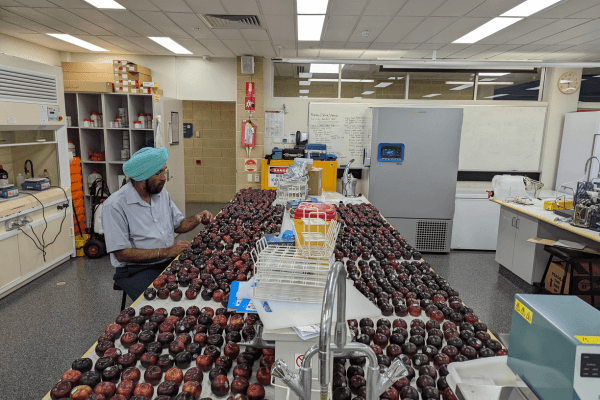
A Foundation Professor in Horticultural Science at WA’s Edith Cowan University, Prof Singh’s particular expertise is post-harvest physiology of fresh produce.
Post-harvest science is the study of what happens to produce after it is harvested, all the way from the farm to the consumer. It focuses on steps like cleaning, cooling, sorting, and packing to keep produce fresh, high quality, and suitable for sale, as it naturally starts to deteriorate once it is separated from the plant.
For his work in developing innovative production and post-harvest technologies to reduce horticultural losses, Prof Singh was honoured this month with the Outstanding International Horticulturist Award by the American Society for Horticultural Science.
He is the first Australian to receive the honour, one of the highest within the worldwide horticulture industry. It recognises Prof Singh’s 30-year career across intensive research, education and global industry collaborations.

EARLY YEARS
Trained at India’s leading agricultural institution, Punjab Agricultural University in Ludhiana, Prof Singh’s ties to agriculture began in a farming family in the region known as the “breadbasket of India”. The northern state of Punjab may be renowned for its production of wheat, rice and maize – but it was fruit, vegetables and flowers that captivated the young Zora. At university, he studied horticultural science, ultimately completing a PhD in mango malformation.
“My work was based on reducing the problem of malformation to increase the yield and profitability for the growers.”
Moving on from mangoes, it was apples and pears for his postdoctoral work in the UK (at the International Horticulture Research Institute at East Malling). Back at his alma mater as Assistant Professor of Horticulture, he returned to his favourite fruit mango, but also studied citrus fruits and other crops.
Following his migration to Australia, Professor Singh dedicated some time working on bananas. “I investigated a banana disease caused by cucumber mosaic virus (CMV), developing a molecular technique to identify the virus and subsequently refining it to determine which CMV subgroup was responsible for the infection.”
WHAT CAUSES POST-HARVEST LOSS?
Post-harvest loss (PHL) refers to the measurable reduction in quantity and quality of produce between the phases of harvest and consumption.
“There are multiple causes for this,” Prof Singh clarifies. “For example, storing temperatures – if you store fruit at a temperature too low, it will cause a chilling injury or a freeze injury. Alternatively, if the temperature is too high, you will fail to extend the shelf life and maintain the fruit’s quality.”
Growth and developmental issues along with metabolic changes also contribute to the issue of post-harvest losses. Post-harvest deterioration is often linked to the living nature of horticultural produce. Respiration, ethylene production, water loss and microbial activity continue after harvest, affecting both quality and marketability.
“Ethylene, a hormone which induces fruit ripening, is being used commercially on a vast scale, on produce such as bananas, avocados, tomatoes and oranges. However, as the saying goes, there are two sides to a coin; ethylene shortens the shelf life. If we dissect the losses, I’d say about 40% alone are caused by ethylene. The usage of ethylene in fruit production majorly contributes to shorter storage lives and food losses.”
There are also instances of post-harvest diseases affecting the produce, causing them to begin rotting. It is no surprise that post-harvest management poses a critical challenge.
HOW TO PREVENT POST-HARVEST LOSS
A major step, Prof Zora Singh states, would be to manage ethylene usage. “In my last 15 years of work, in collaboration with an organic chemist from my previous university, we developed two compounds that antagonise ethylene action. So, when we fumigate the fruits with these ethylene antagonists, the ethylene cannot touch it, whether it comes from inside the fruit or externally.”
Transforming global agricultural trade, Prof Singh has championed the shift from air freight to sea freight for Australian mango exports. Previously, mangoes sent to destinations such as Dubai and London relied on expensive and limited air cargo space, costing growers about $17.50 per tray and restricting export volumes.
To overcome the challenge of mangoes surviving the three-and-a-half-week sea journey, Prof Singh developed a controlled atmosphere storage technology that lowers oxygen, increases carbon dioxide, and stores fruit at 13°C with 90% humidity. The innovation extended mango shelf life to more than six weeks, making commercial sea freight viable.
The impact has been significant. Freight costs have dropped to around $2.20 per tray – nearly 75% lower – while sea freight also offers environmental benefits through reduced fuel use. The technology has already replaced air freight for Kensington Pride and R2E2 mangoes, with work underway for a third major variety in the Northern Territory.
As Prof Zora Singh puts it, the shift is both commercially and environmentally beneficial, improving Australia’s competitiveness as compared to Asian markets, while making exports more sustainable.

The professor’s ultimate aim – to reduce the 30-40% of post-harvest losses and to support food and nutritional security – is particularly relevant in current times when one in 11 people will go hungry every day, especially as conflict – the leading cause of hunger – continues unabated.
Projecting forward, Prof Zora Singh concludes, “The world’s population, currently 8 billion, is expected to reach 10 billion by 2050. We’re going to have to increase the availability of food to the growing population.”
Read Also: Aus-Ind deepen tech ties with $3.76 million boost