


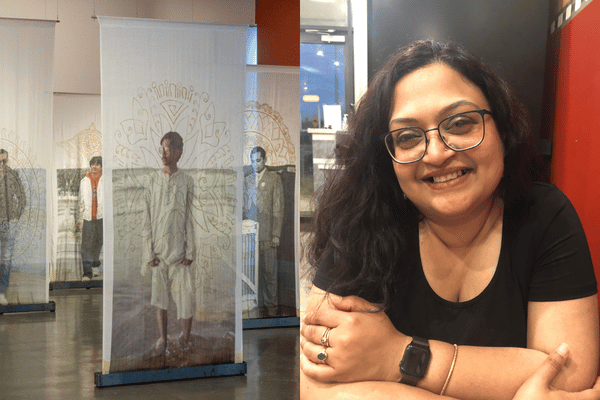

Anindita Banerjee is looking for her grandfather.
Not literally. Her grandfather, whom she called ‘Dada’, passed away years ago. But even today, she finds herself searching for traces of him – in a familiar smile, a certain calmness, a face that reminds her of his.
“My grandfather was a quiet but powerful presence in my childhood,” Kolkata-born Banerjee tells Indian Link. “He was part of my everyday life; in action, inaction, doing, dreaming, and growing.”
Growing up in West Bengal, ‘Dada’ was a constant in her life. His presence felt so natural that she never imagined a time when he would not be around.
After he died, however, something changed.
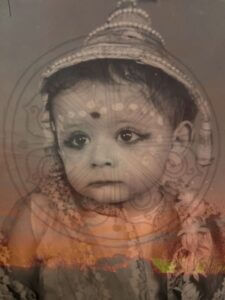
“There was a vacuum, but his presence did not disappear,” she adds. “It became abstract. Elusive.”
Years later, living thousands of kilometres away in regional Victoria (Ballarat), Banerjee found herself wondering how memories survive when the people and places connected to them are no longer close by. That question became the starting point for Anindita Banerjee’s ‘Finding Dada’, her new exhibition at Deakin University.
Running until August 7, 2026, this exhibition features a select photographs of significant men in whom Banerjee finds reflections of her ‘Dada’ – from family members, friends, and even Indigenous Australasian people.
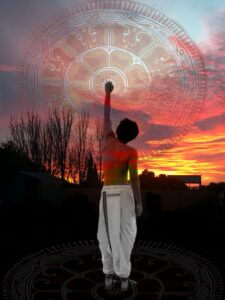
This is the first time Banerjee has used the traditional batik technique. After learning batik from artisan Sanrag Saha during a visit to India in 2025, she incorporated wax drawings into a series of photographs that form the centrepiece of the exhibition.
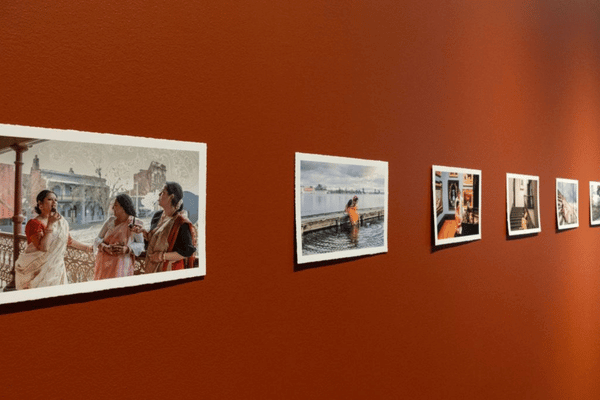
The exhibition also includes works from ‘Ondormohol’, a photographic series imagining the lives of Bengali women in Ballarat, inspired by the architectural similarities between her hometown of Kolkata and her adopted home in regional Victoria.
Memory after loss
The exhibition is not really about finding one person. Instead, it explores what happens to memory after loss, how migrants carry their past with them, and how ideas of home change over time.
“This exhibition was a conscious attempt to dwell in a half-remembered presence that no longer exists,” Banerjee shares. “I was searching for traces. For gestures. For something that lingers in the body across time.”
Visitors may see a story about migration, family and identity, but they may also be reminded of someone they have loved and lost.
“I hope they recognise something of themselves,” Banerjee continues. “Even if their histories are different.”
The exhibition began with a simple realization. As Banerjee thought about her grandfather, she noticed that she was seeing parts of him in other people.
“Faces hold a particular intimacy. They are living archives,” she says, smiling.
She started recognising familiar qualities in strangers, friends and family members – not exact similarities, but echoes.
“I realised I was recognising him in others. Not exactly. But partially. In a cheekbone. A gaze. A way of being present.”
That became one of the central ideas behind the exhibition. Instead of painting her grandfather alone, Banerjee explored how memory can appear unexpectedly through other faces and relationships.
View this post on Instagram
The migrant experience
The project is also closely tied to her experience as a migrant. Anindita Banerjee’s ‘Finding Dada’
Banerjee was born in India in 1983, before moving to the United States and later to Australia in 2010. She describes herself as a “twice uprooted passenger seat migrant”.
Her first move, from India to the United States, happened because of love. The second move, to Australia, included her growing family and young children. Both journeys changed her understanding of identity and belonging.
“In both cases, I was not entirely steering the journey,” she says. “I was being carried by relationships, by circumstances, and by a lack of primary agency.”
Living between countries has also changed how she relates to the rituals and traditions she grew up with.
Among her strongest memories are small everyday acts from childhood: drawing alpona patterns on the floor, preparing offerings and watching family members handle ritual objects with care.
“These were everyday acts, but they carried a quiet intensity,” she says.
Today, those rituals feel both familiar and distant.
“I realise that what I remember is incomplete. Fragmented.”
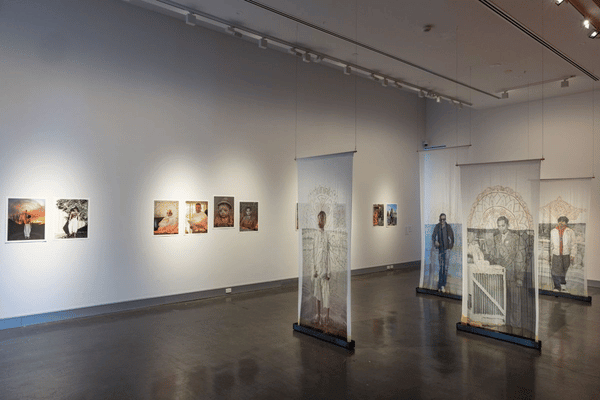
Rather than recreating them exactly, Banerjee incorporates them into her art through abstract patterns and markings. In her exhibition, traditional Bengali motifs sit alongside contemporary portraits, creating a visual bridge between past and present.
When she thinks about West Bengal, home is deeply sensory.
“It is in the sounds, in the language, in humidity, in the closeness of bodies and memory,” she says.
Regional Victoria feels different.
“Home is quieter. More spacious. It unfolds slowly, through landscape, through light, through the passing of seasons.”
Yet she no longer sees belonging as something that can be neatly resolved.
“I do not fully belong in either place,” she says.
Rather than viewing that as a loss, she sees it as a reality shared by many migrants. Home, she believes, is something people continue to create throughout their lives.
That idea sits at the heart of Anindita Banerjee’s ‘Finding Dada’.
“I think it is continuously recreated,” she says. “But not by choice alone. It happens through necessity. Through adaptation. And sometimes through longing.