Tagore on Screen
When the Sydney Opera House announced Balloon Dog for its 2026 season, the billing was straightforward enough: a modern adaptation of Rabindranath Tagore’s short story Kabuliwala, relocated from 1800s Calcutta to 21st-century Auckland by New Zealand’s Indian Ink Theatre Company. The production’s premise, that strangers are more alike than they appear, is precisely the kind of universalist argument Tagore spent a lifetime making. That a theatre company in the South Pacific is still reaching for his work to make that argument is, in itself, a data point worth examining.
Rabindranath Tagore was born on 7 May 1861 in Jorasanko, Calcutta, and died in the same house eighty years later, having somewhere in between written the national anthems of two countries, composed over 2,000 songs, won the Nobel Prize in Literature, founded a university, and produced a body of fiction and poetry that an entire subcontinent is still working its way through. That Hindi cinema keeps borrowing from him, consciously or otherwise, is not surprising. It would be more surprising if it didn’t.
Because Tagore’s relationship with popular Indian cinema is not incidental. It is structural. For the better part of a century, Indian cinema has returned to his stories, his melodies, and his moral universe, sometimes crediting him, sometimes not, but always drawing on a well he effectively dug.
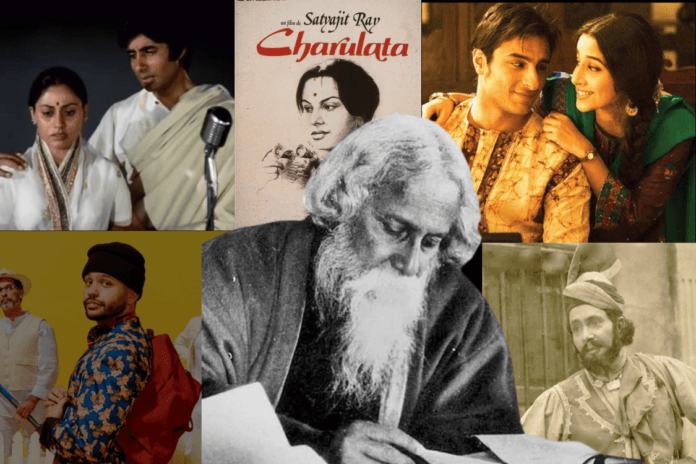
The most direct line runs through adaptation. The 1957 Hindi film Kabuliwala, directed by Hemen Gupta and starring Balraj Sahni, is widely considered one of Hindi cinema’s finest. Sahni’s portrayal of Rahman, the Afghan dry-fruit seller who forms an unlikely bond with a Calcutta child named Mini, is held up as a benchmark of restrained screen acting. The film’s music, composed by Salil Chowdhury with lyrics by Shailendra, produced “Ae Mere Pyare Watan,” a song that has outlived the film itself in public memory. A Bengali adaptation, also titled Kabuliwala, was released the same year, directed by Tapan Sinha, with Chhabi Biswas in the lead role. Both films stayed close to the emotional architecture of Tagore’s original: tenderness as the radical act.
Satyajit Ray’s Charulata (1964), based on Tagore’s novella Nastanirh, brought the literary estate into conversation with art cinema. The film, now studied in universities across the world, uses Tagore’s own Rabindra Sangeet as score. He also made Tagore’s Ghare Baire. Ray was among those who understood that Tagore’s music and his prose were not separable projects. The songs are not decoration; they are argument. Tagore on Screen
It is through that musical inheritance that Tagore’s influence on mainstream Bollywood becomes most traceable, and most interesting. Music director Sachin Dev Burman, a Bengali himself, could naturally relate to the folk music that Tagore had repeatedly used, drawing on Kirtanyagya-based songs and Bhatiyali songs in his own compositions. The transactions were not always transparent. Credit was not always given. But the musical lineage is audible across decades of Hindi film scores.
Three songs in particular illustrate the range of this borrowing. Tere mere milan ki yeh raina from Abhimaan (1973) is perhaps the most famous example, with S.D. Burman drawing directly from Tagore’s Mishra Khamaj-based composition “Jodi tare nai chini go seki” for the song’s opening melody. The duet, sung by Lata Mangeshkar and Kishore Kumar for Hrishikesh Mukherjee’s film about a singing couple, became one of the defining recordings of both singers’ careers. The song was listed among the biggest hits on Binaca Geetmala‘s Annual List for 1973.
A decade later, Chookar mere mann Ko from Yaarana (1981), sung by Kishore Kumar, drew inspiration from Tagore’s Tomar holo shuru, with music director Rajesh Roshan keeping the remainder of the song original. The song, picturised on Amitabh Bachchan, became one of the more enduring pieces of the era’s soundtrack canon, its lyrical quality traceable, at least in part, to the Rabindra Sangeet melody it was reaching toward.
Then there is Piyu Bole from Parineeta (2005), composed by Shantanu Moitra and sung by Sonu Nigam and Shreya Ghoshal. The song was inspired by Tagore’s classic folk composition Phoole phoole dhole dhole from his Kalmrigaya collection. Notably, in both Parineeta and Ray’s Charulata, “Phoole phoole dhole dhole” appears during a scene of a woman on a swing, a deliberate intertextual reference that the 2005 film’s makers embedded knowingly.
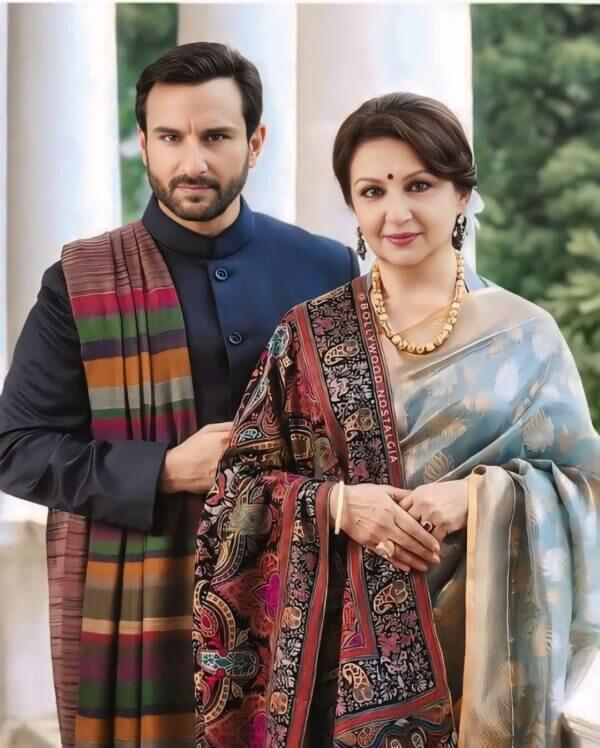
Parineeta carries a further biographical footnote. The film starred Saif Ali Khan, whose family connection to Tagore runs through his mother, the actress Sharmila Tagore. That Saif Ali Khan should appear in a film layered with Tagorean references, performing alongside music drawn from Rabindra Sangeet, while carrying that bloodline through his mother, is the kind of coincidence produced without apparent effort.
Tagore wrote in a register, moral, musical, and narrative, that Hindi cinema kept needing to borrow from. His characters are motivated by longing, dignity, and the particular grief of people who love across social distance. These are not niche concerns. They are, as it turns out, perennial ones. The Auckland production opening at the Sydney Opera House this June is simply the latest confirmation that the well has not run dry. Tagore on Screen
For those interested, Stories by Rabindranath Tagore, directed by Anurag Basu, is a contemporary adaptation of some of Tagore’s works and a popular series streaming on Netflix.
Read more: Empowerment and the Tagore women