Home Blog

Eight-year-old Prahar brews chai for Cancer Council fundraiser

0
Prahar Biggest Morning Tea
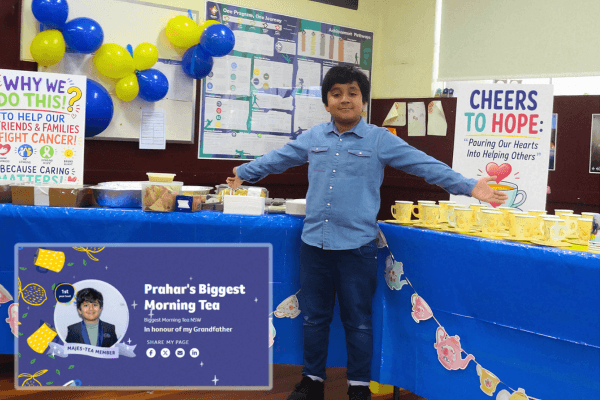
Young Prahar at his Biggest Morning Tea event with his cups of masala chai. (Source: Supplied)
Reading Time: 2 minutes

biggest morning tea

“No matter how small you are, you can always make a difference,” says eight-year-old Prahar.

And he means it. biggest morning tea

Living by his favourite words, Prahar successfully raised a grand total of $5163 with his Biggest Morning Tea campaign – serving his specialty masala chai.  

“I used boiling water, milk, tea leaves, sugar, spices, ginger, cardamom – and don’t forget, love,” a beaming Prahar told Indian Link. 

At the age of five, Prahar watched his mother host a Cancer Council Biggest Morning Tea with her friends. Over the years, he learned from her that even ordinary people can play a part in contributing towards cancer research and support services.  

After the loss of his grandfather – who he fondly calls Nana – to liver cancer, Prahar felt motivated to do something positive and help bring change for families facing cancer. 

That was how the idea of hosting his very own Biggest Morning Tea came to him – if he could make some tea and raise some money, he could help people affected by cancer. This became his way of honouring his Nana’s memory with love and purpose.

“My Nana inspired me very much to host this tea party, I wanted to dedicate this to him.”


View this post on Instagram


A post shared by Prahar (@iamprahar)

What began as a small seed of an idea soon grew into a month-long community campaign. Following his registration for Australia’s Biggest Morning Tea in early May, the enthusiastic Prahar started sharing the word around.  

“He was very excited,” mother Harita Mehta shared. “He even gave a little speech at his father’s office about why he was fundraising.” 

In the days leading up to his Biggest Morning Tea event, Prahar was met with warm support and generosity from his family, fellow Scouts, his teachers and school families as well as the community. 

PRAHAR’S BIGGEST MORNING TEA 

On May 24th, Prahar’s much-anticipated day arrived – he hosted his tea party at the 4th Kingsgrove Scout Hall. Standing before his guests, Prahar gleefully demonstrated how to make authentic masala chai. 

“My most favourite part of the event was making tea for everyone, making everyone smile and seeing all the happy faces,” Prahar recounted. “I loved meeting all those kind people – it was so amazing. I also loved when they clapped for me, I felt like a superstar and a superhero.” 

Prahar personally prepared the tea himself for each guest present. biggest morning tea

The community turnout at the tea party was testament to the people’s sincere support for the fight against cancer, with gestures of magnanimity making the event all the more meaningful. The auction for Prahar’s masala chai attracted a winning bid of $101 for a single cup.
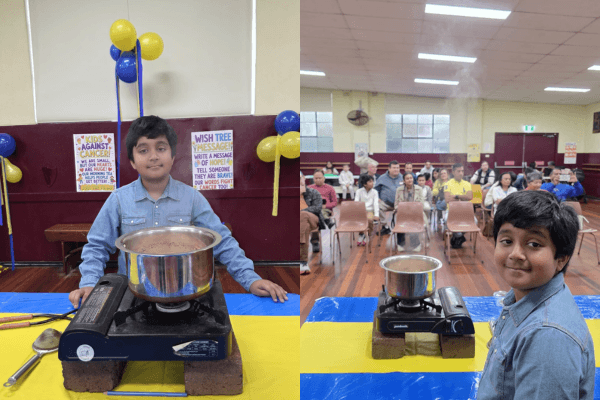
Prahar personally prepared masala chai for each guest at his tea party. (Source: Supplied)

Prahar’s fundraising campaign continued well beyond his main tea party, ending on June 4 – a date he chose to honour his Nana. Falling on his death anniversary, the fundraiser became a heartfelt tribute, carrying with it love, remembrance and hope for better days ahead. 

When asked what kindness means to him, Prahar replied, “Kindness means helping others, accepting diversity, and caring for them.”  

If there is one lesson to take from Prahar’s journey, it is that kindness, however small the gesture, has a way of reaching far beyond itself.

READ ALSO: Pratham Australia 2024: Bondi has never seen this much colour
Sanjay Jha: A cyber security and AI professor turns filmmaker

0
Reading Time: 5 minutes


Sanjay Jha

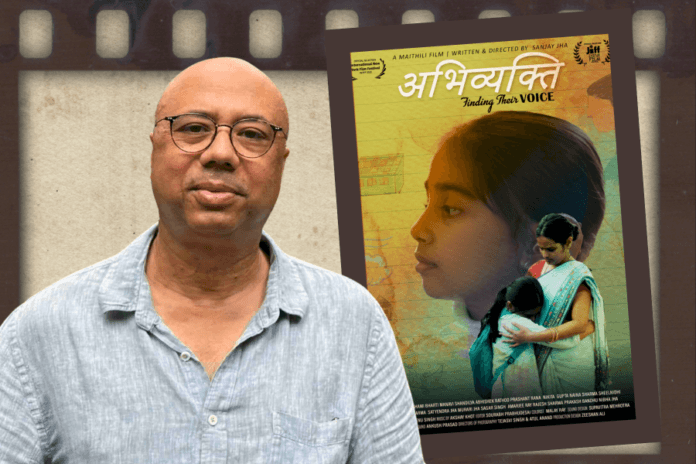
Sanjay Jha does not look like someone who just made his first feature film. He looks like what he is: an academic, composed and precise, the kind of person who measures a sentence before he releases it. But somewhere over the Pacific, on a flight back to Sydney, something shifted.

“I was flying when this idea came to me. I couldn’t wait, I wrote the screenplay on that very flight,” he tells Indian Link.

That screenplay became Abhivyakti: Finding Their Voice, a Maithili-language drama set in rural Bihar. It is the debut feature of a man who, professionally speaking, has nothing to do with cinema. Jha is a full professor of computer science at UNSW, where he teaches artificial intelligence and cybersecurity. He took a short filmmaking course at AFTRS in 2016. That is the sum total of his formal training.

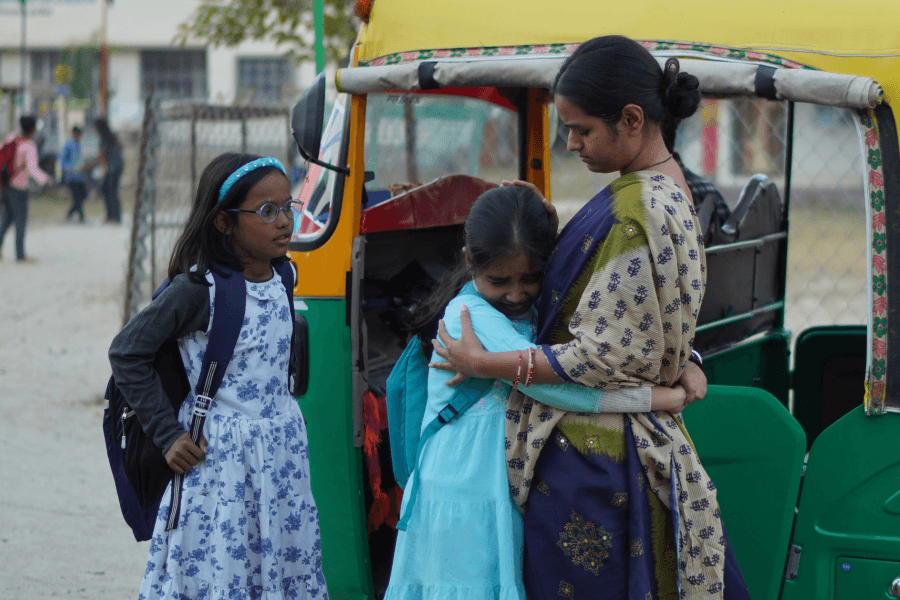
Abhivyakti follows Kanti, a young mother whose daughter Chutki is born with significant hearing loss. Set in Darbhanga, the film unfolds in a world where the family’s first disappointment is that Chutki is not a son and where her diagnosis comes with little support: no nearby specialists, no sign language in schools, and a culture where disability still carries shame. Kanti’s husband withdraws. Kanti does not.

Sanjay Jha
A still from the film (Source: Supplied)

The subject is personal, and its origins are specific. Jha grew up in Darbhanga but had been away for more than three decades. He returned after 23 years for his father’s funeral and, amid the feasts, mourning, and family gatherings that follow a death in a Bihari household, noticed a hearing-impaired man quietly going about his chores, unaware that others were laughing at him.

“He didn’t know,” Jha says. “He was just doing what he was doing. And they were making fun of him.”

That man became a character in the opening of Abhivyakti. Not a protagonist or a plot point, simply a presence that tells the audience, from the very first minutes, what kind of world this story inhabits.

Jha had watched, in families around him, what happens when a system simply has no place for a child. “I have known members in my extended family with hearing disabilities and seen their struggle up close,” he says. Treatment becomes a possibility when finances allow. Social skills can be built when resources are available. “But in rural India, it’s more like a collective failure of imagination. The child is present but treated as absent.”

He wanted to put that gap on screen.

Sanjay Jha
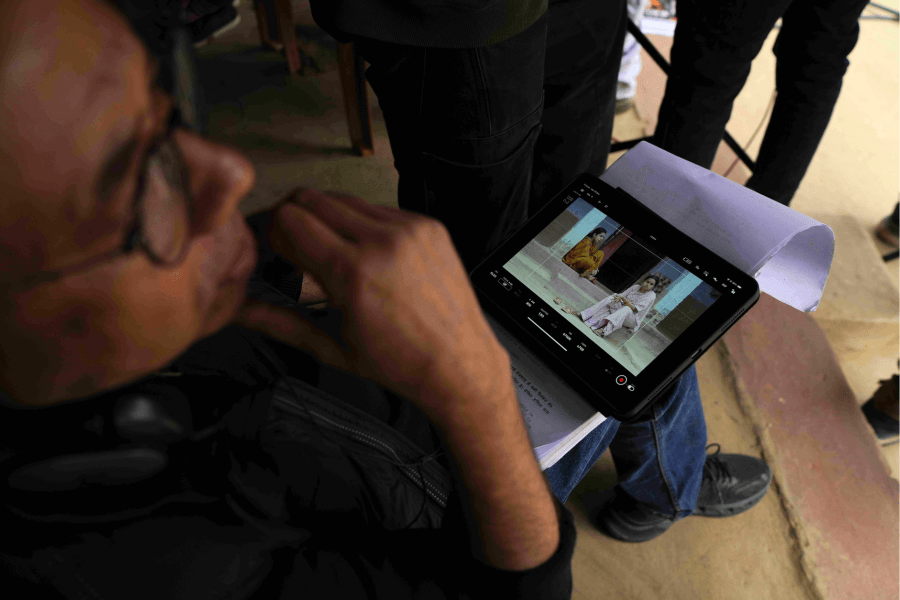
The pensive director (Source: Supplied)

After the screenplay was written, he circulated it widely, gathering feedback from reader after reader before he felt it was ready. “More than perfecting the language, this feedback was important for me to know if people understood the subject and representation.” Then he did something that takes a certain kind of nerve: Sanjay Jha returned to Darbhanga to shoot a film in his mother tongue, Maithili.

“I was lucky, as I got introduced to the local talent there,” he says. “There was a whole group of qualified young indie filmmakers there. I didn’t expect that. In fact, their assistance helped me.”

Long before the shoot, there was the preparation, and that too happened at a distance. From Sydney, Jha ran pre-production sessions with his cast and crew over video calls. Language was an early challenge. Actress Moushami Bharti, who plays Kanti, is not a native Maithili speaker, so Jha coached her scene by scene, line by line, until the language stopped sounding borrowed and started feeling lived in.

The shoot itself was lean. Eleven days in a native village, real-time constraints, limited resources. “Most of my ideas worked,” Jha says, with the mild satisfaction of someone who had done his homework. “Not all. But most.”

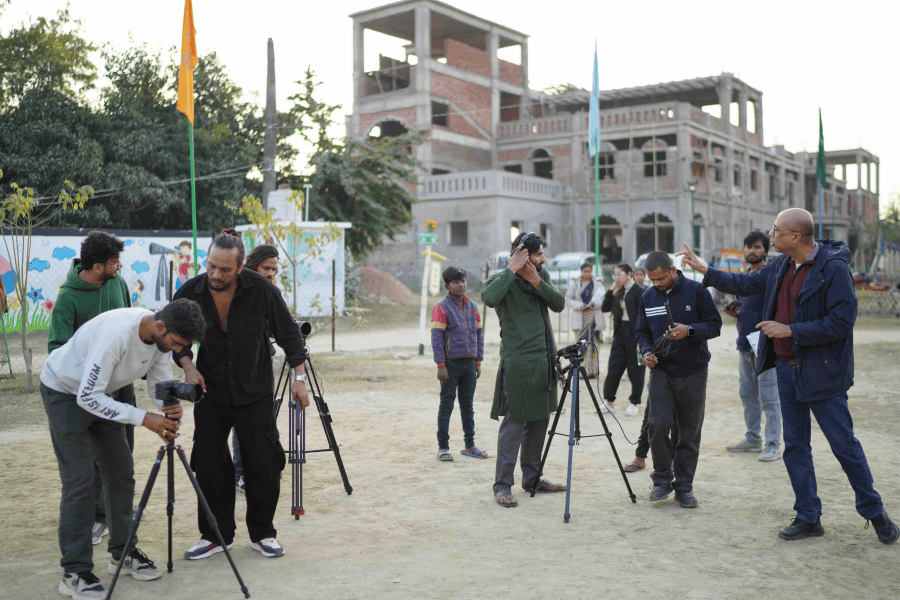
It takes a village to make a film (Source: Supplied)

When asked whether the process differed from what he learned at AFTRS, Jha shakes his head. The grammar of filmmaking travels, he says. What surprised his former classmates was that he had actually used it. Among the first in his AFTRS cohort to make a feature, he has been met with warmth, even enthusiasm, from classmates considerably younger than him. There is something quietly satisfying in that: the professor, the oldest in the room, finishing first.

In a story where the central relationship is shaped by the absence of spoken language, Jha did not want the camera to compensate with noise. A hand on a vibrating surface to feel music. A bowl of water catching the bass of a drum. A mother refusing to let exhaustion become defeat.

“The camera had to become the dialogue,” he says. “What Chutki cannot hear, I wanted the audience to feel.”

Given his day job, the question of AI comes up. Jha is, after all, a researcher whose work sits at the frontier of the technology everyone is talking about. Did he use it?

He shakes his head. “The screenplay I wrote myself. That was important to me.” The only AI in the film is a newsreader scene produced through Eleven Labs, a workaround when a planned journalist sequence couldn’t be shot on the day. Everything else is as analogue as the village it was shot in.

Sanjay Jha
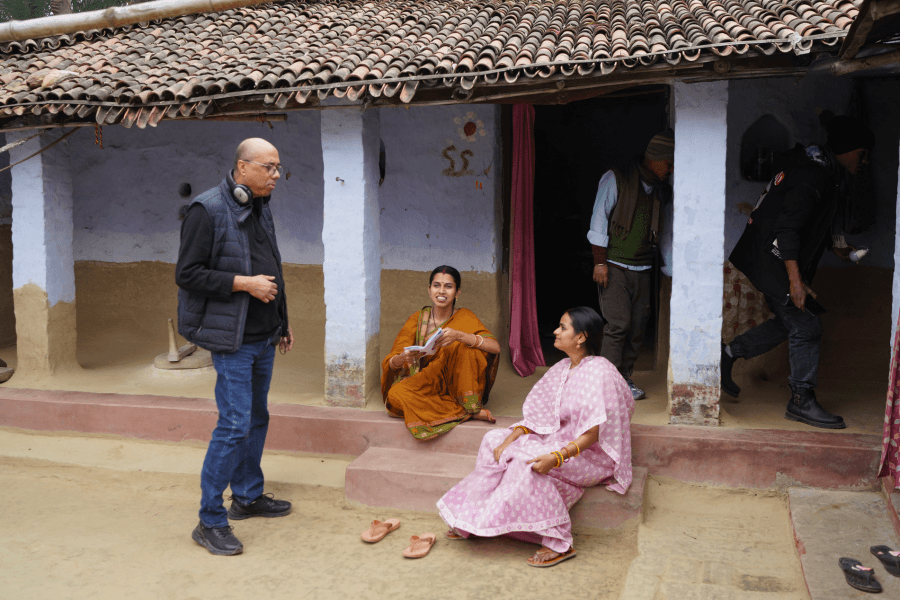
Sanjay Jha guiding the protagonist Moushami Bharti (Source: Supplied)

The film has since found its audience on the festival circuit. Abhivyakti: Finding Their Voice was selected at the International New York Indian Film Festival and the Jaipur International Film Festival 2026. Jha says he made it initially as a test, without great expectations, but invested in a professional post-production team regardless. “I set up a production company in India, got the film certified from India’s Central Board of Film Certification (CBFC) so that we could screen it in India. It was a tedious process full of red tape. But if that means this story and the message get to reach a larger audience, it would all be worth it.” The two things are not contradictory for someone used to running research with rigour, regardless of what the results might turn out to be.

Jha is currently focused on where Abhivyakti: Finding Their Voice goes next – he is negotiating free streaming access and exploring distribution with Prasar Bharati for schools and disability communities in India.

“I would love to screen the film for our Indian community here in Australia.”

Sanjay Jha is clear that he wants it in classrooms and community centres, not just on festival lists.

Read more: Anoop Lokkur: A deeply personal take for Sydney Film Festival

India’s hidden legacy at FIFA World Cup 2026

0
Indian-origin players at FIFA World Cup.
(Left to right, top to bottom) Nishan Velupillay, Sarpreet Singh, Samuel Moutoussamy, Tahsin Mohammed. (Source: X)
Reading Time: 4 minutes

indian-origin players fifa

As the tournament kicks off on June 11 across the United States, Canada and Mexico, four players of Indian heritage will take to the field for their respective nations. They carry different passports, speak different languages, and were shaped by different football ecosystems, but somewhere in each of their stories, a thread connects them back to India.

Nishan Velupillay: The Socceroo from Melbourne indian-origin players fifa


View this post on Instagram


A post shared by CommBank Socceroos (@socceroos)

For Indian-Australians, one name rises above all.

Born and raised in Melbourne, Nishan Velupillay carries Tamil heritage through his father, who is of Sri Lankan Tamil descent with Malaysian roots, and his mother, who is Anglo-Indian. He made his senior international debut in October 2024 during Australia’s 2026 World Cup qualifying campaign and has since earned seven caps, scoring three goals in qualifying matches.

His selection marks a milestone for both Australian football and the global South Asian diaspora, as he will be the first footballer of Tamil heritage to compete at a FIFA World Cup.

Tahsin Mohammed Jamshid: The 19-year-old representing Qatar


View this post on Instagram


A post shared by Tahsin Mohammed (@tahsinmj)

Tahsin was born in Doha in 2006, but his father is from Thalassery, and his mother is from Valapattanam in the Kannur district of Kerala.

Even more exciting is Tahsin reportedly holds an Indian passport, alongside a special Qatari mission passport for international sports, making him the first Indian passport holder to play at a FIFA World Cup. At just 19 years old, the Al-Duhail winger is one of the youngest players inthis year’s tournament.

His path to the national team was laid at the Qatar’s Aspire Academy, an elite youth development program built to identify and grow world-class talent. He is also the first player of Indian-Malayali origin to make it to a men’s World Cup squad.

Sarpreet Singh: The Punjabi who played at Bayern


View this post on Instagram


A post shared by Sarpreet Singh (@sarpreet.singh11)

Sarpreet Singh is the most widely known player of the four. Named in New Zealand’s squad for the 2026 FIFA World Cup, the 27-year-old Auckland-born midfielder is the first Punjabi heritage footballer to play at the tournament.

His parents are from Jalandhar, and he grew up in Auckland. His breakthrough season with Wellington Phoenix secured him a position within FC Bayern Munich, and in 2019 he became the first player of Indian descent to play in the Bundesliga. He was part of the Bayern squad that won the 2019-20 Bundesliga title.

Away from football, Singh has spoken often about his deep connection to Indian cricket, citing Sachin Tendulkar and Virat Kohli as heroes he grew up admiring in a traditional Punjabi household. For him, the 2026 World Cup is more than a tournament- it is the result of a journey that began on football fields in Auckland..

Samuel Moutoussamy: The legend in DR Congo’s colours


View this post on Instagram


A post shared by Samuel Moutoussamy (@s_moutoussamy)

The fourth player on this list carries a connection to India that is the most different.

Born in France, a country known for one of the most competitive football ecosystems in the world, Samuel Moutoussamy’s father is of Indo-Guadeloupean heritage, a community descended from South Indian indentured labourers who were shipped to the Caribbean under the British colonial system in the late 19th century, and his mother is Congolese.

The 29-year-old midfielder represents DR Congo (commonly called Les Léopards) internationally and has earned over 50 caps with the national team after his debut in 2019. Known for his discipline, consistency and hard work, he currently plays for Atromitos in the Greek Super League.

At the 2026 World Cup, Moutoussamy will be seen in the colors of DR Congo’s national football team as the country marks their historic return to the world stage.

The Indian Super League (ISL) Connection

Fans of ISL will witness a favourite face – Duckens Nazon who played for Kerala Blasters, now part of the Haiti team. (Source: X)

The World Cup will also feature a familiar face for ISL followers. Haiti striker Duckens Nazon, who played for Kerala Blasters during the 2016 ISL season, has been named in Haiti’s squad for the tournament. Now 32, Nazon is Haiti’s all-time leading scorer with 44 goals in 76 appearances.

The 20-year drought is over

Before these four players, only one footballer of Indian origin had ever appeared at a men’s FIFA World Cup. Vikash Dhorasoo, whose family roots trace back to Andhra Pradesh via Mauritius, represented France at the 2006 World Cup in Germany, making substitute appearances in the group stage as part of a squad that reached the final.

Since then, no player of Indian heritage has featured on football’s grandest stage.

But the two-decade drought is now over.

India may not be on the official team list of 2026, but Indian heritage will vibrantly come alive on the pitch across North America.

After twenty long years, that is a moment worth celebrating.

READ ALSO: How migration became a key to World Cup success

How to Talk Australians: Laughing through the cultural divide

0
how to talk australians
Reading Time: 4 minutes

How To Talk Australians

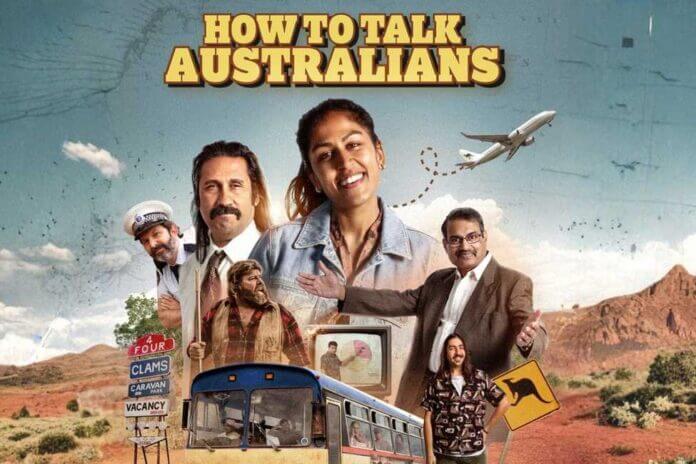
If you’ve ever landed in Australia wondering why strangers call you “mate”, why there are giant roadside attractions everywhere, or what Australians mean when they say “have a crack”, How To Talk Australians will feel instantly familiar.

The new comedy film from writer and director Tony Rogers takes those moments of cultural confusion and transforms them into a hilarious, absurd and surprisingly insightful story about belonging. 

Adapted from the cult web series of the same name, the film follows a group of Indian students navigating Australian culture through a crash course that quickly descends into chaos.

While the premise lends itself to plenty of laughs, Tony tells Indian Link the story was always about something deeper.

“Humour is one of the quickest ways to connect people,” he says. “I’ve always believed that if the comedy is right, most people will laugh regardless of where they come from.”

That belief was reinforced when the film screened in India, where audiences embraced its distinctly Australian humour and awarded it Best Comedy at the Jaipur International Film Festival.

“The audiences really connected with it,” Tony says. “At the end of the day, people understand what it feels like to be misunderstood.”

The journey from web series to feature film, however, was far from straightforward.

Tony spent years developing the project, navigating funding challenges familiar to many independent Australian filmmakers.

“Getting funding for unusual comedy is incredibly difficult,” he says. “We explored different versions of the concept over the years before deciding to make the film independently.”

Eventually, a group of private investors helped bring the project to life, allowing Tony to preserve the unique voice and offbeat humour that had attracted a loyal following online.

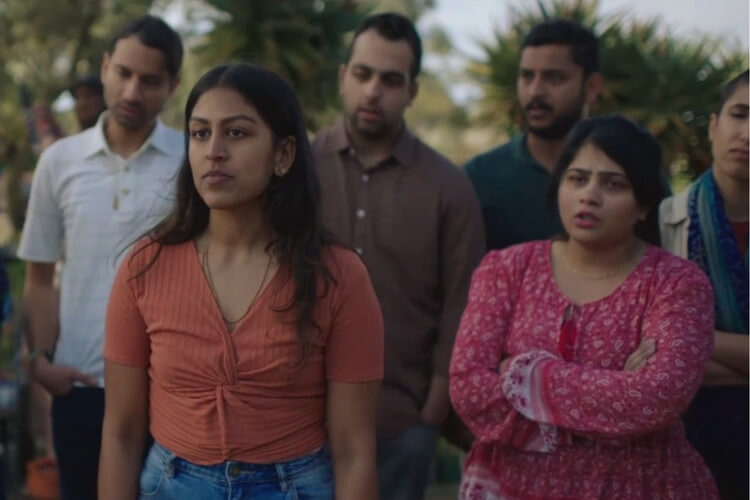
At the centre of the film is Shani, played by Melbourne actor Ria Patel. Introduced as a diligent, rule-following student, she gradually becomes one of the story’s most compelling forces – a transformation that immediately drew Patel to the role. 

how to talk australians class
Ria Patel as Shani, and the HTTA class group (Source: Supplied)

“Growing up, I often saw Indian female characters portrayed in very limited ways,” Ria tells Indian Link

 “What I loved about Shani is that she starts off as the good student but gradually finds her voice.”

Across the film, Shani shifts from quietly observing the chaos to actively challenging it, becoming a catalyst for change. 

“There’s something powerful about showing women, especially South Asian women, embracing their anger in a healthy way,” Ria says. “Anger can be feedback.”

The role resonated personally. Ria describes herself as the quintessential “good Indian daughter”. “I was that student who wanted the A-plus grades,” she says. “Playing Shani let me explore another side of myself and find that fire.”

That understated approach shapes How To Talk Australians, which avoids stereotypes and instead finds humour in the awkwardness of cultures colliding. 

One of the film’s strengths is its refusal to caricature either Australians or Indians. Instead, it pokes gentle fun at the assumptions both groups make about one another.

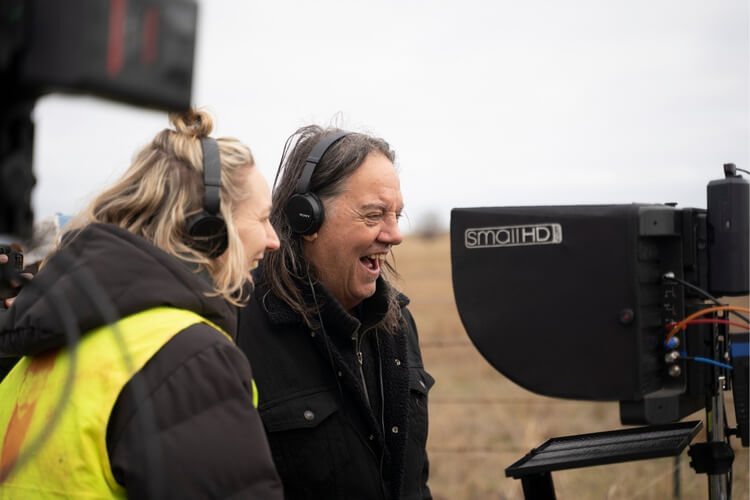
Tony Rogers, Writer-Director
Tony Rogers, Writer-Director (Source: Supplied)

For Tony, his own travels through India as a young backpacker in the 1980s helped shape that view. “The more time you spend with people from different backgrounds, the more you realise how similar we all are,” he says.

Ria admits she wasn’t sure how Indian audiences would respond to the film’s distinctly Australian setting. 

“I remember wondering whether people in India would connect with it,” she says. But her cousin laughed the whole way through and her parents loved it.

What struck her most was the story’s universality. “The characters are constantly misunderstanding each other, but most of the time their intentions are good,” she says. 

In an era often defined by division, How To Talk Australians offers something refreshingly basic – that laughter may be one of the most effective ways to close the distance between cultures.

For both Tony and Ria, that idea feels particularly relevant in contemporary Australia, where conversations about migration, identity and multiculturalism continue to evolve.

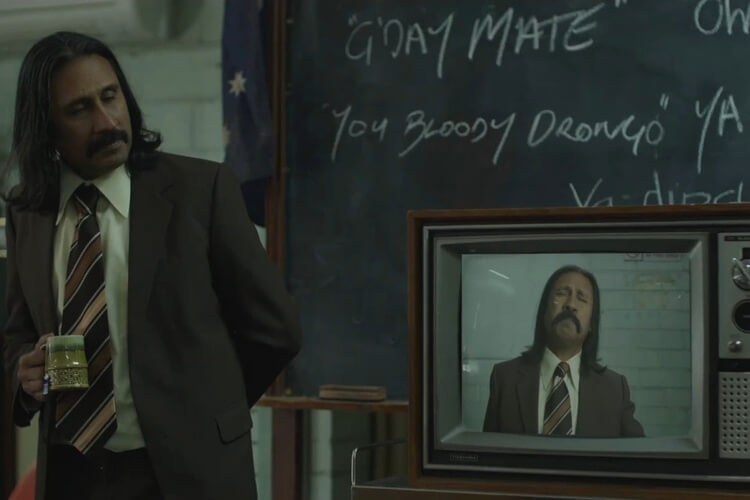
HTT Australians Delhi School
“The characters are constantly misunderstanding each other, but most of the time their intentions are good” (Source: Supplied)

“We live in a time shaped by questions about race, belonging and how we relate to each other,” Tony says. “Comedy gives us a way to talk about those things without preaching.”

Ria hopes audiences leave the cinema with more than just a few laughs.

“With everything happening in the world, I hope the film reminds people of our shared humanity,” she says. “Most problems happen because of misunderstanding. If we take a moment to understand each other, so many of those problems disappear.”

In a country built on migration and cultural exchange, How To Talk Australians offers a simple but timely message: understanding one another does not always begin with grand gestures or political debates. Sometimes it begins with listening, learning – and laughing together.

“I really believe we’re more alike than we are different,” Tony says. “That’s what the film is about.”

How to Talk Australians releases in cinemas on 11 June.

Read Also: Anoop Lokkur: A deeply personal take for Sydney Film Festival

12 years of PM Modi: How they reshaped Australia-India relations

0
Modi 2014 Australia visit, 12 Years of PM Modi
Modi’s addressed the diaspora at the Allphones Arena in Sydney Olympic Park during his Australia visit in 2014 (Source: AFP)
Reading Time: 4 minutes


On June 10, 2026, Narendra Modi surpassed Jawaharlal Nehru’s record of 4,398 consecutive days as prime minister, becoming India’s longest-serving elected leader. It is a milestone that invites reflection, and for the Indian diaspora in Australia, it raises a particular question: how has the relationship between these two countries transformed across his tenure? The answer, as with most things in geopolitics, is complicated.

When PM Modi first landed in Australia in November 2014, he was still finding his feet on the global stage, appearing somewhat nervous at the G20 in Brisbane. The India that stood behind him was a rising economy hungry for partnerships. Australia, for its part, was cautiously optimistic. Nearly 12 years on, that bilateral relationship has been institutionalised, tested, and, in patches, strained.

The big deal: ECTA

The centrepiece of the economic relationship is the Australia-India Economic Cooperation and Trade Agreement. Signed in April 2022 and officially entered into force in December 2022, ECTA aims to grant Australian producers access to the Indian market while providing opportunities for trade, investment, and innovation. The numbers are significant: ECTA was designed to save Australian exporters around $2 billion a year in tariffs, while consumers and businesses stood to save around $500 million on imports of finished goods and manufacturing inputs. Notably, it was the first FTA India had struck with a major economy in over ten years.

The agreement was not without friction. Agriculture proved contentious throughout negotiations, with India protective of its dairy sector and domestic farming vote bank. Still, what was achieved represented a significant reset after decades of slow-moving economic ties.

India’s Prime Minister Narendra Modi addresses attendees during a community event at Qudos Bank Arena in Sydney, Australia, 23 May 2023. (Source: EPA-EFE/DEAN LEWINS) 12 Years of PM Modi

One..two..three visits

PM Modi’s engagement with Australia has been personal as well as political. His 2014 visit saw him address a joint sitting of both Houses of Parliament in Canberra, the first Indian prime minister to do so. His return to Sydney in May 2023 was a different kind of moment altogether. Around 20,000 cheering fans welcomed him at a Sydney stadium. That visit produced the Migration and Mobility Partnership Arrangement and new consulates (Brisbane and Bengaluru) on both sides. And now, a third visit is supposedly scheduled for July 2026, covering Sydney for official bilateral engagements and Melbourne for a large-scale diaspora gathering expected to attract up to 40,000 attendees. Each visit has marked a new elevation in the relationship’s temperature.

People on the move: The working holiday visa

Among the more consequential shifts for ordinary Indians has been the opening of the working holiday visa pathway. Announced during the 2023 visit, the scheme allows Indians under 30 with relevant skills and proficient English to apply for two-year working visas without requiring prior job confirmation, with places initially capped at 3,000 per year. It was a long-awaited move for a community that had watched peers from European nations enjoy this mobility for years, and it signalled that Australia was now willing to treat India as something closer to an equal partner in migration policy.

Photo of the Quad
12 Years of PM Modi

Quad: The strategic backbone

Perhaps the most consequential development of the PM Modi years in terms of regional architecture has been the reinvigoration of the Quad. In 2017, PM Modi joined the leaders of Japan, Australia, and the United States to revive the grouping, spurred by growing concerns over China’s expanding economic and military influence in the region. What began as a security dialogue has since broadened significantly. With Biden and Japanese PM Kishida having left office, PM Modi has emerged as the one constant presence at Quad summits since the grouping began meeting at the leaders’ level in 2021. For Australia, which has aligned its strategic posture firmly with this Indo-Pacific architecture, India’s reliability as a Quad partner has been foundational.

The difficult chapters

No honest account of this relationship omits its friction points. The most visible of these arrived in April 2024, when Avani Dias, the ABC’s South Asia bureau chief, left India after being told by a Ministry of External Affairs official that her visa extension would be denied because her reporting had “crossed a line.” Her visa troubles followed the production of an episode about the killing of pro-Khalistan activist Hardeep Singh Nijjar in Canada. The Australian government intervened; a two-month extension was granted hours before her flight. Dias left anyway. The episode drew sharp criticism from press freedom organisations and sat uncomfortably alongside PM Modi’s characterisation of India as “the mother of democracy.”

Then there is the question of polarisation. The Indian diaspora in Australia, once a relatively unified community presence, has increasingly reflected the political fault lines of home. Protests during PM Modi’s 2023 visit, disagreements over how to engage with Australian politicians, and divergent views on Indian domestic policy have all surfaced.

TThousands of fans of Indian Prime Minister Narendra Modi welcome him at Allphones Arena Sydney, Monday, Nov. 17, 2014. (AAP Image/Jane Dempster)
Thousands of fans of Indian Prime Minister Narendra Modi welcome him at Allphones Arena Sydney, Monday, Nov. 17, 2014. (AAP Image/Jane Dempster) 12 Years of PM Modi

A relationship worth watching

Twelve years of PM Modi have produced a bilateral relationship that is deeper, more institutionalised, and more strategically significant than at any prior point in history. Critical minerals have emerged as a key pillar of the partnership, particularly in the context of clean energy and advanced technology. Trade has expanded, people-to-people ties have multiplied, and the strategic alignment through the Quad has given the partnership genuine weight.

What it has also revealed is that warm summits and signed agreements do not resolve every underlying tension. Democratic norms, and community cohesion will remain live questions as this relationship matures. As PM Modi heads into his record-breaking term, and as his third visit to Australian shores approaches, both countries will be watching to see which version of this partnership defines the years ahead.

Read more: The cat’s out of the bag? PM Modi’s Australia visit all but confirmed

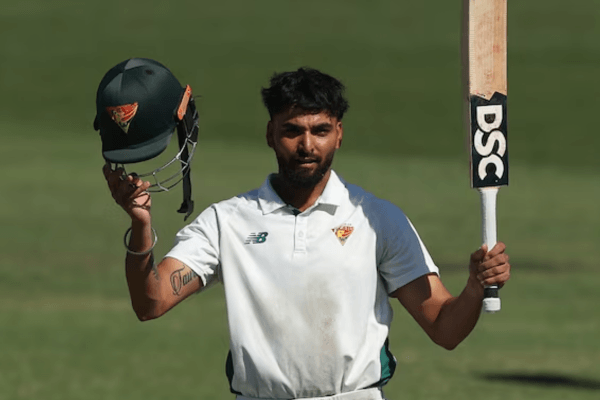
Nikhil Chaudhary to play T20 for Australia

0
Nikhil Chaudhary Australia Cricket
(Source: X)
Reading Time: 2 minutes


Nikhil Chaudhary, Australia Cricket

Nikhil Chaudhary could be the first Indian-born man to play for Australia in 60 years, following his selection for the Australia’s T20I squad against Bangladesh.

The 30-year-old is set to join his teammates on Friday as they prepare for the series.

National Selector Tony Dodemaide says the panel are excited to welcome Chaudhary to the team.

“Nikhil will gain invaluable experience in Bangadesh and will be in contention to play his first game for Australia when we sit down to pick a team for the opening T20 fixture here next week,” he said.

They have followed Chaudhary’s game for some time, including his last three years as an allrounder with the Hobart Hurricanes.

“Nikhil has been a player of national interest for some time. He was a standby player for this tour, joining the squad at pre-season camps in Brisbane and comes in as a replacement for Travis Head,” Dodemaide said.

“The panel has been impressed by his BBL form, particularly last season, leading to his addition to the squad. He has also been part of the Delhi Capitals setup in this year’s IPL.”

Hailing from Delhi, Chaudhary’s career began alongside giants Shubham Gill and Harbhajan Singh with his Twenty20 debut for Punjab but he was unable to pass trials for IPL’s Mumbai Indians.

Getting stuck in Australia while visiting family during lockdown, Chaudhary found his feet again in Brisbane, pursuing cricket alongside odd jobs like being a courier with Australia Post.

The hard work paid off in 2023, when after success in Brisbane’s grade cricket scene, he made it onto the Hurricanes team. As a permanent resident of Australia, Chaudhary satisfies the ICC’s conditions to play for the country at the international level.

Chaudhary’s selection makes him the first Indian-born male player since the 1960s to play international cricket for Australia, when Rex Sellars, a Gujarat-born leg-spinner featured in the 1964 Calcutta Test. Nikhil Chaudhary, Australia Cricket

On the women’s side, Pune-born Lisa Sthalekar has been a noteworthy international player for Australia.

Australia’s T20I series, to be played in Chattogram, will begin next Wednesday with the second of three ODIs to be played today.

Read more: Vishwa Ramkumar: the Indian moving up in Australian cricket

How migration became a key to World Cup success

0
Nishan Velupillay of Melbourne is part of Socceroos, representing Australia on football's grandest stage.
Reading Time: 4 minutes

migration fifa world cup

Few would have predicted Morocco’s success at the 2022 Fifa World Cup. Heading into the tournament, they were ranked 22nd in the world and had never progressed beyond the round of 16. migration fifa world cup

Yet they beat Belgium, Spain and Portugal – countries that both then and now rank inside the world’s top ten – on their way to becoming the first African nation ever to reach the semi-final.

Morocco’s run was not only remarkable (and thoroughly deserved). It also sparked debate beyond football because 14 of the players in their 26-man squad were foreign-born, more than any other nation in the tournament.

The 2026 World Cup will feature more foreign-born players than any previous edition. Nearly a quarter of the 1,248 players selected for national teams were born in a different country from the one they will represent.

In some squads, the proportions are far higher than this – 96% of Curaçao’s players were born abroad, as were 85% of the Democratic Republic of the Congo’s and 73% of Morocco’s. Overall, foreign-born players make up the majority of footballers in eight of the tournament’s 48 squads.

Migration has been part of the World Cup story since its inception. At the tournament’s third edition in 1938, for example, 12% of players represented a country other than the one in which they were born.

This was in part because Fifa didn’t introduce regulations governing football players’ eligibility for national teams until 1962, meaning it was not uncommon for players to represent multiple countries throughout their careers.

Achraf Hakimi, who was born in Madrid, plays for Morocco at the World Cup.

Some players represent countries other than those in which they were born because they are eligible through a parent or grandparent. These players often emerge from diaspora communities created by earlier waves of migration.

One example is 2018 World Cup finalist Ivan Rakitić, who was born and raised in Switzerland but chose to represent Croatia. In a 2025 interview, Rakitić explained that when he had to choose between the two countries, his heart told him he should play for Croatia.

Other players qualify through residency requirements. Pepe, for example, was born in Brazil but played in four World Cups for Portugal between 2010 and 2022 after becoming a Portuguese citizen at the age of 24.

Yet foreign-born players are only part of the story. World Cup squads also contain many second-generation migrants. France’s 2018 World Cup-winning squad is perhaps the best-known example: 12 of their 23 players had African parents.

Such patterns are not random. France’s squad reflected the country’s colonial and postcolonial links with north and west Africa. Similarly, since the mid-2000s, Switzerland’s national team has increasingly been shaped by migration from the former Yugoslavia following the conflicts and displacement that accompanied its breakup in the 1990s.

England’s 2026 squad also tells a story about the country’s migration history. Alongside Marc Guéhi, who was born in Ivory Coast, at least nine players had a parent born overseas. Most have family roots in former British colonies in Africa and the Caribbean, reflecting patterns of post-second world war migration to the UK.

At the same time, 24 players born in England have been selected by other World Cup teams. This includes five representing Scotland and 19 playing for countries beyond the British Isles (including the US, New Zealand and Ghana).

Does this matter on the pitch?

Relatively little research has examined whether national teams with more migrant players perform better on the pitch. But the available evidence suggests they do.

Foreign-born players are boosting the World Cup.
Back-to-back World Cups: Awer Mabil is one of the first Sudanese-Australians to represent the Australian Socceroos at a World Cup.

One study from 2022 analysed every World Cup between 1970 and 2018 and found that teams with more foreign-born players generally progressed further in the tournament. On average, each additional foreign-born player was associated with roughly 0.15 additional matches played.

The relationship remained even after accounting for broader differences between countries, suggesting that migration may provide advantages beyond those associated with wealth or footballing tradition alone.

Another study from 2023 examined European national teams competing in World Cups and European Championships between 1970 and 2018. Using players’ surnames to estimate their ancestral origins, it measured the diversity of backgrounds within each squad and found that more diverse teams tended to perform better on average.

Specifically, the research found that a one standard deviation increase in diversity led to an increase in goal difference (the number of goals a team scores minus the number of goals they concede) of around 1.3 per match on average.

There are at least two factors that might explain these results. First, migration can expand the pool of players available to a national team. Ghana’s squad for the 2026 tournament draws heavily on diaspora communities in western Europe. This allows it to recruit players developed in some of the world’s strongest football systems.

Second, migration may increase the diversity of skills available within a squad. Football players need specific physical traits and technical skills to succeed on the pitch. Central defenders, for example, are usually tall and physically strong. More attacking players, on the other hand, often require speed.

A more diverse population will probably provide a larger pool of potential players for each position, resulting in better complementarity at the team level. migration fifa world cup

This does not mean that migration wins World Cups. Argentina won the 2022 World Cup without a single foreign-born player in their squad. Success also depends on population size, economic wealth and coaching. Lionel Messi playing for your team helps, too.

Nonetheless, the limited evidence available indicates that migration may influence international football beyond simply changing the make-up of the teams competing.

If Morocco’s 2022 squad had been limited to players born and raised in Morocco, would they still have reached the semi-finals? We’ll never know for sure. But if Curaçao do so this time around, the role of migration in footballing success may become harder to ignore.

This article, written by Ben Brindle, a researcher in Migration Observatory at The University of Oxford, first appeared in The Conversation, and has been republished under a Creative Commons license. Find the original article here.

READ MORE: Nishan Velupillay: South Asian-origin forward named in Australia’s FIFA World Cup Squad

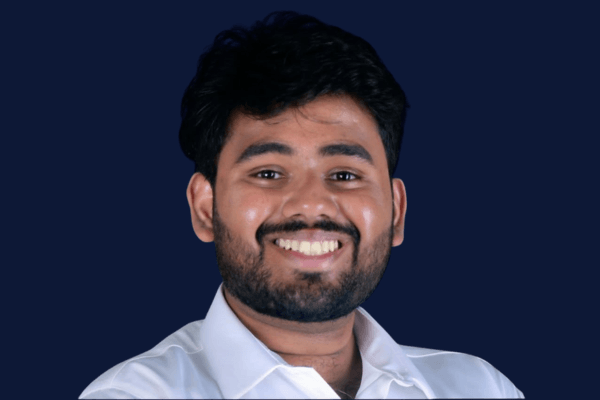
Kaushal Ottem: MBA at 18, Startup at 23

0
Kaushal Ottem, 2026 7NEWS Young Achiever Award VIC for Luminary Tech Visionary (Source: Supplied)
Reading Time: 4 minutes


Despite completing a Masters degree aged 18, Kaushal Ottem never really liked school.

Temporarily bedridden at the age of seven after being hit by a bus, Ottem was cut off from his friends and education, and told he would have to repeat a year.

Feeling the pressure of the Indian education system, and bored to tears by lying in his room all day, he turned to his computer, teaching himself how to code a rudimentary cricket game.

“It became survival mode for me – I had to find different, out-of-the-box ways to ensure that I would be able to have a career or do what I like,” he remembers.

Little did he know that game would be downloaded by over 3 million people, sparking a career in computer science that has gone from innovation to innovation.

Having now won the 2026 7NEWS Young Achiever Award VIC for Luminary Tech Visionary, he reflects on his unconventional path to success, driven by his own health struggles.

“I also had my own health battle to overcome. To make this kind of progress, I had to make a lot of sacrifices, particularly around my diet and fitness, to make sure that I don’t cease,” says Ottem.

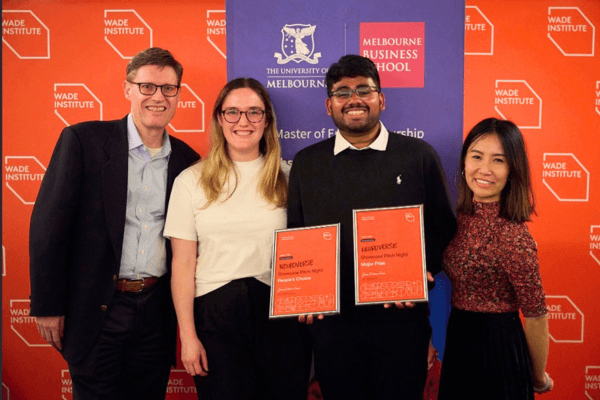
Kaushal Neuroverse Wade Institute
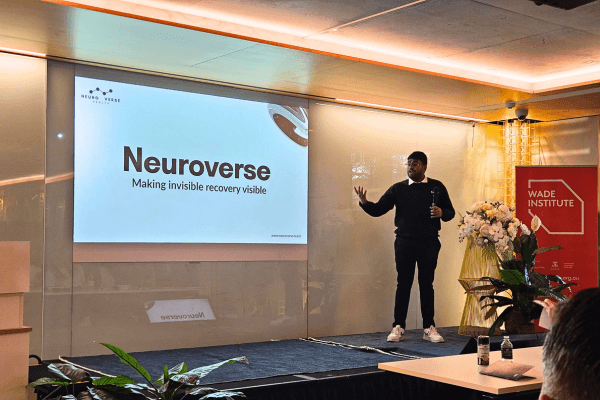
Kaushal Ottem presents Neuroverse at the Wade Institute. (Source: Supplied)

After finishing his Masters in Computer Science at RMIT University, Ottem started to feel the aftershocks of his childhood accident, experiencing severe epileptic seizures that put him in hospital. It was here the idea for his latest startup, Neuroverse, emerged.

“I had to go to neurological rehab. It really annoyed me the rehab happened the same way it had 15 years ago – no technological developments, there was nothing in the preventative health space,” he recounts.

“One in three people in their lifetime will go through a neurological condition – there’s a significant aging population. That tells you how big that entire landscape is; I knew something had to be done.”

Frustrated at the lack of accessible platforms to track neurological markers and monitor brain health, he set out to remedy this major healthcare gap.

“It’s such a multidisciplinary field; research in this field has always been in universities, but nothing translated commercially,” says Ottem about why there’s been so few neurological tech innovations. “Hardware was also bulky, clunky. But machine learning models have made it easier now for people working in this space to look at commercialising that research and bringing something to life that makes an impact for people.”

Kaushal Ottem

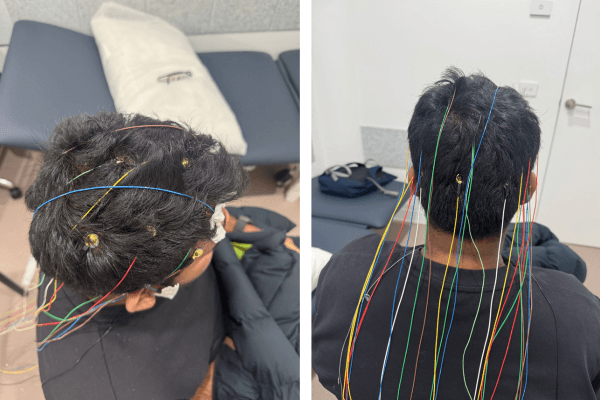
Existing EEG technology can only be operated by clinicians, as it requires cumbersome setup. (Source: Supplied)

From strokes, to Parkinsons, to Cerebral Palsy, Neuroverse has the potential to transform patient recovery by making it easy to track the efficacy of intervention and rehabilitation efforts.

“A rehab centre would put this on a patient and then the patient and clinician gets the app, and they’re able to see things like fatigue, tremor rate, control rate, muscle activation rates – tap into different brain regions, biomarkers and things like that,” explains Ottem on how the technology works.

“One key factor is we do it in a real life simulation; it allows the physios and the clinicians to be able to see [in real time] if exercises they’ve prescribed to patients are actually hitting the right part of the brain, and by doing that they’re able to make changes on the go.”

With the ambition to eventually create an ‘alternative to the Apple watch that tracks neuro health’, over the last year Ottem has experimented heavily to reach a prototype, including flying to Asia to form hardware partnerships.

“That’s just been the philosophy, right – you move fast, you fail fast, you learn faster,” he says.

So far, he’s successfully created a less cumbersome piece of headgear which can be used without electrode gel, and he hopes to keep innovating towards a more discreet, wearable patch suitable for home care.

Kaushal Unimelb pitch
Kaushal won the Major Prize at the Wade Institute’s Showcase Pitch Night. (Source: Supplied)

“For me, it’s not about just simply launching headgear; it’s launching a meaningful piece of technology and data-driven metrics because it’s a very complex field we’re working on,” Ottem says.

“Instead of a startup, I like to call it more of a research idea. That’s how I would like to put it at this stage.”

Having embraced the digital world around him, Kaushal Ottem encourages other young innovators to take advantage of the unlimited information available to them.

“Any career that you want to take, there’s so many resources available online,” Ottem says. “You can just start now, there’s nothing really stopping you.”

READ ALSO: Veer Tangri: Golden Wickets, golden heart

UNSW to open Bengaluru campus by August 2026

0
UNSW August opening
Reading Time: 2 minutes


The University of New South Wales will establish its first international campus in Bengaluru, with classes set to begin in August this year.

Located at Embassy Manyata Business Park, the UNSW Bengaluru campus will initially offer undergraduate degrees in Business, Computer Science and Data Science, as well as a postgraduate degree in Cyber Security.

UNSW Vice-Chancellor Professor Attila Brungs says the North Bengaluru location for this campus was carefully chosen due to the nearby multinational and Fortune 500 companies housed in the compound.

“Bengaluru’s position as a global technology and innovation hub makes it an ideal location for our first campus in India,” she said.

“Through strong industry integration, future-focused programs and global academic standards, we aim to prepare students for the rapidly evolving workforce and careers of the future.”

UNSW is the sixth Australian institution to open a campus on the subcontinent, others including Western Sydney University and fellow Group of Eight-member University of Western Australia.

This trend has been bolstered by India’s National Education Policy (NEP) 2020 framework, incentivising high-performing foreign institutions to forge connections with India’s higher education sector.

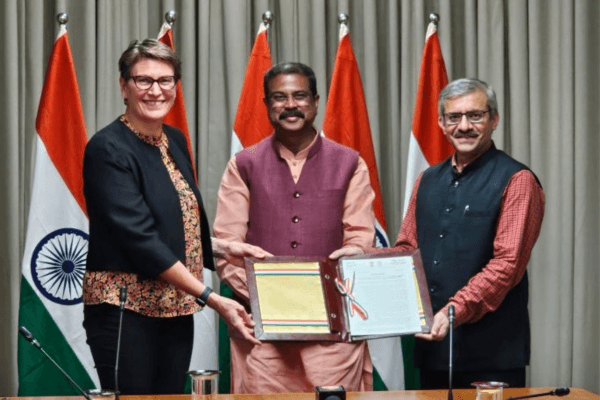
Philip Green, Australian High Commissioner to India, says the proposed campus which has just been approved by the Indian Government is “further endorsement of the quality of Australian education.” UNSW Bengaluru

“It reflects the growing strength of the Australia-India education relationship and the shared commitment of both countries towards advancing research, innovation and talent development,” he said.

The University have a storied history of engagement with India over the last 70 years, notably a 2019 partnership The Manipal Academy of Higher Education, and recently, a strategic collaboration with Deloitte India.

They have also received dignitaries such as the Indian Minister for Commerce and Industry, Piyush Goyal, who came to lay a garland at the Mahatma Gandhi visible on the Sydney campus’ lawn during the time of the ECTA agreement. UNSW Bengaluru

The UNSW is ranked 20th in the world as per the 2026 QS University rankings, making it Australia’s second highest ranking university.

UNSW Bengaluru

READ ALSO: UNSW’s Beach Ocean Safe: battling South Asian drowning statistics

Maa Behen: Review

0
Maa Behen, a Hindi-language black comedy thriller.
Reading Time: 3 minutes

Maa Behen

For decades, the phrase ‘Maa-Behen’ clubbed together has existed as an insult, thrown casually into conversations, road rage arguments and social media comment sections. Director Suresh Triveni takes those two words, strips them of their ugliness and turns them into a story about women who are tired of being told who they should be. The result is messy, chaotic, occasionally uneven, but also wickedly entertaining. 

At the centre of Maa Behen is Rekha, played by Madhuri Dixit with the kind of confidence that comes only from an actor who knows exactly how much screen presence she possesses. Rekha is the woman every neighbourhood seems to have. She wears what she likes, laughs a little too loudly, doesn’t care much for public opinion and therefore becomes the favourite subject of gossip. Society has a strange habit of treating independent women as public property. Everybody has an opinion on them.

AT A GLANCE

FILM: Maa Behen (Netflix)
CAST: Madhuri Dixit, Triptii Dimri, Dharna Durga, Ravi Kishan
DIRECTOR: Suresh Triveni
PRODUCERS: Vikram Malhotra, Suresh Triveni
Rating: ★★★ 1/2

Madhuri understands this woman completely. There is no attempt to make Rekha likable in the conventional sense. She is flawed, stubborn, impulsive and gloriously unapologetic. The actress gives her warmth without softening her edges. It is one of Madhuri’s most enjoyable performances in years because she is allowed to be funny, reckless and vulnerable all at once. It’s unlike anything usual Madhuri, who carries that theme with remarkable ease. 

Opposite her, Triptii Dimri delivers one of her stronger performances in recent memory. As Jaya, a woman trapped inside a deeply patriarchal household, she captures a frustration that feels painfully familiar. Her anger is not explosive. It simmers. It sits quietly in dining rooms, family gatherings and everyday compromises. 

Then there is Dharna Durga as Sushma, bringing youthful energy and unpredictability to the trio. Together, the three women create a family dynamic that feels wonderfully dysfunctional. They bicker, misunderstand each other and repeatedly make terrible decisions. Yet beneath all the chaos is genuine affection. 

And then there is Ravi Kishan, who quietly walks away with some of the film’s funniest moments. As Guptaji, the middle-aged neighbour hopelessly smitten with Rekha, he resists the temptation to turn the character into a caricature. Kishan understands that comedy works best when played straight. His expressions, awkward silences and earnest attempts at romance generate laughs without ever feeling forced. The actor has built a reputation in recent years for scene-stealing supporting turns, and Maa Behen continues that streak.

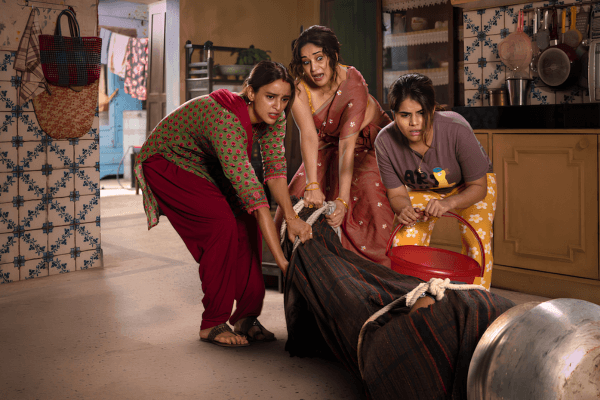
The plot kicks off when a dead body enters the picture. Instead of treating murder as a thriller device, Triveni uses it as an excuse to throw these women into increasingly absurd situations. The comedy comes not from punchlines but from panic. One particularly memorable moment reportedly involves the family debating how to dispose of a corpse while discussing tea. That perfectly captures the film’s tone. 

The most enjoyable, however, was the film’s understanding of how women are watched. The gaze.

Every colony has unofficial surveillance officers. Every family gathering has people keeping score. Every woman who crosses an invisible line is labelled something. Maa Behen takes those labels and laughs at them.


View this post on Instagram


A post shared by Netflix India (@netflix_in)

Rekha, Jaya and Sushma. These names evoke the iconic Nirma advertisement that celebrated the ideal Indian homemaker. Here, those same women are dealing with secrets, resentment, murder and identity crises. It is a clever piece of cultural irony that perfectly suits the film’s larger themes. 

The film is not without flaws. The screenplay occasionally loses focus, juggling too many ideas and subplots at once. Some emotional beats could have landed harder. A few stretches feel longer than necessary. The writing sometimes struggles to match the strength of its premise. 

Yet somehow, like Tumhari Sulu (2017), Triveni’s offering in the past, the imperfections become part of its charm.

READ ALSO: Made in India: A Titan Story review