



Maa Behen
For decades, the phrase ‘Maa-Behen’ clubbed together has existed as an insult, thrown casually into conversations, road rage arguments and social media comment sections. Director Suresh Triveni takes those two words, strips them of their ugliness and turns them into a story about women who are tired of being told who they should be. The result is messy, chaotic, occasionally uneven, but also wickedly entertaining.
At the centre of Maa Behen is Rekha, played by Madhuri Dixit with the kind of confidence that comes only from an actor who knows exactly how much screen presence she possesses. Rekha is the woman every neighbourhood seems to have. She wears what she likes, laughs a little too loudly, doesn’t care much for public opinion and therefore becomes the favourite subject of gossip. Society has a strange habit of treating independent women as public property. Everybody has an opinion on them.
AT A GLANCE
FILM: Maa Behen (Netflix)
CAST: Madhuri Dixit, Triptii Dimri, Dharna Durga, Ravi Kishan
DIRECTOR: Suresh Triveni
PRODUCERS: Vikram Malhotra, Suresh Triveni
Rating: ★★★ 1/2
Madhuri understands this woman completely. There is no attempt to make Rekha likable in the conventional sense. She is flawed, stubborn, impulsive and gloriously unapologetic. The actress gives her warmth without softening her edges. It is one of Madhuri’s most enjoyable performances in years because she is allowed to be funny, reckless and vulnerable all at once. It’s unlike anything usual Madhuri, who carries that theme with remarkable ease.
Opposite her, Triptii Dimri delivers one of her stronger performances in recent memory. As Jaya, a woman trapped inside a deeply patriarchal household, she captures a frustration that feels painfully familiar. Her anger is not explosive. It simmers. It sits quietly in dining rooms, family gatherings and everyday compromises.
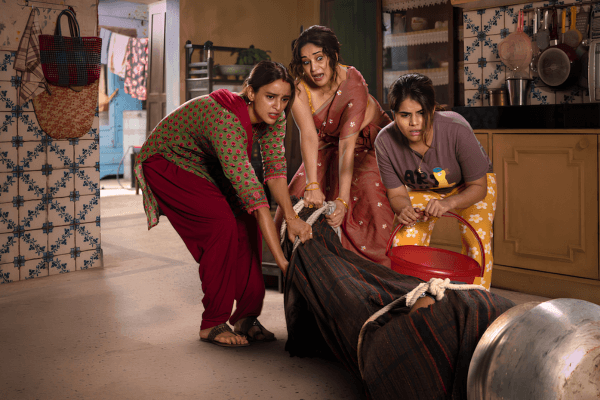
Then there is Dharna Durga as Sushma, bringing youthful energy and unpredictability to the trio. Together, the three women create a family dynamic that feels wonderfully dysfunctional. They bicker, misunderstand each other and repeatedly make terrible decisions. Yet beneath all the chaos is genuine affection.
And then there is Ravi Kishan, who quietly walks away with some of the film’s funniest moments. As Guptaji, the middle-aged neighbour hopelessly smitten with Rekha, he resists the temptation to turn the character into a caricature. Kishan understands that comedy works best when played straight. His expressions, awkward silences and earnest attempts at romance generate laughs without ever feeling forced. The actor has built a reputation in recent years for scene-stealing supporting turns, and Maa Behen continues that streak.
The plot kicks off when a dead body enters the picture. Instead of treating murder as a thriller device, Triveni uses it as an excuse to throw these women into increasingly absurd situations. The comedy comes not from punchlines but from panic. One particularly memorable moment reportedly involves the family debating how to dispose of a corpse while discussing tea. That perfectly captures the film’s tone.
The most enjoyable, however, was the film’s understanding of how women are watched. The gaze.
Every colony has unofficial surveillance officers. Every family gathering has people keeping score. Every woman who crosses an invisible line is labelled something. Maa Behen takes those labels and laughs at them.
View this post on Instagram
Rekha, Jaya and Sushma. These names evoke the iconic Nirma advertisement that celebrated the ideal Indian homemaker. Here, those same women are dealing with secrets, resentment, murder and identity crises. It is a clever piece of cultural irony that perfectly suits the film’s larger themes.
The film is not without flaws. The screenplay occasionally loses focus, juggling too many ideas and subplots at once. Some emotional beats could have landed harder. A few stretches feel longer than necessary. The writing sometimes struggles to match the strength of its premise.
Yet somehow, like Tumhari Sulu (2017), Triveni’s offering in the past, the imperfections become part of its charm.
READ ALSO: Made in India: A Titan Story review