Indian Link has won the Best Multicultural Publication Award at the NSW Premier’s Harmony Dinner 2026 a proud milestone celebrating years of storytelling, community connection, and cultural representation. In this video, Rajni & Pawan Luthra share what IndianLink is all about from amplifying diverse voices to building a platform that connects and empowers the Indian-Australian community and beyond.
This is the fifth time Indian Link has won this award, and it marks our 33rd award since the awards were instituted in 2012.
As the Strait of Hormuz remains blocked, and the price of diesel surges, the trucking and transport industries are continuing to feel the pinch.
Today’s news of a brief ceasefire is promising but may not be enough for workers who are ‘weeks away from going out of business’ according to transport advocates.
“It is critical that we see fuel costs paid for by the top of the supply chain—the retailers, manufacturers and mining giants that are already increasing costs for customers, while truck drivers and businesses are struggling to hold on,” he said.
‘An uncertain future’
Transport operator Amar Singh says the fuel shortage is resulting in an ‘uncertain future’ for workers, reduced shifts and redundancies continuing as transport companies divert their income towards petrol.
Morale is low amongst transport business owners and workers, forced to choose between fuel and workers’ wages.
“You feel and hear the pain in their voice…it’s a horrible position to be in,” Singh recounts.
With recently migrated Indian-origin truck drivers making up over five percent of the largely casual and shift-based industry, the fuel shortage has been particularly dire for those still establishing themselves financially.
“In our trucking meetings, I’ve heard from many people even offering to take a pay cut from the company to make sure that they can get some money in, rather than being told that they had to stay home,” explains Singh.
Amar Singh
“You feel that in the general conversations around our tea or coffee breaks, they’re concerned about how they’re going to work.”
Even despite the fuel excise cut, diesel prices have soared to almost 350 cents, nearly double what they were in February 2026.
“I’ve heard from companies that their fuel bill for a week has gone up – say it’s a fleet of 25 to 30 trucks – by almost $50,000 on top of the normal spend,” Singh explains.
“No business has that much sort of running cash around, and that is the scary part.”
‘Bite the bullet and fill up’
The founder of food relief charity Turbans4Australia, Singh says the fuel shortage has caused them to lose volunteers and abandon pick-ups and deliveries of donations.
This has meant they will soon ‘have to send people away’ from their food relief service, an alarming prospect during an already strained economic period.
“There’s only so much reserve stock we have…unfortunately people are going to have to go elsewhere to seek that relief,” Singh says.
Earlier this month, the government passed the Fairer Fuel Bill, allowing the Fair Work Commission to fast-track emergency applications from transport operators.
Many regional bowsers have surpassed $4 for diesel. (Source: Unsplash)
A hearing is underway at the Fair Work Commission, where the Transport Workers Union have applied for a road transport contractual chain order, encouraging major retail clients to take greater responsibility for fuel prices.
Singh warns this latest proposal could devolve into ‘robbing Peter to pay Paul’ if major retailers pass on even more of their fuel costs to consumers.
He hopes instead to see the government freeze heavy vehicle tolls and fuel prices for the transport sector and activate disaster recovery funds for small trucking businesses.
With no intervention in sight, Singh and other transport operators are forced to work through constant uncertainty.
“It does make you think every time you fuel up…but it’s something you can’t really live without, so you have to bite the bullet and fill up and try to keep doing what you’re doing at a smaller scale,” he says.
While an official announcement is still pending, it is expected that PM Modi will be in Australia on 8 July for 48 hours after his first ever visit to New Zealand in the preceding two days.
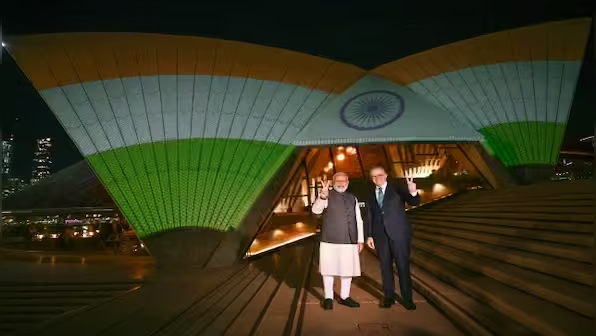
This will be his third visit to Australia. His previous visits in 2014 and 2023 were hailed as landmark diplomatic visits with PM Albanese introducing PM Modi as the Boss and the Sydney Opera House illuminated in the tricolour.
However, uncertainties on the world stage continue to remain a caveat.
“Of course, we need to be mindful about the fast-changing global geopolitics which can cast a shadow over any planned visit, but at the moment, it is all systems go on the visit,” said a source who did not wish to be identified.
No official announcement has yet been made by the Australian Dept of Foreign Affairs and India’s Ministry of External Affairs or its Ministry of Trade and Commerce. It is expected that details will be officially confirmed once the new Indian High Commissioner Nagesh Singh takes up his role this month.
This visit down under, should all go according to plan, will start with a visit to New Zealand on 6 July.
It was 40 years ago that an Indian Prime Minister last visited New Zealand.
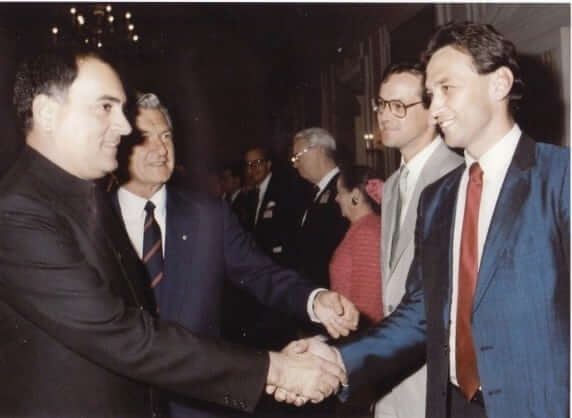
Rajiv Gandhi’s 1986 visit to Australia (Source: File Photo)
Prime Minister Rajiv Gandhi travelled to Wellington in 1986, at a time when global politics were defined by nuclear tensions and ideological blocs. That trip was shaped less by trade and more by shared principles. New Zealand had just declared itself nuclear-free, straining ties with traditional allies, while India championed global disarmament as a leader of the Non-Aligned Movement. The visit underscored common ground on anti-nuclear policy and independent foreign policy thinking, even though economic engagement remained limited.
Should PM Modi’s visit go ahead, India-NZ ties are poised for a reset after nearly four decades, reflecting how geopolitics and priorities have evolved since the Cold War era.
During the PM’s visit to NZ, it is expected that the Free Trade Agreement (FTA), will be formally signed. The two countries concluded FTA negotiations in late 2025 after years of stalled talks, marking a major step forward in bilateral relations.
Once implemented, the FTA is expected to significantly boost trade by reducing or eliminating tariffs on a wide range of goods and services. It will likely benefit sectors such as agriculture, technology, education, and services, while also improving market access for businesses on both sides.
NZ negotiations with India have so far not secured greater progress towards dairy trade liberalisation. (Source: Unsplash)
Earlier negotiations between 2010 and 2015 had failed, mainly due to disagreements over agriculture, particularly dairy. The renewed progress reflects changing economic priorities and a growing interest in strengthening ties in the Indo-Pacific region.
The Indo-Pacific has emerged as a central arena of global competition and cooperation, bringing countries like New Zealand into sharper strategic focus for India. Both nations share concerns about regional stability, supply chain resilience, and the need for diversified partnerships.
Another key shift is the rapid growth of the Indian diaspora in New Zealand. Once relatively small, this community has become economically and politically influential, adding a new dimension to bilateral ties. At the same time, trade discussions have regained momentum, with both sides interested in unlocking opportunities in agriculture, education, technology, and services.
Despite these positive signals, challenges remain. Geographic distance, limited trade complementarities, and differing regulatory frameworks continue to slow progress. Yet the broader trajectory suggests renewed intent.
As both countries navigate a more complex global order, the absence of a prime ministerial visit since 1986 stood out as an anomaly.
PM Modi’s 2026 visit would not only be symbolic but could also mark a turning point – transforming a historically cordial relationship into a more strategic and economically meaningful partnership.
After two days in New Zealand, PM Modi is expected to arrive in Australia on 8 July to spend two days in Sydney.
At a time of challenging international issues, it is expected that the discussions will be on strengthening the Indo-Australian relationship.
It is to be noted however, PM Modi’s planned visit comes amid signs of strain within the Quad grouping, which also includes the United States and Japan. While leaders continue to emphasise cooperation, differences over strategic priorities and global alignments have slowed momentum.
Items high on the agenda will be trade in critical minerals, and also, a focus on the ongoing need of Australian capital for India’s infrastructure development. Both PM Modi and PM Albanese have framed this as a mutually beneficial partnership – supporting India’s growth ambitions while providing Australian investors with access to one of the world’s fastest-growing major economies.
However, taken together, Modi’s visits and Albanese’s outreach to India highlight a maturing partnership – one that remains resilient bilaterally, even as broader regional frameworks face growing uncertainty.
Away from politics, what the Indian diaspora here would be looking forward to, would be another opportunity to hear directly from Mr Modi.
With only 48 hours or less in Sydney, odds are shortening that his address to the Indian diaspora will be on 8 July.
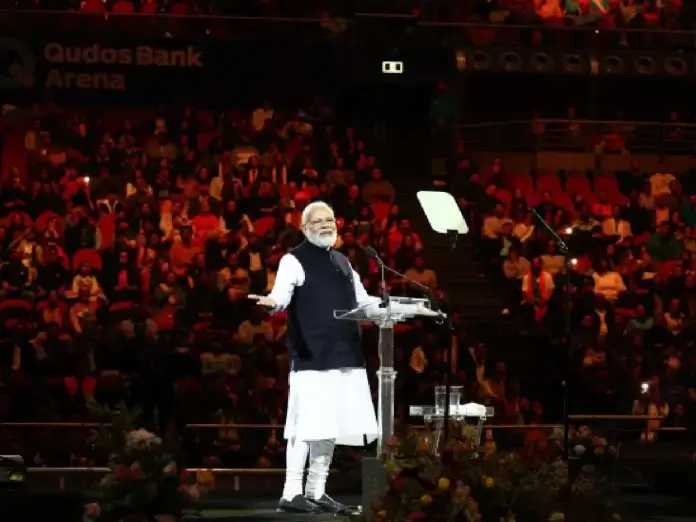
Thousands of fans of Indian Prime Minister Narendra Modi welcome him at Allphones Arena Sydney, Nov. 17, 2014. (AAP Image/Jane Dempster)
His address to the community in his previous visits to Australia in 2014 and 2023, highlighted the growing importance of diaspora engagement in India’s foreign policy.
In 2014, Modi addressed a large crowd at Sydney’s Allphones Arena (now Qudos Bank Arena) during his first visit as Prime Minister.
The event marked a historic moment, as it was his first major outreach to the Indian community in Australia. His speech focused on India’s economic potential, democratic values, and the role of the diaspora as a bridge between India and Australia.
The enthusiastic reception signalled a renewed sense of connection among overseas Indians and set the tone for future engagements.
Australia’s Minister for Foreign Affairs, Senator Penny Wong and India’s External Affairs Minister, Dr Jaishankar and India’s NSA Chief Ajit Doval at the Qudos Bank Modi reception, 2023. (Source: Twitter)
Nearly a decade later, in 2023, Modi returned to the same venue to an even larger and more energetic audience. Over 20,000 people attended, creating an atmosphere often compared to a rock concert.
Anthony Albanese famously remarked that the welcome rivalled that of Bruce Springsteen.
Modi’s speech then emphasised themes such as democracy, diversity, and friendship, often summarised in catchy phrases like “democracy, diaspora, and dosti.”
While the 2014 speech symbolised a new beginning in India-Australia relations, the 2023 address reflected a new maturity and growing strategic alignment.
Three years later, amidst global trade and security uncertainty, PM Modi’s message will be closely heard not only by the Indian diaspora but also by political leadership worldwide.
The name ‘Shakespeare’ almost inevitably comes to mind when we think of literature. Whether on stage or on the page, his works have endured across time: when you consume literature, you inevitably consume Shakespeare, either directly through his works or by means of adaptations and inspired pieces.
With themes of love, power, free will and vengeance, Shakespeare’s plays became universally relevant. Beginning exclusively as performances in theatres, Shakespeare’s plays eventually made their way to the world of movies in 1899 through an English silent film, King John. Indian cinema enters the frame in interesting ways here. Shakespeare’s plays reached India following the English Education Act of 1835 that mandated the use of English Language as the medium for education, and the plays were integrated into the curriculum. Now, with Indian movies having regular roots in Indian epics and inspiration commonly drawn from theatrical forms alongside their staple engagement with high-staked drama, conflict, romance and revenge tales, Indian cinema’s exploration of Shakespeare was almost inexorable.
Recreating, altering and reimagining the original texts, these must-watch movies portray Shakespeare on the big screen with mastery, depth and of course, a perfect touch of Indian cinema’s vibrance.
HAIDER (2014)
Based on Hamlet
Starring: Shahid Kapoor, Tabu, Shraddha Kapoor, Kay Kay Menon
Set against the backdrop of the 1995 insurgency in Jammu and Kashmir, the film follows a a young student and poet, Haider (Shahid Kapoor), who returns to Kashmir to make sense of his father’s disappearance, but soon gets embroiled in the state’s political tension. The film shares plot parallels with the play – a son seeking to avenge his father who was deceived by his uncle, who then married his mother – fusing personal vendetta and political chaos. Hamlet’s iconic phrase uttered in a moment of existential doubt “To be or not to be” is transformed into a political question here amidst a state of crisis “Hum hain ki hum nahin” (Are we, or are we not?). A bold, haunting and intense reinterpretation.
In this adaptation of the tale of the infamous forbidden lovers, the Montague and Capulet clans are recast as two rival Gujarati families, the Rajadis and Sanedas. An opulent and larger-than-life retelling with majestic production designs, this version follows Ram and Leela who fall irrevocably in love but are forced apart by a violent ancient feud raging between their gangster families. Tragic and emotionally intense, the film depicts the sometimes irreconcilable interests of true love and family loyalty, and the consequences that follow.
Two sets of identical twins. One new town. Sounds familiar! In this Bengali adaptation, a merchant (Kumar) and his servant (Bandopadhyay) visit a small town for a business meeting. In a comedic turn of events, they are mistaken for two locals, who happen to be their actual twin brothers whose existence they had been unaware of. Riddled with confusion and plenty of laughter, the film effectively brings the Shakespearean comedy to life in its own unique style.
JOJI (2021)
Based on Macbeth
Starring: Fahadh Faasil, Baburaj, Basil Joseph
In this brilliant Malayalam retelling of Macbeth, Joji (Faasil) is an engineering school dropout who desires to become wealthy without having to work hard. Exhausted from living a life fearing his overbearing and dominating father alongside being prodded by his sister-in-law, Joji murders his father. Driven by his crazed pursuit for freedom and power, his own sins and deceit eventually catch up to him – he and Macbeth shared the same doomed fate. Shakespeare in Indian Cinema
OMKARA (2006)
Based on Othello
Starring: Ajay Devgn, Kareena Kapoor, Saif Ali Khan, Vivek Oberoi, Konkona Sen Sharma
While Shakespeare’s play followed the estrangement of Othello due to skin colour, Vishal Bhardwaj’s adaptation Omkara represents this phenomenon through caste discrimination. Set amid political conflict in rural India, this film recounts the story of Omkara (Devgn) who appoints Kesu (Oberoi) as his lieutenant instead of his loyal right-hand man Langda (Ali Khan), leading to Langda’s rage of jealousy and his subsequent descent as the antagonist. Constructing a vengeful manipulation of Omkara’s thoughts, Langda wreaks a bloody and chaotic tragedy, similar to Othello’s plot. A powerful study of envy, loyalty, love and betrayal, Omkara is an almost verbatim reiteration of the Shakespearean classic, and a must-watch.
ZULFIQAR (2016)
Based on Julius Caesar and Antony and Cleopatra
Starring: Prosenjit Chatterjee, Kaushik Sen, Parambrata Chatterjee, Dev, Nusrat Jahan
A fused adaptation of Shakespeare’s two tragedies, Julius Caesar and Antony and Cleopatra, this Bengali action-crime drama is set in the docks of Kolkata. The film reimagines the Senate as Syndicate, a powerful organisation that illicitly governs the city’s many events. The ascend to dominion of Syndicate’s chief member Zulfiqar (Prosenjit Chatterjee) triggers a fury of jealousy, leading to an unforeseen betrayal by his best friend Basheer (Sen). Following the vengeance for this fatal betrayal by Zulfiqar’s trusted right-hand men Tony (Parambrata Chatterjee) and Markaz (Dev), Akhtar and Laltu Das, the film continues to explore Akhtar’s desire to attain dominance. Director Srijit Mukherjee seamlessly weaves Shakespeare’s other tragedy, Antony and Cleopatra, into the film through the romantic relationship between Markaz and Rani (Jahan). Combining themes of power, loyalty, love and violence, Zulfiqar delivers a high-octane narrative. Shakespeare in Indian Cinema
This Malayalam reinterpretation of Macbeth tells the story of Chandu Chekaver (Kapoor), North Malabar’s legendary warrior. Upon a sorceress’s prophecy that Chandu would become a powerful commander, he gets immersed in a relentless pursuit of dominance and political leverage. Blinded by his maddening ambition, Chandu turns against his own clan and masterminds the downfall of his comrade Aromal (Padmanabhan). Reflecting Macbeth’s tragic end, Chandu’s act of evil leads to his ultimate descent.
In Gulzar’s retelling, two pairs of identical twins who are separated at birth eventually encounter each other years later. Their father Raj Tilak (Dutt) names both his twin sons Ashok (Kumar) and his adopted twin sons Bahadur (Verma). An unfortunate incident divides the family, causing one child out of each twin pairs with Tilak and his wife respectively. When both Ashoks and Bahadurs grow up, they end up in the same city, leading to baffling moments and riots of laughter, making Angoor one of Bollywood’s most iconic comedies. Shakespeare in Indian Cinema
The saga of the ever adored star-crossed lovers travels to the fictional town of Almor in this romantic action film. The Chauhans and the Qureshis are rival families haunted by a legacy of political enmity, yet this friction disintegrates in the hearts of Parma (Kapoor) and Zoya (Chopra) who develop romantic feelings for each other. Despite an initial betrayal, Parma and Zoya’s relationship slowly blooms, but it is heavily opposed by their respective families, pushing them to flee and seek refuge. Wretched and fuelled by emotional intensity, the final standoff stands testament to the devastating pains often experienced by interfaith companions.
MAQBOOL (2003)
Based on Macbeth
Starring: Irrfan Khan, Tabu, Pankaj Kapur, Om Puri, Naseeruddin Shah
This acclaimed reimagination of Macbeth witnesses the Scottish tragedy’s transposition into the Mumbai world of crime. It tells the story of Maqbool (Khan), the right-hand man of Jahangir Khan (Kapur). The Witches from the original text appear in the form of two corrupt policemen (Puri and Shah) who foretell that Maqbool will claim rule over the underworld from his leader. Maqbool and Jahangir’s mistress Nimmi (Tabu) are secretly in love — Maqbool, persuaded by Nimmi and his own desire for power, murders Jahangir and asserts his rule as Don. Haunted by immense guilt and paranoia, Maqbool and Nimmi’s moral corruption turns calamitous for the couple.
QAYAMAT SE QAYAMAT TAK (1988)
Based on Romeo and Juliet
Starring: Aamir Khan, Juhi Chawla, Goga Kapoor, Dalip Tahil
A brilliant take on a romance tragedy, this cult classic narrates the story of Rajveer (Khan) and Rashmi (Chawla) who fall in love, unaware of their families’ enmity resulting from a past dishonour and murder. Rajveer and Rashmi attempt to salvage their relationship, eloping to a deserted fort, but their opposers eventually catch up to them. Succumbing to fierce familial restrictions, the lovers meet their deadly fate. QSQTeffortlessly mirrors the classic play in its passion and intensity. Shakespeare in Indian Cinema
Stop me if you’ve heard this one before; a comedian called Mark Silcox walks on stage at a comedy club in England to tell some deadpan, self-deprecating jokes.
Except the person who walks on is a mild-mannered middle-aged Indian science teacher, and the jokes are meandering anti-humour lectures told with straight faced sincerity and a desi uncle accent.
“[There’s] complete separation from my personal feelings and what I want to present as a character,” Silcox explains.
“I build up lots of expectation and people can see there’s nothing behind it… that’s where the funny bit comes.”
It’s this dissonance between expectation and reality which Mark Silcox (obviously a stage name) has playfully mined since 2008, where he first created the persona as part of a comedy course at London’s adult education college CityLit.
“I was watching a documentary, and they were saying you don’t have to be born funny to become a comedian. I was 45, looking to experiment, so I did that course; it was funny because there were lots of actors doing really serious stuff about comedy, and I just couldn’t relate to any one of them, so I developed my own style of comedy – not telling jokes, just talking rubbish,” he says.
With a love of ‘winding people up’, Silcox’s unique style is antithetical to the current wave of lively, Vir-Das-esque social commentarians, or the observational hopscotch of British contemporaries like Russell Howard.
“In the textbook they will teach, you have to do this, you have to keep the energy high; I just ignore all those warnings and do whatever I like,” he says.
“I’m not solving any world problems; I just want to have fun and wind people up.”
It’s a comedic voice that’s both anomalous, and in the words of peer Paul Chowdhry ‘very British’; blunt, dry, subdued, and unlikely to translate back home in India.
“It takes time for a nation to develop the style of comedy; in India, comedy is relatively new. So everybody is copying the same style – the sharp joke, acting out your punchline, the energy, filling the room with your voice. People get kind of used to that, then someone does something completely different, and they remember it,” Silcox explains.
Mark Silcox is obviously a stage name… (Source: Supplied)
Uncle Shady
“When I started doing comedy, none of the Asian comedians were doing my style of comedy; [the audience] actually relate to me more than other comedians, and because of the name, they remember me better.”
Silcox’s irreverent nonsense, as seen in his Channel 4 series ‘An Immigrant’s Guide to Britain’, isn’t for everyone – but Silcox wears his one-star reviews as a badge of honour, inspired by Steve Martin and the niche stylings of his friends Sam Campbell and Aaron Chen.
“Steve Martin’s comedy style was very loose; he’d say ‘I don’t want to push you, laugh [at] whatever you want’. I think I get a similar kind of response, sometimes they’re laughing,” Silcox says.
Nonetheless, it’s a persona that has charmed audiences across the globe, and after reaching the finals of the BBC New Comedy Awards in 2013, Mark Silcox has gone from strength to strength with his show-stealing turn as Uncle Shady in Guz Khan’s comedy-drama Man Like Mobeen, as well as roles in Channel 4’s Joe Lycett’s Got Your Back, and absurdist comedy series Mandy.
Despite being thrust into the spotlight through his silver screen appearances, Silcox isn’t concerned about reaching comedy stardom, having already achieved a successful career in science, including a PhD from Imperial College London and multiple journal publications.
“For me, [comedy’s] always been a hobby…I don’t have to prove my intelligence ’cause I have paper qualifications,” he says.
“Comedy is just like a paid holiday; I’m a science teacher, so I get paid from the school and I use my holiday to do comedy. I have a lot of respect for those who choose comedy as a career, because I know how hard it is for them to get a regular income.”
Instead, he appreciates having some distance between his home life and comedy persona.
“I invite my wife when I’m doing a panel show or some acting, then I will take her to the set to show things; but my stand-up comedy is so bad, I don’t want anybody to see it!” he says of showing his family his work.
This month, he brings his latest show “The Successful Gold Trader” to Melbourne’s Motley Wherehaus for the Comedy Festival. It’s one of the rare occasions the Bhopal-born Silcox has performed outside of the UK.
Based on his own experiences investing in the lead up to his retirement, the show takes the form of a dubious PowerPoint seminar told with a ‘somewhat charming yet deadpan delivery’.
“I wouldn’t be able to do this comedy in India, because people will demand – you haven’t worked hard, written some jokes, so what are you doing here on the stage?”
“So I haven’t gigged in India; it will take some time for the comedy [scene] to become more mature, [and for] people to want to explore more. That’s what happened in America, where Steve Martin started doing this kind of anti-comedy there.”
Content with his own pace, Mark Silcox, 62, looks forward to his retirement in five years, during which time he hopes to do as much comedy as he can.
“I don’t think I have struck comedy gold, but I’m having fun.”
For many families, a girl’s first period is a milestone that arrives with a mix of pride, awkwardness and concern. But for parents of autistic girls, it can bring something more intense: fear.
Fear that she may not understand why she is bleeding. Fear that she may panic at school. Fear that a pad may feel unbearable against her skin. Fear that mood or behaviour changes will be misunderstood. Fear that poor understanding of privacy and body boundaries may place her at greater risk of harm.
These fears are real, yet they are rarely discussed openly.
In many Indian families, periods are still wrapped in silence, embarrassment or half-explanations. But autistic girls usually need the exact opposite. They need clear words, early preparation, repeated teaching and practical support. For them, menstruation may not be “just a period.” It can be a sensory, emotional and social challenge all at once.
That is why this conversation matters.
Don’t wait for the first period
Most girls begin menstruating between the ages of 9 and 15. For parents of autistic girls, that means one thing: preparation should begin early.
If an autistic girl suddenly sees blood in her underwear without warning, she may not think, “This is normal.” She may think she is injured, frightened or in trouble. The first experience can become distressing very quickly if nobody has explained what is happening.
Preparation should begin early (Source: Canva) for autism and menstruation
The best approach is not one uncomfortable “big talk,” but many small, calm conversations over time. Explain that periods are a normal part of growing up. Explain where the blood comes from, how long it may last, and that it will happen again every month. Use simple, direct language. Pictures, visual charts and step-by-step routines can help more than vague explanations.
For autistic children, predictability reduces fear. Preparation builds confidence.
Why periods can feel harder for autistic girls
Periods can be difficult for any teenager, but autism can make them feel bigger, heavier and harder to manage.
Some girls are very sensitive to touch, smell or dampness. A sanitary pad may feel scratchy, bulky or uncomfortable. The smell of blood may be overwhelming. Stained clothing may be upsetting. Stomach cramps may feel stronger or be harder to describe. Even getting used to a new routine can be exhausting.
Periods can also affect behaviour. A girl who is usually calm may suddenly become irritable, withdrawn, tearful or overwhelmed. Some may have meltdowns; others may shut down. Some may appear restless or angry without being able to explain why.
This is not bad behaviour. It is often distress, discomfort and confusion showing themselves in the only way the child can express.
Hygiene needs to be taught clearly
One of the biggest mistakes adults make is assuming girls will naturally know how to manage periods. Many autistic girls need these skills taught clearly, step by step, just like any other important life skill.
Parents may need to show how to open a pad, where to place it, when to change it, how to wrap and dispose of it, how to wash hands properly, and how to clean the body if there is leakage. Some girls may need repeated practice before they feel comfortable.
It also helps to teach body care around puberty more broadly. Bathing, changing clothes, washing underarms, managing body odour and understanding personal hygiene may all need extra support during this stage.
The goal is not only cleanliness. It is dignity, comfort and growing independence.
Comfort matters more than habit
There is no single perfect period product for every girl.
Some girls will manage well with disposable pads. Others may find period underwear much more comfortable because it feels closer to normal clothing. Some may prefer softer fabrics or different styles. What matters most is not what adults assume should work, but what the girl can tolerate and manage.
If one product causes distress, try another. If she dislikes the feel of pads, explore alternatives. If she is sensitive to the sight of blood, darker products or period underwear may feel less confronting. Period care should be adapted to the child, not forced in one rigid way.
When comfort improves, cooperation often improves too. for autism and menstruation
Pack before panic happens
School is where many parents worry most. Busy bathrooms, noise, embarrassment, fear of leaking and not knowing whom to ask for help can all make periods harder.
Keep a small period pouch in your daughter’s school bag (Source: Canva) autism and menstruation
A simple school plan can make a huge difference. Keep a small period pouch in your daughter’s school bag with spare pads or period underwear, clean underwear, and a bag for soiled clothes. Show her exactly where it is. Practise what she can do if bleeding starts at school. Some girls may benefit from a simple visual reminder card.
It is also wise to identify one trusted adult at school, a teacher, aide or wellbeing staff member , so your daughter knows exactly whom she can approach without fear or shame.
Many autistic girls cope better when the response is planned.
Behaviour changes need understanding, not blame
Parents often notice emotional or behavioural changes before a period begins. A daughter may become more sensitive, more tired, less patient or more easily overwhelmed. If the family does not recognise the pattern, the behaviour may be mistaken for defiance.
Tracking the menstrual cycle can help parents anticipate what is coming. A simple calendar or app can help connect mood changes, tiredness, discomfort or meltdowns with the timing of periods. This allows families to respond with more compassion and less frustration.
Sometimes the child herself does not know why she feels “different.” When adults understand the pattern, they can reduce demands, offer comfort and avoid unnecessary conflict.
Social rules are often invisible
Periods come with many unspoken rules. Change your pad discreetly. Hide stains. Don’t talk loudly about bleeding. Ask for help quietly. Keep it private.
The message should be simple: your body is normal, you are safe, and we will help you learn. (Source: Canva)
But autistic girls may not pick up these social expectations on their own. They often need direct teaching about privacy, bathroom routines, stained clothing, asking for help, and what can be said in public versus private.
If something matters, it should be taught clearly. Never assume she will just “pick it up.”
Periods also bring a safety issue in autism and menstruation
Puberty is not only about periods. It is also the time to strengthen teaching around body safety, privacy and boundaries.
Autistic girls can be more vulnerable if they do not fully understand private body parts, consent, safe touch and unsafe touch, or who is allowed to help with intimate care. Parents should teach these ideas calmly and clearly. Explain which parts of the body are private, when the bathroom door should be shut, who can help if needed, and when to tell a trusted adult immediately.
These conversations can feel uncomfortable for families, but silence does not protect children. Clear teaching does.
Less shame, more support
In many homes, menstruation is treated as something secret or embarrassing. But autistic girls need openness, reassurance and practical guidance. They need to hear that periods are normal, that help is available, and that they are not doing anything wrong.
The message should be simple: your body is normal, you are safe, and we will help you learn.
For autistic girls, support during menstruation is not just about managing bleeding. It is about comfort, dignity, confidence, self-care and protection. And for parents, the goal is not perfection. It is preparation. for autism and menstruation
Because when families prepare early and respond with patience instead of panic, a frightening milestone can become a manageable part of growing up.
This year’s Adelaide Fringe was different. The iconic arts festival where thousands of performances compete for attention, the presentation ‘We Belong’ did something rare – it made audiences stay back in silence, then speak. Not just about poetry, but about memory, erasure, caste, Country, and the uneasy inheritance of language.
When the spoken word performance ‘We Belong’ won the 2026 Award for Excellence in Poetry, it marked a milestone for an India-Australia collaboration. But for its director Tess Joseph, the recognition pointed to something deeper: that poetry, when held with care, can carry histories across continents – and still feel intimate.
Bringing together Australian First Nations poet Dakota Feirer and Indian Dalit poet Aleena Sabu, ‘We Belong’ creates a live dialogue between two marginalised histories – without collapsing their differences. The show is created by Kommune, a Mumbai-based creator collective.
‘We Belong’ won the 2026 Award for Excellence in Poetry (Source: Supplied)
How the idea took root
For Tess, the project began not as a production, but as a feeling.
“I start my days with poetry,” she tells Indian Link. “It’s something my Amma began with me, and it has stayed like a quiet ritual, a way of listening to the world before all the talking begins.”
That instinct sharpened a few years ago while moderating a panel with First Nations poet Kirli Saunders. What she heard echoed something she already knew from Dalit and Adivasi writing – particularly from Aleena and poets like Jacinta Kerketta.
Different lands, but a shared pulse of land, identity, memory, and resistance.
“That’s when the idea first began to take shape: what would it mean to bring these voices together in conversation?”
By the time she arrived at Adelaide Fringe in 2025, the idea had found direction.
When funding opened up, ‘We Belong’ became the proposal she had to write.
“It began as a concept, but I trusted that if we brought the right artists together, something truthful would emerge. And it did.”
English language, a bridge and burden
At the heart of ‘We Belong’ lies a central tension: English as both bridge and burden.
Tess deliberately places Aleena’s ‘My English’ alongside Dakota’s ‘English is my foster home’, forcing the audience into discomfort from the outset.
“English as access, but also as violence, as inheritance, but it not being the language that runs in our veins,” she explains.
Rather than smoothing this contradiction, the performance leans into it.
“We made deliberate choices to rupture English. Aleena’s ancestral Malayalam chant enters the second segment of the show as an invocation before comprehension. Its meaning is offered after it is sung.”
When the performance finally came together, something clicked. (Source: Supplied)
Through oral traditions – whale songlines, Pulaya cosmology, grandmother memory – the work reclaims spaces that existed long before English.
“So English becomes the bridge, but never the root.”
A stellar performance built across distance
In November 2025, the team began meeting weekly on Zoom, building trust, exchanging stories, and slowly shaping the work.
“The structure emerged like a journey, not a framework,” Tess says.
The narrative moves from language to myth and origin, then into lineage and water, before arriving in the present – where borders, visas, and bureaucracy complicate belonging.
Then came the challenge: the team met in person just one day before the actual show.
“We had one day. Four runs in my hotel room and one on stage rehearsal only. Jet lag wasn’t on the call sheet!”
Yet when the performance finally came together, something clicked.
“I still remember the first time we performed the duet in person. Suddenly – it landed! It was relief but also felt like ‘an arrival’.”
When two worlds meet
For Dakota Feirer, the show’s tone was set by “a provocation of solidarity across oceans”.
At its core was a question: “if two of our ancestors met, what would they say to one another?”
The answer unfolds through a dialogue that connects, but does not collapse, Dalit and First Nations experiences.
“’We Belong’ is also one of a kind in terms of a storytelling exchange between Dalit peoples and First Nations Australian peoples,” Dakota says.
“The specificities are different, but the realities often mirror each other,” Aleena adds. “We did not merge experiences, we allowed them to stand alongside one another in conversation.”
Courtrooms in India are rarely quiet. They are almost like chaotic characters. They gossip, they stall, they erupt, they decide fates. Netflix series Maamla Legal Hai Season 2 taps into this chaos with a little more heart, a little more self-awareness, and just enough madness to keep you hooked.
Set once again in the gloriously dysfunctional Patparganj District Court, Season 2 leans into what worked the first time. Quirky, almost unbelievable cases drawn from real life and then stretched to make it a bit OTT (over the top) for OTT (platforms). The show reminds you early on that truth, in Indian courts, is often stranger than fiction.
Cast: Ravi Kishan, Naila Grrewal, Nidhi Bisht, and Kusha Kapila
Rating: ★★★☆☆
From petty disputes to morally tangled cases, the series never tries to sermonise. Instead, it lets the absurdity of the system do the talking. And in doing so, it quietly slips in commentary on power, gender, trust, and the grey zones of justice.
It’s a show about people trying to survive the law.
Ravi Kishan with a gavel and gravitas
The biggest narrative pivot this season is Ravi Kishan’s V.D. Tyagi moving from lawyer to judge. It’s a shift that could have flattened the character, but instead, it adds a delicious tension.
Tyagi is now expected to embody restraint but instinctively remains a man of jugaad. Watching him negotiate this internal tug-of-war is where the show finds its sharpest humour and its most surprising emotional beats. Kishan plays this duality with ease. He doesn’t overplay the authority, nor does he abandon the street-smart chaos that made Tyagi memorable.
The women hold the room
Nidhi Bisht’s Sujata Negi continues to be the spine of the narrative. She is sharp, messy, and deeply human. She’s not here to be liked, she’s here to win. Enter Kusha Kapila as Naina Arora, the Harvard-returned disruptor who brings both rivalry and reflection. Her dynamic with Ananya (Naila Grewal) and their ego tussle makes it further interesting. The show smartly avoids turning its women into moral anchors. Instead, it lets them be flawed, ambitious, sometimes petty, and, therefore, real.
The humour still lands… mostly
What continues to work is the writing’s ability to mine humour from the mundane. A cough during an oath, a bizarre civil dispute, a client who makes no sense – more than punchlines, it is the lived realities that have been successfully turned into situational comedy by the writers.
But the season isn’t airtight. There are moments when it leans too heavily into Tyagi’s emotional arc, slowing down the otherwise brisk, episodic rhythm. The tonal shifts from comedy to melodrama don’t always blend seamlessly.
And yet, the show recovers quickly. Because it understands one thing: its strength lies in its ensemble and its world.
A courtroom that feels lived-in
What makes Maamla Legal Hai 2 quietly addictive is its ecosystem. The Patparganj court is a messy, crowded, unpredictable character. Lawyers hustle, clerks linger, clients overshare, and somewhere in the middle of it all, justice happens. There’s no glossy heroism here. Just a system trying to function, and people trying to function within it.
Season 2 doesn’t reinvent the wheel, and perhaps it doesn’t need to. It sharpens what already worked: humour rooted in reality, characters that feel like people you’ve met, and a legal system that is as chaotic as it is compelling. It falters in parts, especially when it tries too hard to feel important. But when it relaxes into its own absurdity, it’s a delight.
Because in Maamla Legal Hai, justice may be blind, but it’s also sarcastic, slightly confused, and running late.
Dr Prabhat Raj Sinha was born in Gwalior, India, and migrated to Australia in 1973 in pursuit of new horizons. He began his medical career in Australia as a Senior Medical Officer with the Health Commission of NSW in Sydney, serving until April 1975, after which he established his own private practice. As the founder of Strathfield Plaza Family Medical Practice in Strathfield, he devoted over five decades to delivering compassionate, high-quality medical care. His warmth, gentle manner, and reassuring presence earned the trust of generations of patients, many of whom travelled long distances to seek his care. He also served on the Medical Panel of the Indian Consulate and several insurance companies.
A proud Indian Australian, Dr Prabhat Sinha became an Australian citizen to fully participate in the life of his adopted country. A firm believer in multiculturalism and social cohesion, he dedicated himself to upholding the values of parliamentary democracy, rule of law, equality, and compassion. Together with his wife, Mrs Neena Sinha, he raised two children Piyush Raj Sinha and Pallavi Sinha in Australia while preserving and promoting Indian cultural traditions, languages, and heritage.
Dr Sinha as the President of the United Indian Association (Source: supplied)
Dr Sinha’s contributions to community life were extraordinary in both scope and impact. As Founder and President of Sri Mandir in Auburn, he played a pivotal role in establishing one of the first Hindu temples in Australia. Through his efforts, the temple grew into a vibrant centre for religious, cultural, and social activities. He also initiated “Navrang,” an annual cultural programme to promote Indian performing arts and encourage youth participation.
As a Founder Member and Past President of the United Indian Association (UIA), he strengthened community engagement by establishing forums for youth, women, and senior citizens. In 2006, as President of UIA and Director of the India Australia Fair at Sydney Olympic Park, he led a landmark event attended by over 20,000 people, fostering cultural exchange and unity among diverse communities. He also initiated the involvement of other ethnic and faith communities (such as the Chinese and Polish communities) by inviting them to participate in cultural activities of the Fair. This resulted in better interaction and appreciation of different cultures.
Dr Sinha at the Opera House Diwali Celebration (Source: Indian Link)
His community involvement extended widely. He served on Strathfield Council’s Multicultural Committee, founded Strathfield Australians of Indian Sub-Continental Heritage Inc., and helped organise the first Deepavali celebrations in Strathfield. As part of the Deepavali Celebration Committee of NSW Parliament, he helped in the organisation of Deepavali festival, illumination and installation of a plaque in the NSW Parliament. As a Founder Member and Vice President of Hindi Samaaj, he promoted Hindi language education. Dr Sinha was one of the Founders of Kayasth Vahini Association which was instrumental in helping children to retain their culture. He also contributed to healthcare advocacy as Vice-President of the Overseas and Australian Medical Graduates Association. As International Services Director Rotary Club of Strathfield, he raised significant funds for healthcare and the elderly. He also served as Worshipful Master of the Masonic Lodge.
His outstanding service was recognised through numerous accolades, including Inner West Business Awards for his medical practice and a Premier of NSW Government Award for Community Service.
Dr Sinha passed away in his beloved homeland India, and his ashes were immersed in the Ganges by his family. Even on his plane trip to India, his commitment to community service was exemplified by provision of medical care, in response to a request for help on the plane. Dr Sinha was deeply devoted to his family, his profession, and his community. He embraced every opportunity to serve, to bring people together, and to uplift those around him. His enduring legacy is one of kindness, humility, compassion, and unwavering dedication. He is fondly remembered by his wife, his children and their spouses and his grandchildren, and the wider community for his gentle smile, his high standard of medical care and tireless service, and the profound difference he made in the lives of so many.
Dr Sinha with wife Neena (Souce: Supplied)
Throughout his life, Dr Prabhat Sinha exemplified integrity, quiet strength, and a steadfast commitment to doing what was right.
As a cherished member of our community, he always offered his support with characteristic generosity and sincerity, and spoke thoughtfully about the importance of integrity and principled leadership.
His was a life lived with purpose, courage, and compassion. His achievements stand as a testament to his dedication, vision, and lasting contribution to our community.
The Sinha family will be holding a Shraddhanjali and Celebration of Life service to honour and remember Dr Sinha on Saturday 25 April at 3:00 PM. This Service will provide family, friends, and community members an opportunity to come together, pay their respects, share memories, and celebrate a life so meaningfully lived in service of others.
As places are strictly limited, for further details regarding the Service, attendees are kindly requested to contact Pallavi Sinha directly on 0410546685.
Did Krishna, Rama, Shiva, Hanuman – and so many others – ever truly exist? One wonders. Perhaps they live not in history, but in the vast landscape of our spiritual imagination. And yet, through music and dance, they are made vividly, almost tangibly real. When movement, melody, and costume align with meaning and intent, these figures step out of myth and stand before us. It was this thought that stayed with me as I watched Nanadana Nithin’s arangetram at NIDA, Sydney, late last month.
What stood out during the performance were the many evocative poses of Krishna, Rama, Shiva, and Hanuman that Nandana embodied throughout her recital – often balancing gracefully on one leg, holding each form with striking poise and control. Added to these were the dramatic scenes she created with her skilful abhinaya: Krishna’s birth, Poothani Samhara, Kalinga Mardhana, the rendering of Bhagavath Geetha, and Krishna’s assurance to us as “Yadha yadhahi dharamsya glanirbhavathi Bharata, Sambhavami yuge yuge.” [Whenever and wherever there is a decline in righteousness (Dharma), O Bharata (Arjuna), and a predominant rise of unrighteousness – at that time I manifest Myself on earth.]
Poise in stillness, power in pose (Source: Supplied)
Turning to the Ramayana, we witnessed Lakshmana drawing the Lakshmana Rekha around Sita, the episode of Sita Apaharana, Jatayu’s valiant struggle, and a playful, humble Hanuman dancing about – to name just a few of the many moments brought to life.
Bharatanatya is a seamless blend of abstract nritya and expressive abhinaya, and Nandana excelled in both. Throughout the recital, she was given ample scope to showcase her command of mudras and the nuanced movements of the neck, eyes, and limbs through intricate jathis. She moved with striking agility across the stage – in one moment poised in a corner, and in the next, fluttering elsewhere like a butterfly.
Nandana started her recital with the usual Pushpanjali, ending in Kamakhya Shlokam. With brilliant footwork she showed that she has learnt the art well and compelled us to join her in her journey.
The next item, addressed to the Lord Muruga and set to Shanmugapriya raga, was enlivened by the majestic vocal rendering of Balasubramanya Sharma. Words, rhythm, music all worked in unison towards a unique experience for the audience. It ended in a visibly grand finale. The item Ras Leela, portraying love between Radha and Krishna also provided such an experience.
Mid-recital, fully immersed in the rhythm and emotion of her performance. (Source: Supplied)
Varnam is the piece where the dancer is tested for his or her stamina, imagination, craftsmanship and dance skills. The item chosen was Krishna portraying various aspects of his personality – stealing butter as a child, killing demons, as lover for hundreds of gopikas, driving the chariot for Arjuna (Partha Sarathy) and giving an assurance to mankind that He will preserve Dharma and righteousness in the world. It appeared as if the chosen raga Reethigowla was created for Him. Throughout this number, which took almost 45 minutes, Nandana exhibited her craft in pure dance as well as abhinaya.
Nandana with her guru Manjula Viswanath (Source: Supplied)
In Pradosha Samayadi, Nandana took on the role of Shiva with remarkable control and intensity. A striking moment was her sustained wink, held steadily for over two minutes. She followed this with a sequence of thirty-two uninterrupted poses of Shiva, all performed while balancing on one leg – a testament to both her stamina and precision.
The performance also included a Thillana (in Athana Raga), the enchanting Pibare Ramarasam, and concluded with Managalam.
At the conclusion, the 19-year-old debutante Nandana Nithin, a student at Macquarie University, expressed quiet satisfaction of having achieved something significant – a true milestone in her dance journey. The audience, too, felt they had spent an evening well, and offered warm appreciation and blessings to the young artiste.
Nandana, the daughter of Sandhya Sugathan and Nithin Salgunan, is a student at Manjula Viswanath’s Rasika Dance Academy. Founded in 2001, the Academy has now completed 25 years of dedicated service to dance, nurturing numerous students while also extending its support to a range of charitable causes. It is heartening to note that twenty five of its students had completed their arangetrams and salangai poojas. Recipient of various awards, Guru Manjula herself has given over one thousand performances all over the world.
Nandana Nithin with her ensemble of musicians (Source: Supplied)
Nandana’s performance was supported by a team of musicians. The Bangalore-based Balasubramanya Sharma, most sought after, provided vocals – which at times reverberated in the auditorium and heightened the dance experience. The most essential mridanga support was given by the locally generated talent Janakan Suthanthiraraj, who seemed to enjoy himself, cleverly changing the tone of playing to suit the mood. The multi-talented Jeiram Jegathesan played the ghatam, morsing as well as the rhythm pad. He excelled in the Varnam with his haunting Morsing background. Venkatesh Sridharan played the flute melodiously, also presenting a solo item. Guru Manjuala gave a varied nattuvangam. She choreographed every item in the recital. Impressive lighting enhanced the experience, and the charming Sangarika (Manjula’s daughter) did an outstanding job as the MC.
Nandana’s family had made excellent arrangements for the event which included refreshments in the beginning, and dinner during the interval.