



Modi visits down under
While an official announcement is still pending, it is expected that PM Modi will be in Australia on 8 July for 48 hours after his first ever visit to New Zealand in the preceding two days.
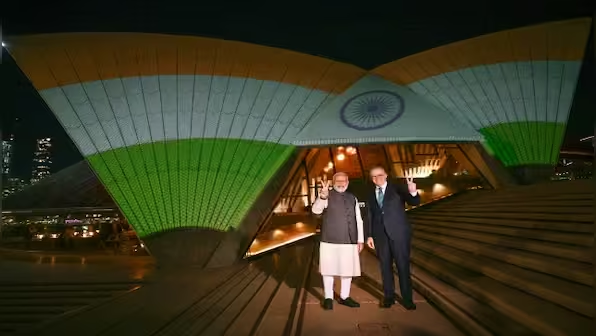
This will be his third visit to Australia. His previous visits in 2014 and 2023 were hailed as landmark diplomatic visits with PM Albanese introducing PM Modi as the Boss and the Sydney Opera House illuminated in the tricolour.
However, uncertainties on the world stage continue to remain a caveat.
“Of course, we need to be mindful about the fast-changing global geopolitics which can cast a shadow over any planned visit, but at the moment, it is all systems go on the visit,” said a source who did not wish to be identified.
No official announcement has yet been made by the Australian Dept of Foreign Affairs and India’s Ministry of External Affairs or its Ministry of Trade and Commerce. It is expected that details will be officially confirmed once the new Indian High Commissioner Nagesh Singh takes up his role this month.
This visit down under, should all go according to plan, will start with a visit to New Zealand on 6 July.
It was 40 years ago that an Indian Prime Minister last visited New Zealand.
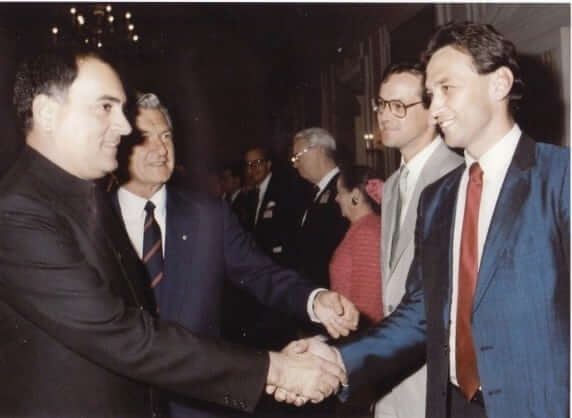
Prime Minister Rajiv Gandhi travelled to Wellington in 1986, at a time when global politics were defined by nuclear tensions and ideological blocs. That trip was shaped less by trade and more by shared principles. New Zealand had just declared itself nuclear-free, straining ties with traditional allies, while India championed global disarmament as a leader of the Non-Aligned Movement. The visit underscored common ground on anti-nuclear policy and independent foreign policy thinking, even though economic engagement remained limited.
Should PM Modi’s visit go ahead, India-NZ ties are poised for a reset after nearly four decades, reflecting how geopolitics and priorities have evolved since the Cold War era.
During the PM’s visit to NZ, it is expected that the Free Trade Agreement (FTA), will be formally signed. The two countries concluded FTA negotiations in late 2025 after years of stalled talks, marking a major step forward in bilateral relations.
Once implemented, the FTA is expected to significantly boost trade by reducing or eliminating tariffs on a wide range of goods and services. It will likely benefit sectors such as agriculture, technology, education, and services, while also improving market access for businesses on both sides.

Earlier negotiations between 2010 and 2015 had failed, mainly due to disagreements over agriculture, particularly dairy. The renewed progress reflects changing economic priorities and a growing interest in strengthening ties in the Indo-Pacific region.
The Indo-Pacific has emerged as a central arena of global competition and cooperation, bringing countries like New Zealand into sharper strategic focus for India. Both nations share concerns about regional stability, supply chain resilience, and the need for diversified partnerships.
Another key shift is the rapid growth of the Indian diaspora in New Zealand. Once relatively small, this community has become economically and politically influential, adding a new dimension to bilateral ties. At the same time, trade discussions have regained momentum, with both sides interested in unlocking opportunities in agriculture, education, technology, and services.
Despite these positive signals, challenges remain. Geographic distance, limited trade complementarities, and differing regulatory frameworks continue to slow progress. Yet the broader trajectory suggests renewed intent.
As both countries navigate a more complex global order, the absence of a prime ministerial visit since 1986 stood out as an anomaly.
PM Modi’s 2026 visit would not only be symbolic but could also mark a turning point – transforming a historically cordial relationship into a more strategic and economically meaningful partnership.
After two days in New Zealand, PM Modi is expected to arrive in Australia on 8 July to spend two days in Sydney.
At a time of challenging international issues, it is expected that the discussions will be on strengthening the Indo-Australian relationship.
It is to be noted however, PM Modi’s planned visit comes amid signs of strain within the Quad grouping, which also includes the United States and Japan. While leaders continue to emphasise cooperation, differences over strategic priorities and global alignments have slowed momentum.
Items high on the agenda will be trade in critical minerals, and also, a focus on the ongoing need of Australian capital for India’s infrastructure development. Both PM Modi and PM Albanese have framed this as a mutually beneficial partnership – supporting India’s growth ambitions while providing Australian investors with access to one of the world’s fastest-growing major economies.
However, taken together, Modi’s visits and Albanese’s outreach to India highlight a maturing partnership – one that remains resilient bilaterally, even as broader regional frameworks face growing uncertainty.
Away from politics, what the Indian diaspora here would be looking forward to, would be another opportunity to hear directly from Mr Modi.
With only 48 hours or less in Sydney, odds are shortening that his address to the Indian diaspora will be on 8 July.

His address to the community in his previous visits to Australia in 2014 and 2023, highlighted the growing importance of diaspora engagement in India’s foreign policy.
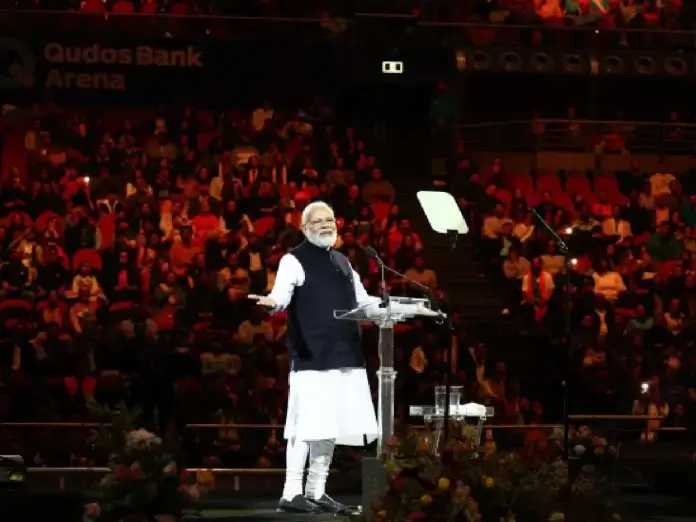
In 2014, Modi addressed a large crowd at Sydney’s Allphones Arena (now Qudos Bank Arena) during his first visit as Prime Minister.
The event marked a historic moment, as it was his first major outreach to the Indian community in Australia. His speech focused on India’s economic potential, democratic values, and the role of the diaspora as a bridge between India and Australia.
The enthusiastic reception signalled a renewed sense of connection among overseas Indians and set the tone for future engagements.

Nearly a decade later, in 2023, Modi returned to the same venue to an even larger and more energetic audience. Over 20,000 people attended, creating an atmosphere often compared to a rock concert.
Anthony Albanese famously remarked that the welcome rivalled that of Bruce Springsteen.
Modi’s speech then emphasised themes such as democracy, diversity, and friendship, often summarised in catchy phrases like “democracy, diaspora, and dosti.”
While the 2014 speech symbolised a new beginning in India-Australia relations, the 2023 address reflected a new maturity and growing strategic alignment.
Three years later, amidst global trade and security uncertainty, PM Modi’s message will be closely heard not only by the Indian diaspora but also by political leadership worldwide.