


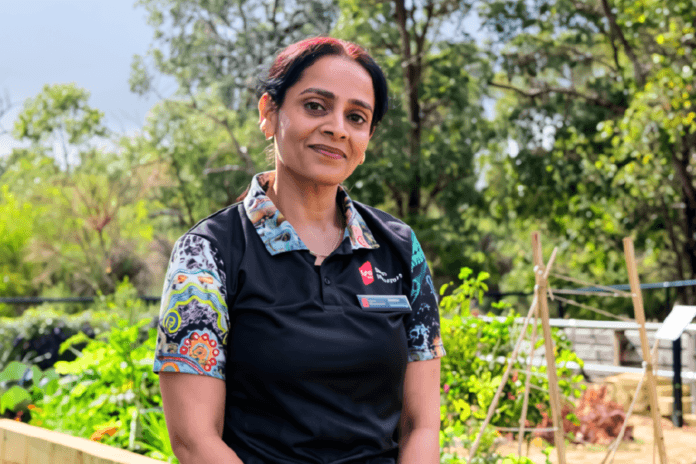

Her first science classroom was a small farm in Gujarat.
Long before Dr Neha Umaretiya was using high-tech systems to teach the next generation of agricultural workers in Western Australia, she was watching crops grow in Gujarat.
“Farming was never an abstract concept,” she says, “It was part of everyday life.”
She became curious about why plants grew well under certain conditions and how science could improve their growth and productivity.
That curiosity led her to horticultural science and a PhD, and later to Australia, where her career has moved between horticulture, education and agricultural technology.
Last month, that journey earned Dr Umaretiya the 2026 People’s Choice Award at the WA Premier’s Science Awards. The award recognises the finalist who received the highest number of valid public votes.
Dr Umaretiya has spent 15 years bringing Industry 4.0 technologies into vocational training. Today, as an Advanced Skills Lecturer at North Metropolitan TAFE, she uses an automated hydroponic greenhouse, cloud-connected sensors and a digital twin to teach students how technology can change the way we grow plants.
Horticulture meets high-tech
But for Dr Umaretiya, technology is not a departure from the farming she knew in Gujarat. It is an extension of the same curiosity that began there.
“For me, the transition was a natural extension of horticulture rather than a move away from it,” she tells Indian Link.
Modern horticulture, she says, increasingly requires workers to understand data, monitor environmental conditions, automate processes, and make informed decisions. The classroom, in her view, has to keep pace with that changing workplace.
She developed the automated NFT hydroponic greenhouse, which brings those ideas together. Sensors monitor pH, electrical conductivity, dissolved oxygen, temperature, flow, and pressure. The information is connected through cloud technology, while a digital twin provides a visual representation of how the system is operating.
“A conventional greenhouse is an excellent learning environment because students can observe plants, inspect their condition and learn how to manage a growing system. What our technology adds is the ability to connect those observations with live environmental data and a digital representation of the system.” Dr Neha Umaretiya
For students, the value is not simply learning to operate new equipment.
“The real value is in developing students’ ability to interpret information and make evidence-informed decisions,” Dr Umaretiya explains. “Rather than simply following instructions, they can ask questions, investigate patterns, identify potential problems and consider what action may be appropriate.”
“The digital twin does not replace hands-on horticulture. It strengthens it by helping students connect what they see in the greenhouse with the data behind it,” she informs.
That balance is important to Dr Umaretiya because she is wary of the idea that technology automatically equals progress.
“A sensor may provide accurate data, for example, but the farmer still needs to understand what that data means and what action to take,” she points out.
What India, Australia can learn from each other
The same principle applies when comparing farming systems in Australia and India.
Having grown up on a farm in Gujarat, Dr Umaretiya understands that the most useful technology for a small farmer may not be the most sophisticated. An affordable tool that helps monitor irrigation, identify a pest or improve water efficiency could be more useful than an expensive automated system requiring specialist support.
“We should not assume that innovation must always be expensive or complex,” she notes.
She believes Australia and India can learn from each other: Australia has experience in precision agriculture, advanced irrigation management, biosecurity and technology integration, while India’s small-farm experience highlights resourcefulness, local knowledge and solutions designed around individual growers.
For Dr Umaretiya, the future agricultural worker needs to be more than technically competent.
“Students need strong practical skills, but they also need to be confident using technology, interpreting information, communicating with others and solving problems in unfamiliar situations,” she adds.
Her work also extends beyond the classroom. She collaborates with industry, government and Aboriginal communities to help shape training around real workforce and environmental needs, including biosecurity, water management, biodiversity and urban greening.
“Vocational education must remain connected to the industries, communities and environments it serves,” she says.
The People’s Choice Award has given that work to a wider audience. Dr Neha Umaretiya
“I felt incredibly grateful and humbled,” she says, continuing, “For me, this recognition was not just about individual achievement. It was also an opportunity to bring greater visibility to horticulture, vocational education and the important role TAFE plays in science, technology and innovation.”
View this post on Instagram
Her message to young people from farming families in Gujarat is simple: “Never underestimate where you come from.”
“Growing up on a small farm is not a limitation; it can be a wonderful foundation for understanding the natural world, asking questions and identifying problems worth solving,” she signs off.
READ ALSO: The shelf life scientist: Prof Zora Singh wins world honour in horticulture