


Every January, millions of people promise themselves they will exercise more, eat better and finally get serious about their health. For a while, some might even follow a workout schedule, track their meals or download a fitness app. Then work gets busy, family commitments take over, motivation dips, and the new year resolutions quietly disappear.
“There is a gap between intention and action,” she tells Indian Link. “People genuinely want to change, but competing time pressures get in the way.”
What if the problem isn’t knowing what to do, but having someone – or something – help you keep going?
That is the question Indian researcher Sowmya Jayatheertha Vaikar is exploring through her PhD at Adelaide University. She is investigating whether artificial intelligence (AI), combined with behavioural science, could provide personalised support to help people build healthier lifestyles and sustain those changes.
The idea is to move beyond AI tools that simply recommend what to eat or how much to exercise, towards a system that could offer ongoing support, helping people set realistic goals, track their progress and stay accountable.
Seeing the bigger picture
Vaikar’s interest in the subject grew out of her experience as a physiotherapist. During her clinical rotations and internship, she noticed a recurring pattern among patients who returned with similar problems.
Many struggled to stick to their prescribed exercise programs. Some cited a lack of time, while others found that the exercises simply did not fit into their everyday routines.
These experiences prompted her to pursue a master’s in Mind-Body and Lifestyle Sciences, where she began looking at health more holistically.
Rather than treating physical activity in isolation, she learnt to consider the wider factors influencing a person’s wellbeing, including nutrition, sleep, stress management and social relationships. The program also introduced her to Stress Management and Resilience Training (SMART).
But another challenge became apparent: providing this kind of comprehensive support takes time, and healthcare professionals can only attend to a limited number of people each day.
“I started thinking about how this kind of support could be scaled up, and that’s what led me to my current PhD on using AI to support lifestyle behaviour change,” she explains.
More than a chatbot
Imagine someone who wants to exercise three times a week but cannot afford a personal trainer or access regular health coaching. An AI-based program could offer regular check-ins, remember their goals and progress, and help them monitor their efforts over time.
“The biggest potential benefit is accessibility: support that’s available when and where a person needs it,” Vaikar informs.
However, she is careful to distinguish this approach from simply asking a chatbot for a diet plan or workout routine.
“The main difference is how the support is delivered. Asking a chatbot for a meal plan is a one-off question, a bit like a single web search.”
The intervention she is researching aims to offer something closer to ongoing health coaching. A user could work with an AI coach to establish a SMART goal – one that is specific, measurable, achievable, realistic and time-bound – and then receive regular support while working towards it.
Personalisation is central to this process. The program would need to account for information individuals choose to share and their particular circumstances, rather than offering identical recommendations to everyone.
But can AI understand why someone is struggling? A person missing workouts because of long working hours may need a very different approach from someone who has lost motivation or cannot afford a gym membership.
Vaikar draws on the principles of motivational interviewing, a technique used in human coaching. Rather than prescribing solutions, a coach helps individuals identify their own obstacles and work out what might fit into their lives.
“Whether AI can do this well is exactly what my PhD is exploring, and that research is still ongoing,” she adds.
Building healthier futures AI health coaching
Now in the second year of her PhD, Vaikar’s study has three connected stages.
The first involved a global survey of adults to understand how people currently use generative AI for healthy lifestyle support.
The next stages involve participants in Australia. Through co-design workshops, she is working with adults to understand their needs and expectations of an AI-based program. End-user testing will then help assess what works, what does not, and what needs to be improved.
The program being developed will include safeguards to direct users towards appropriate support when their needs fall outside its intended purpose.
Could it work in India?
Having grown up in India, Vaikar is also interested in the possibility of reaching large populations through technology.
She believes her experiences of the Indian healthcare system have influenced how she thinks about scaling up health interventions. However, she cautions against assuming that an approach developed in Australia would automatically work in India.
Any such program would need to account for the country’s cultural and linguistic diversity, differences in access to technology and varying levels of acceptance of digital health solutions. Its effectiveness would need to be tested locally.
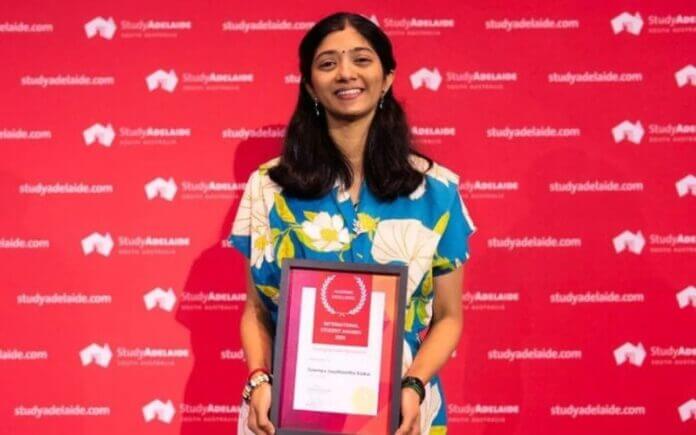
Vaikar’s work has earned her the 2026 StudyAdelaide International Student of the Year – Postgraduate Research Award. She was also selected for the Kathleen Fitzpatrick ARC Laureate Fellowship PhD Thinkers Program in 2025, one of only 13 female PhD candidates chosen from across Australia.
According to Jane Johnston, Chief Executive of StudyAdelaide, the judges were particularly impressed by Vaikar’s research publications, the potential impact of her work and her wider community involvement. She was their unanimous choice for the award.
Read Also: Indian-origin scientist tackles battery ageing in $1.3m project
AI health coaching