


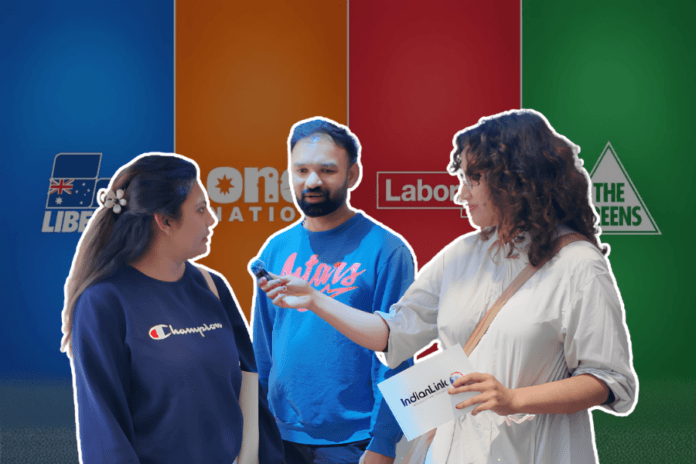
The Liberal/National coalition has emerged as the most popular choice of first preference in Indian Link’s survey gauging the voting intentions of Victoria’s Indian community. Victorian election
Of 1530 Victorian Indian community respondents, 32% said they would vote for the Liberal/National party (LNP) if a Victorian state election was held today. This is in line with Roy Morgan and AFR/Redbridge/Accent Research polling of the general Victorian public which is also forecasting an LNP victory.
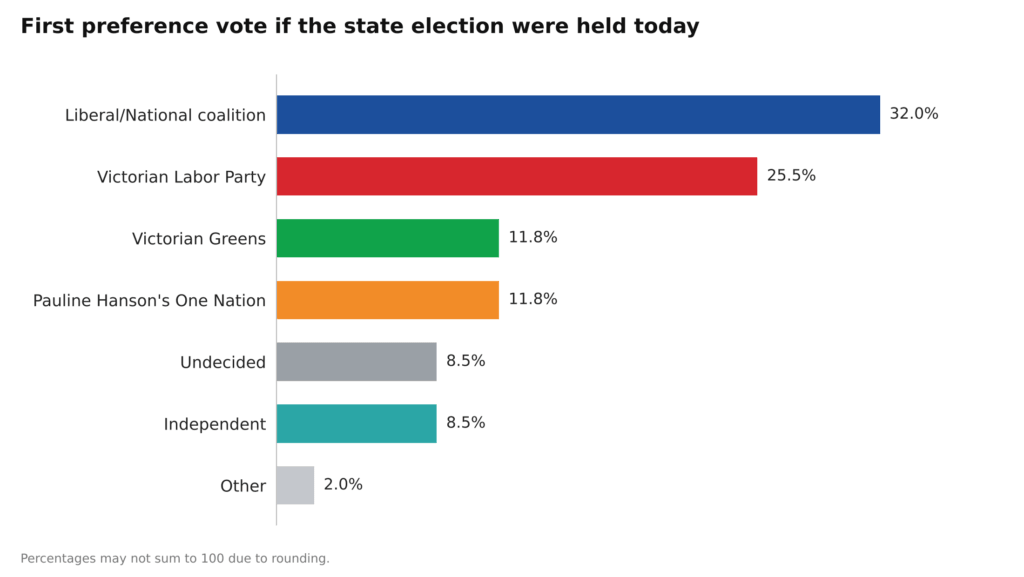
Liberal was also the most popular option among those who have lived in Australia for more than 20 years, those around the 3029 (Hoppers Crossing) postcode area, and those in the 41–55-year-old age group.
Labor emerged second on Indian Link’s survey, with 25.5% of respondents, followed by Pauline Hanson’s One Nation and the Victorian Greens on 11.8% of respondents apiece. Meanwhile, 8.5% of respondents chose Independent, and an equal amount chose ‘undecided’.
Meanwhile, respondents around Melbourne CBD (postcode 3000) were most likely to be undecided, while Labor holds a narrow lead for the 25–40-year-old age group and those in the 3064 (Craigieburn) area, a region which has consistently been part of Labor’s outer north-west heartland.
Labor voters are swapping to Liberal and the minors
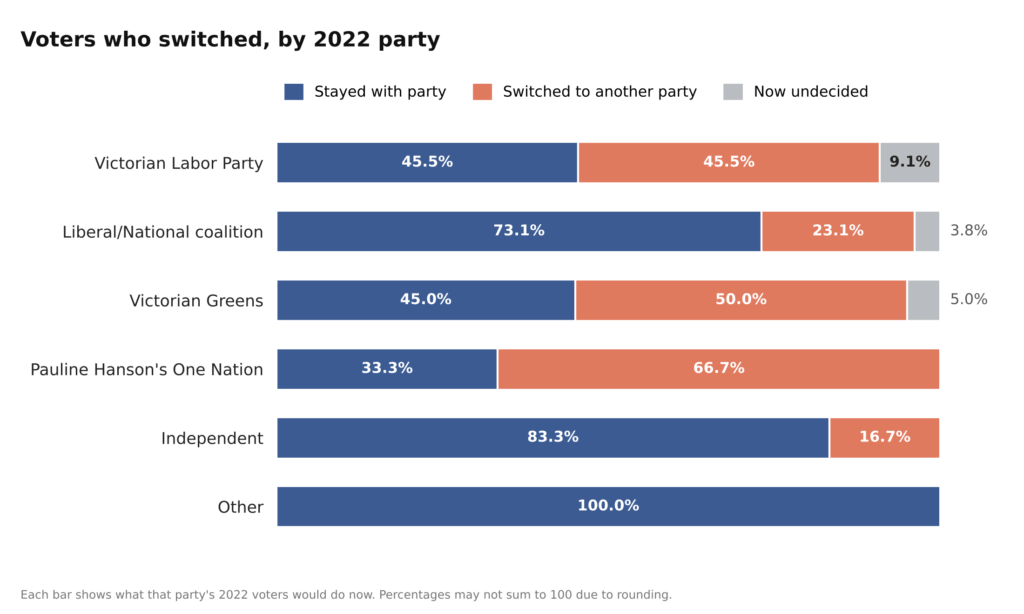
The survey also asked respondents to recall their 2022 state election first preference, and it was here the most striking data emerged.
While Labor led the survey’s 2022 first preferences, only about 45% of these voters have continued this support at the current election. Almost a third of these 2022-Labor respondents changed their first preference to Liberal, and the rest opted for an Independent, a minor party (Greens, One Nation) or chose ‘undecided’.
“Not just the appeasement of people, the ‘vote bank’ policies – we want someone who can take the state ahead. Our kids’ futures should be better,” one voter told this masthead. (Indian Link also travelled to Melbourne’s west on the first day of early voting to speak with Indian community voters, who have been kept anonymous here.) Victorian election Indian voters
Much has been said about the waning popularity of recent Labor premiers and the ongoing Royal Commission exposing corruption on their Big Build project, and it seems this has taken a toll on the Indian community’s support for them. When asked which party they trusted to ‘ensure public funds are spent responsibly and government is accountable’, just 20.9% respondents selected Labor.
“I’m an old Labor voter but I’m unfortunately disgusted at the previous and current premiers. The way they’ve done deals with the union, I’m put off,” another voter in the west told us.
Political trust towards the major parties, however, seems to be generally fragmented; on this same question, although Liberal led with 24.2% of responses, a sizable 18.3% respondents chose ‘no party’, and the Greens proved the next most popular response at 17%.
“[I trust] no political party. But [I] don’t know how much Independents are able to control the fiscal discipline and transparency,” one survey respondent who selected ‘no party’ commented.
Though trust in Labor’s accountability has dipped, they remain the most trusted party to ‘maintain social cohesion and community harmony’, with a lead of 27.5% as compared to Liberals’ 20.9%. However, most respondents (59.7%) chose either ‘no party’, a minor party or an Independent for this question too.
Stoked by growing polarisation, Melbourne has seen a rise in protests over the last few years, with negative sentiment towards the Indian community growing across the country too, elements which may have factored into the community’s thoughts on social cohesion.
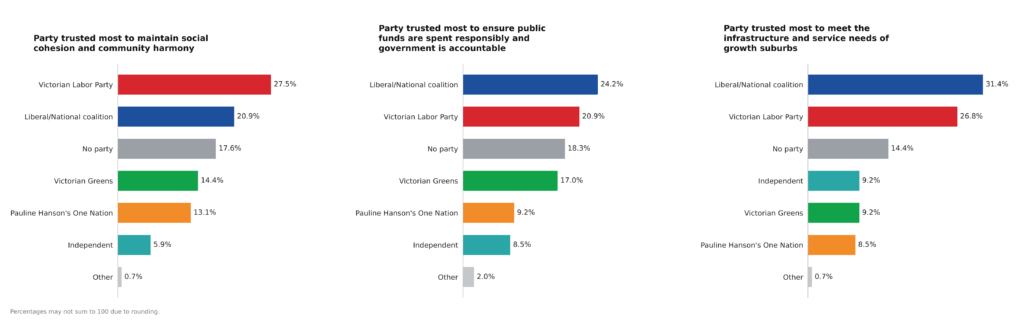
The last of our survey’s trust questions asked who voters believed would ‘meet the infrastructure and service needs of growth suburbs’ – here, Liberal led with 31.4% of respondents, followed by Labor at 26.8% and ‘no party’ at 14.4%. With Victoria’s Indian population concentrated in the outer Western and Southeastern suburbs, this was also a major issue among those we spoke to.
“My main priority is getting in and out of my town and hospitals. There’s nothing here, only one,” said one voter in the west.
“We may need to move to another suburb for secondary schools – that’s a major concern for us,” said another.
Of course, both majors are aware of how instrumental growth-suburb multicultural communities are – Labor has pledged over $3bn towards road upgrades in the outer suburbs, while the Coalition have promised $524 million to duplicate Donnybrook Road between Woodstock and Kalkallo. Victorian election Indian voters
Crime and cost-of-living relief, not more temples, say community
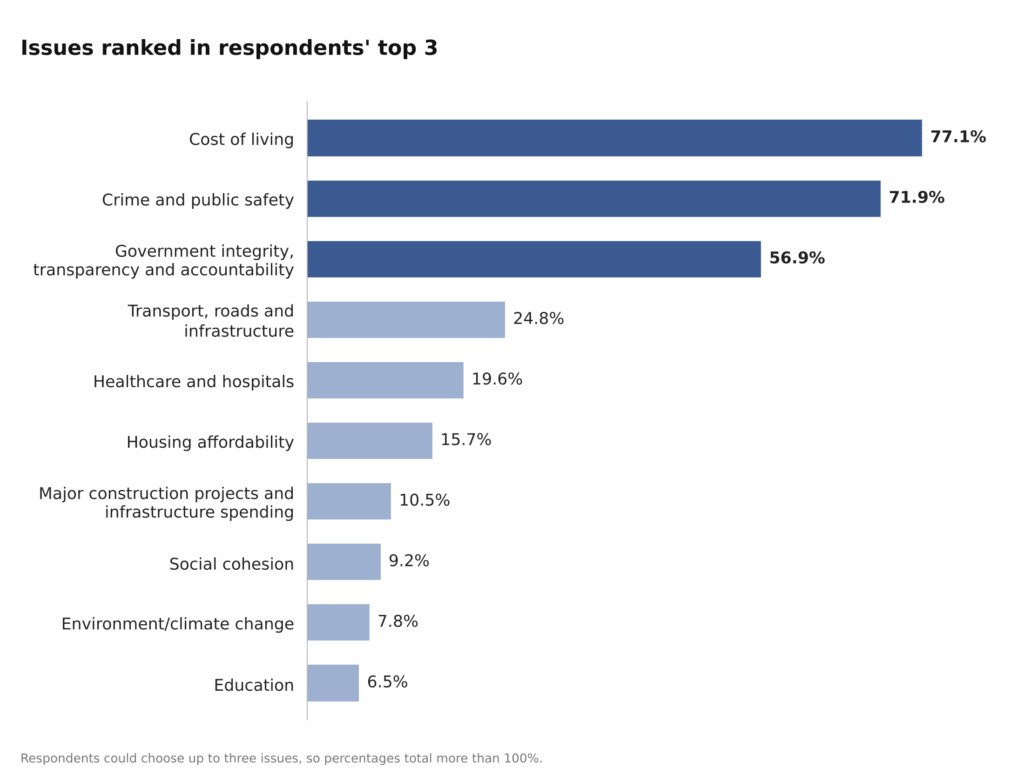
Unsurprisingly, the survey’s top three issues of importance to the community were cost-of-living, crime and public safety, and government integrity, transparency and accountability.
With a recent spate of stabbings rocking the Melbourne CBD, crime has come back in focus for voters, while the latest rate rise and continual struggle to keep up with household expenses remain ever present pressures.
“The increasing living expenses – for families it’s very important we have that support from the government,” one western suburbs voter told us.
“Cost-of-living is going up – government can try to control this, but not much. The uneven spending and corruption and everything going on is frustrating,” another voter told us.
In Craigieburn, Labor and Liberal are locked in a pledge war over the Kali Mata Mandir, six figures promised as they court the Indian community, and both parties have also made pledges around community language and faith-based schools.
But if the survey’s responses are anything to go by, rather than such targeted promises, Victoria’s Indian community just want to see the same cost-of-living relief as everyone else. Or, as one voter we spoke to put it: “We don’t want things only for Indians. We want something for the country.”
Community leader Ruchi Sharma expressed a similar sentiment on Facebook.
“Every election cycle, the Indian community suddenly becomes important…Politicians and aspiring community representatives attend our religious gatherings, cultural events and celebrations, seek our support, take photographs and make promises,” she posted.
“Is our identity limited to our religion, festivals, temples, gurdwaras and cultural celebrations? Are these the only issues for which we expect representation and funding?”
Commenter Priya Shukla concurred: “Alluring the community in terms of Mandirs etc is not what we are here for. We do need Mandirs but we need more than that for our future.” Victorian election Indian voters
Overwhelming concern over minority govt, One Nation
If this election is remembered for anything, it is the growing influence of previously ‘minor’ parties like the Greens and One Nation – last week’s historic four-way leaders debate is testament to this shift. Election analyst Antony Green says in the inner city, Labor will face competition from the Greens and other minors, while One Nation is likely to get a solid primary vote in the regions.
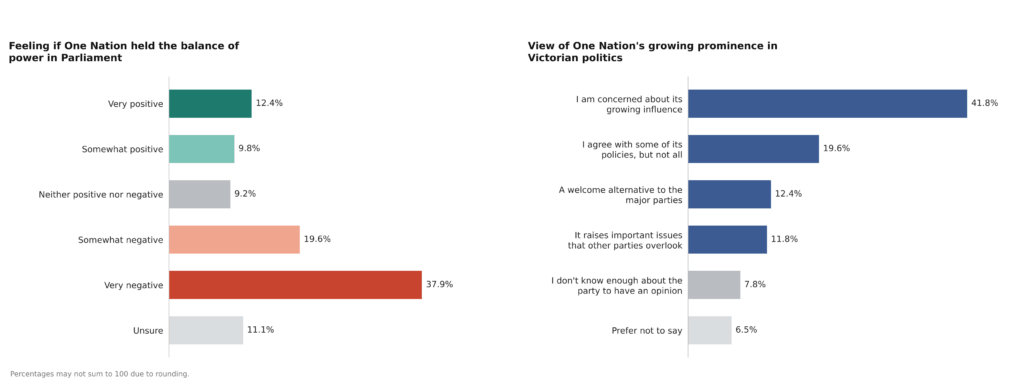
Indian-Australian voters, however, are less enthusiastic about One Nation, with an overwhelming 57.5% saying they’d feel either somewhat or very negative if they ‘held the balance of power in Parliament’. When asked how they view One Nation’s presence in Victoria, 41.8% of respondents expressed ‘concern about their growing influence’, while 19.6% said they ‘agree with some of their policies, but not all’.
Amongst the community members we spoke to, mention of One Nation was met with ambivalence.
“They have a valid point – it’s not like we can totally cut off what they say,” one voter told us.
“Some of Pauline Hanson’s policies are good, but some we can’t say. We don’t have any experience about her [in the] house, whether it works…if she gets power and it works for the country, then yes,” another said.
Others condemned the party’s divisive rhetoric.
“I think it’s more fear based; if One Nation and Liberals were elected, I think it wouldn’t be a good turn for Australia,” a voter told us.
Respondents were also asked to select their top concern if the election resulted in a minority government; interestingly, among those who felt very or somewhat negative if One Nation had the balance of power, the most popular concern was ‘election promises may be harder to keep’, followed by ‘minor parties/independents may have too influence.’
On the other hand, 22.2% were somewhat or very positive about the prospect of One Nation having a decisive say, and of these responses, ‘minor parties/independents may have too much influence’ was strangely their most common concern for a minority government, then ‘election promises may be harder to keep’.
It remains to be seen how the community will reconcile Liberal’s preference deal with One Nation. Victorian election Indian voters
Either way, there’s a sense people’s patience and trust towards the current political landscape is wearing thin. One voter we spoke to summed this up: “They promise, and many don’t keep their promises. But at the same time, we have to vote, that’s our legal thing.”