


With seven weeks till what Antony Green calls the most consequential state election in his lifetime, the haze is slowly clearing on voting intentions here in Victoria. The VEC expect 60 percent of voters to cast their ballots early, meaning the race to persuade could be shorter than expected. Vic Election 2026
Roy Morgan’s latest findings say a result is still ‘too close to call’ – but what should be most concerning here is the cloud of orange impinging on the outer-suburbs of Melbourne, signalling One Nation’s growing appeal is no longer contained to ‘traditional rural strongholds’.
In the outer north-western seats of Melton, Sunbury and St Albans, One Nation look poised to strike, having named these electorates on their ‘hit list’, and they’re sure to make some headway with Labor-weary mortgage holders desiring better infrastructure.
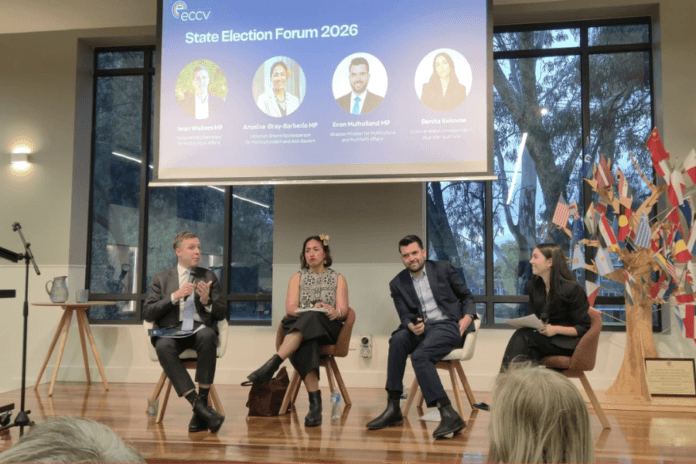
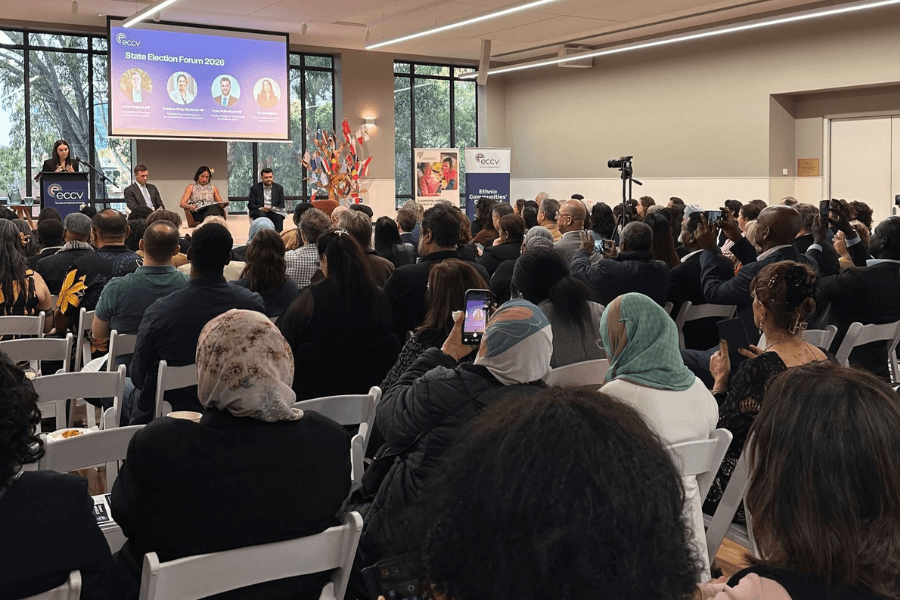
At the ECCV’s Election Forum on Monday 12th October, the looming orange wave was the elephant in the room, multicultural leaders unsettled by the divisive rhetoric it was already enabling.
The speakers for the evening, Parliamentary Secretary for Multicultural Affairs Iwan Walters, Shadow Minister for Multicultural and Multifaith Affairs Evan Mulholland, and Victorian Greens spokesperson Anasina Gray-Barberio, seemed equally perturbed. Vic Election 2026
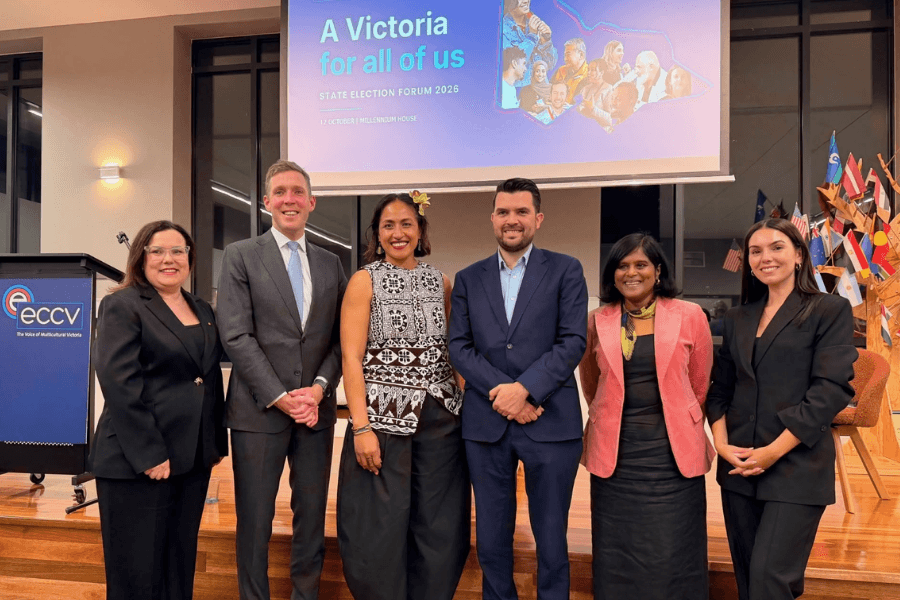
As three committed multiculturalists, they were all able to speak cogently to the priorities raised on the night, including intercultural connection, rising hate, the fate of Multicultural Victoria, supporting ageing migrant populations, and investing in growth corridors. Many such concerns are mentioned within the ECCV’s Election Platform, but all three speakers remained tight-lipped on directly endorsing these recommendations.
Labor’s Iwan Walters approached the discussion with the party’s trademark, pluralistic brand of multiculturalism, pointing to tightened anti-hate laws and $750m of investment in festivals and infrastructure projects over their tenure.
“We don’t just tolerate diversity, we embrace it, and we back it with action and investment,” he said in his opening remarks.
“But multiculturalism isn’t something you win once and keep. You have to defend it.”
Representing the Greens, Anasina Gray-Barberio’s lens was informed by anti-colonial, social justice frameworks, hitting out at wealth inequality and conditional ‘good migrant, bad migrant’ multiculturalism. Vic Election 2026
“We’re tired of being welcomed into our home,” she asserted. “We are more than just our food and our festivals.”
Finally, as the grandson of Italian migrants who has invested hours in on the ground engagement, Liberal representative Evan Mulholland espoused conservative, hegemonic multiculturalism, citing the diverse candidates standing for the party and the need to invest in growing suburbs.
“You can’t be what you can’t see…it’s about making sure culture is passed on,” he told the room.
When it came to the issue of One Nation, however, jaws collectively clenched.
Vic Election 2026
All three acknowledged underlying economic stress had led to voter alienation and strained social cohesion.
“I partially blame it on the lack of service delivery, healthcare and infrastructure…We’ve seen consistently governments fail to deliver the infrastructure in growth communities,” said Evan Mulholland, when asked about tackling the rise in racism.
“Multicultural communities have signed up for the Australian way of life, and communities in Donnybrook and Tarneit deserve the same level of infrastructure as Box Hill.”
Anasina Gray-Barberio went further, highlighting the exploitation of this economic pain in the form of vilification and scapegoating.
“This is rhetoric [One Nation] have been using for 30 years…we need to stop using our multicultural communities as political footballs,” she said.
“It’s being emboldened everywhere…We can’t just be shrugging our shoulders and sending out media releases – we need to be out there fighting the rise of the far-right.”
But it was Iwan Walters who articulated best the immediacy of One Nation’s threat. Vic Election 2026
“The populist rhetoric clearly has a resonance with people beyond those who are ‘hardcore’…that means it needs to be challenged and confronted by everyone,” he noted.
“We’re talking about 46 days to an election, where there’ll be a point in time where there could be One Nation members elected. That would inevitably, profoundly reshape the nature of discourse and the direction of policy.”
With polling showing support divided, and a minority government looking increasingly possible, any preference or power-sharing deals done between minor and major parties will have critical consequences.
View this post on Instagram
But the Liberals have been reticent to clarify what their how-to-vote cards will look like. Jess Wilson hasn’t moved beyond her script when asked to rule out a deal with One Nation – “The only deal is between the Victorian Liberals and the Nationals, and we are running to form majority government.” Certainly, it’s not in their interests to alienate a party who may end up having the balance of power, but voters deserve a clear answer.
Likewise, there needs to be greater consideration of the aftermath this election, once One Nation’s ideology gains further legitimacy in the form of seats. How will each party reinspire jaded two-party voters who have turned to One Nation? Can they address the economic conditions they have identified as feeding into One Nation’s popularity? Where do they stand on implementing key multicultural strategies, such as the AHRC’s National Anti-Racism Framework?
To this extent, both parties cannot continue to view One Nation as a hurdle to be crossed in the distant future. If the Farrer and Secret Harbour by-elections are anything to go by, major political change is already happening, and we can’t afford to consign Victoria to the fate of orange petri dish.
Multicultural communities are already grappling with the harm caused by One Nation’s rhetoric, and attacks on social cohesion will only deepen once seats are inevitably won at the state election.
The opportunity instead, is to meet it head on, and protect multiculturalism from the further erosion it is set to experience. The orange wave is coming, but it’s up to us whether we start swimming. Vic Election 2026
READ ALSO: When pessimism looks for someone to blame