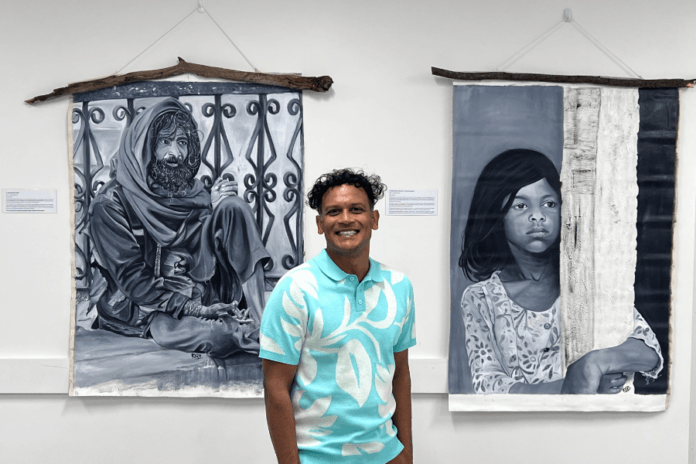

When Ryan Michael moved from India to Australia at 12, he suddenly became aware of something he had never really thought about before: his skin colour.
“In India, we were all Indian, even if we were different shades of brown,” he tells Indian Link, adding that he had little reason to think about where he fitted in.
Australia was different. He had to navigate unfamiliar customs, a different way of communicating and, eventually, the subtleties of Australian humour.
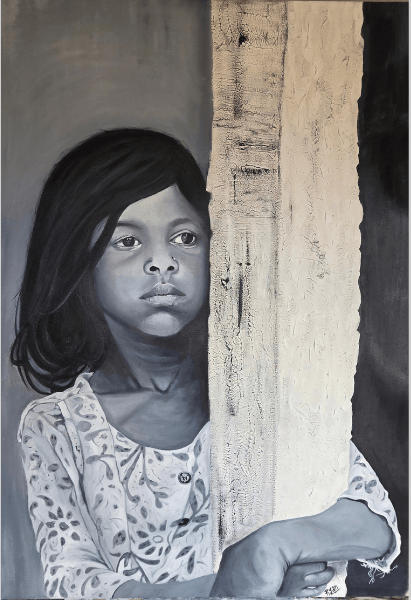
More than three decades later, that experience of being both an observer and someone being observed has found its way into his art.
“I think that is why I became sensitive to the stories that sit beneath the surface,” Michael shares candidly. “A person’s appearance or circumstances might tell you one thing, but there is always another story underneath.”
Portraiture allows him to look beyond that first impression.
It is this idea that sits at the heart of his latest exhibition, The Marginalised – Who is looking out for them?.
The exhibition opened at Langley Park Pavilion in Perth on October 3 before moving to Manning Primary School from October 5, the Indian Society of WA in Willetton, and finally the Rod Evans Community Centre in East Perth on October 18. Michael plans to take the exhibition to cities on Australia’s east coast in 2027.
View this post on Instagram
To see, and be seen
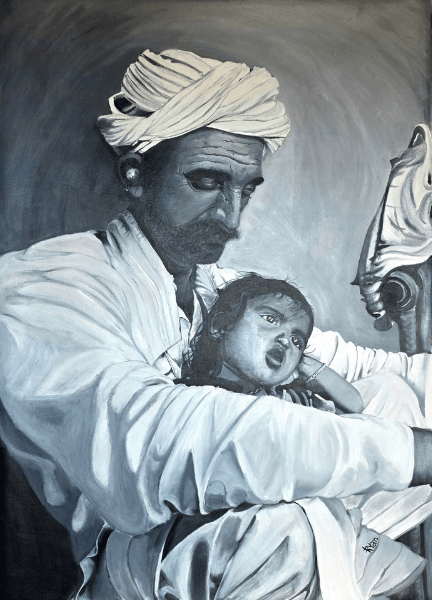
Ryan Michael’s realist portraits explore homelessness, health inequality, displacement, poverty, family and migration. But Michael is careful not to turn his subjects into symbols of suffering.
“I paint the person, not the problem,” he points out.
That approach is rooted partly in his own childhood memories of India, where he remembers the crowds, colours, festivals, aromas and many languages, but also the striking proximity of wealth and poverty.
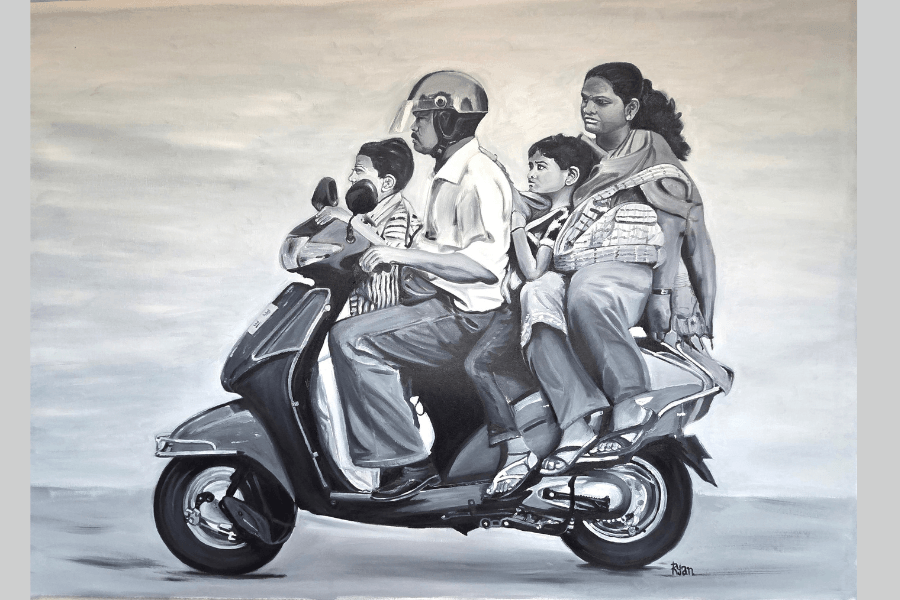
Those contrasts stayed with him even as his own circumstances changed. A portrait of a family of four riding a scooter, for instance, comes from a fond childhood memory of heading to an evening gathering with his own family.
India remains part of his visual vocabulary after 34 years in Australia, influencing his use of colour and his questioning of cultural and gender conventions. More broadly, he says, he is still trying to understand what it means to be Indian in Australia.
That question of representation became even more pronounced during a research trip to the Louvre in Paris. After spending nine days visiting the museum, Michael was struck by how few works featured a person of colour as the central subject.
For an Indian-Australian who had grown up in Australia in the 1990s, the absence felt familiar. He had rarely seen people who looked like him prominently represented in advertising, television, museums or positions of influence.
Rather than simply questioning that absence, he decided to respond through his own work.
“My Indian heritage gives me a particular lens, but the issue is much bigger than Indian representation. It’s about asking whose faces and stories we see in art — and whose are still missing.”
Who gets to be represented?
Yet ‘The Marginalised’ is not solely about Indian representation. Michael’s subjects encompass homelessness, health inequality, displacement, poverty, family and migration, raising what he calls an uncomfortable question: “who gets opportunities, who doesn’t, and who do we choose to notice?”
“We are constantly bombarded with statistics about poverty, inequality, migration and disadvantage,” he says, adding, “Numbers can tell us how big a problem is, but a face can make us feel it.”
For Michael, the face is what transforms an abstract social issue into a human encounter. He deliberately removes unnecessary visual distractions, including elaborate framing, allowing the sitter to confront the viewer almost directly.
He wants audiences to see dignity rather than deprivation.
“Their lives may be very different from the lives many of us lead in Australia, but human dignity isn’t relative,” he continues.
The children in the series have affected him particularly deeply. As someone who grew up in India and is now a parent himself, he sees in them both his younger self and a reminder of how profoundly nutrition, education, healthcare and a supportive environment can influence a child’s future.
Yet he resisted portraying them as victims.
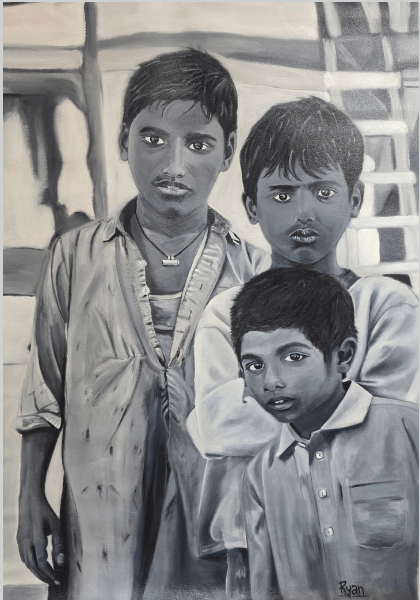
The final painting, depicting three brothers looking directly at the viewer, became for him a portrait of hope — children whose circumstances do not necessarily determine where they will end up.
Art meets audiences
That sense of possibility may also explain why Michael wanted the exhibition to travel.
At Langley Park, the first audience included people familiar with his work. At Manning Primary School, he is interested in seeing how children respond to ideas such as inequality, privilege and opportunity, with explanatory posters designed specifically for younger viewers.
At the Indian Society of WA, he expects the conversation to become more personal, as members of the Indian diaspora encounter stories and contradictions that may resonate with their own experiences.
“The paintings remain the same, but every audience brings a different lens,” he says. “That, for me, is where the real exhibition begins.”
Ultimately, Michael is not asking audiences to feel sorry for the people in his paintings. He wants them to examine the privileges they may take for granted in Australia and recognize the person behind the statistic.
“If someone leaves the exhibition and starts looking at the world a little differently — perhaps noticing someone they would normally walk past, questioning why some people have opportunities while others don’t, or simply appreciating what they have — then the work has done its job.”
Read more: Brandon Colaco: Bengaluru techie turned top didgeridoo player