


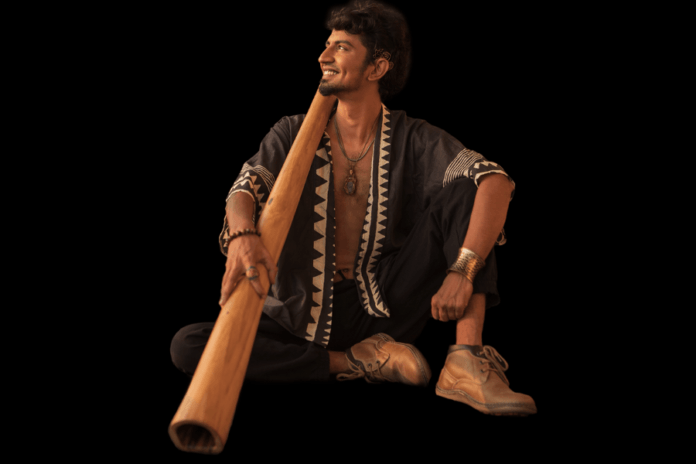

The first didgeridoo Brandon Colaco of Bengaluru ever made was seven feet tall. The ancient wind instrument, created by the Aboriginal peoples of northern Australia, had fascinated him for years.
He had travelled to Rishikesh in 2012 to meet Mukesh Dhiman, a craftsman who ran a DIY workshop specialising in wooden instruments. Dhiman did not teach Colaco how to play the didgeridoo, but taught him how to work with wood and hand tools and, in Colaco’s words, craft instruments of “the highest possible quality”.
Colaco returned to Bengaluru immensely proud of his creation. Then came a small accident.
The seven-foot instrument fell and cracked in multiple places. Naturally, he was devastated. But Dhiman told him to fix it himself.
What began as a repair job soon became an obsession. Colaco started researching wood, experimenting with different designs and exploring how the material could change the instrument’s sound and tone. He spent the next few years making instruments with wood native to Indian forests, while gradually developing his own way of playing.
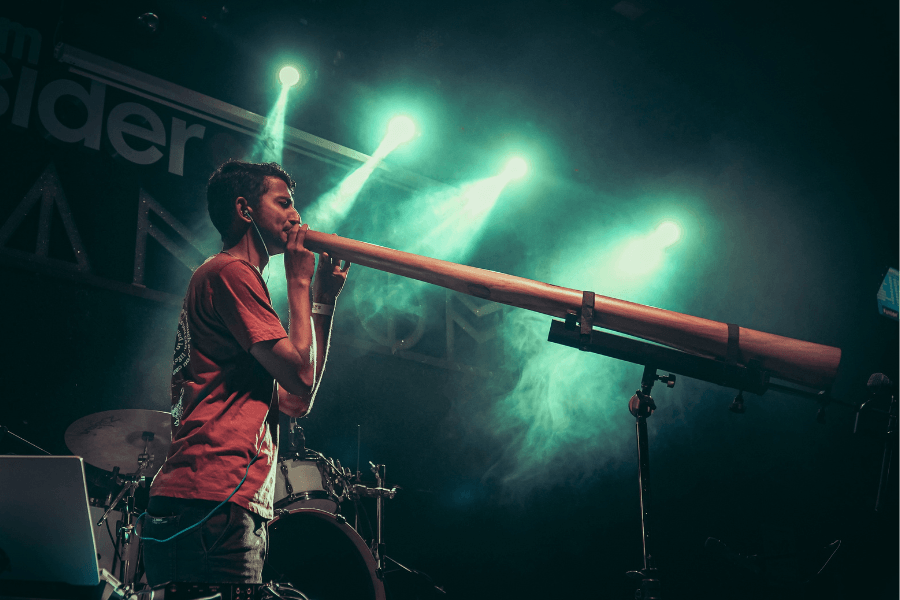
It was a fitting progression for someone whose fascination with the didgeridoo had begun almost by chance.
That journey has earned Colaco a unique recognition. He is a finalist in the Excellence in Creative & Sporting Economy category at the India Australia Business & Community Alliance (IABCA) Awards, appreciating his work at an unusual intersection of Indian music, contemporary didgeridoo and Australia-India cultural exchange.
For Brandon Colaco, the honour is less a destination than an affirmation that there is room for his sound to grow.
“It gives me reassurance that my work has been recognised and has scope to grow more,” he tells Indian Link. “I feel it is a step in the positive direction.”
View this post on Instagram
A sound of his own
As a child, Colaco vaguely remembers seeing the instrument during a Yanni concert on TV around 1995. Although he did not connect with its sound then, it registered somewhere in his mind.
Later in 2009, after he had started working as a corporate engineer in Bengaluru, he finally heard a didgeridoo live.
He had gone to a concert by French band ‘Highlight Tribe’. The sound captivated him.
“I could not believe that just a wooden tube could make such a rich sound and it could be modulated in interesting ways,” he recalls.
He had no teacher and did not know where to find one. But when he tried to make his first sound, it worked.
More than a decade later, that curiosity has turned Colaco into one of India’s dedicated contemporary didgeridoo artists and the creator behind Two Eyed Wizard, his musical project that combines the instrument with Indian rhythms, electronic music and contemporary sounds.
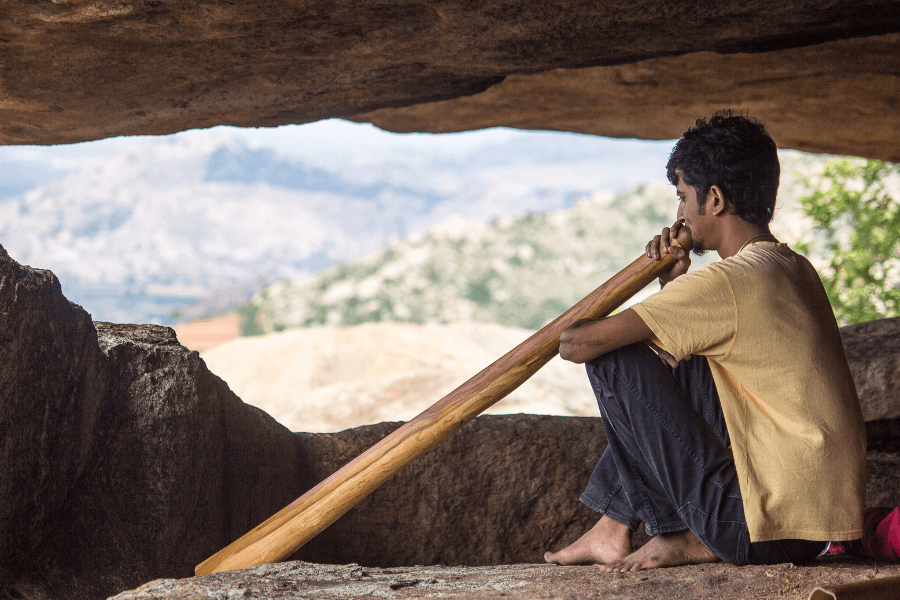
But perhaps the most interesting part of Colaco’s story is not how he discovered the didgeridoo. It is what happened after he began trying to understand it.
In the initial years, his playing was essentially built around a simple, long drone. Then one day, something changed.
“As far as I recall, for the first four years of playing the instrument, I could create a simple, long drone sound and then one fine day a new sound appeared, followed by a rhythm!”
From there on, that rhythm began building his musical identity.
In 2017, Colaco quit his corporate job and moved back to his village in Chikmagalur, Karnataka, to support his father on the family coffee farm. There, he began thinking about creating a professional musical act that could take his sound to an international audience.
View this post on Instagram
Two Eyed Wizard was born from that process.
Learning to record himself led to another discovery. While studying the waveforms of his recordings, Colaco began noticing recurring patterns in his playing. He learnt about transients, rhythm and time signatures and realised that he could translate his instinctive playing into a structured musical language.
“I realised I have some signature rhythms as my musical language. Thus my journey as a musician really started,” he says, smiling.
View this post on Instagram
In tune with two cultures
Colaco has never visited Australia but says he has “the utmost respect and gratitude” for the First Nations Peoples of Australia, whom he describes as the rightful custodians of the didgeridoo. He also acknowledges that he still has much to learn about the yidaki, a didgeridoo of north-east Arnhem Land.
His dream is to visit Australia and spend time learning from one of its yidaki masters.
That journey would also allow him to challenge assumptions about the didgeridoo in India, where audiences sometimes mistake its origins or think it produces little more than a single drone sound.
“My challenge is to re-introduce the instrument in any musical context, whether it is Indian Bollywood music or Western jazz, to show my audience how powerful it can be.”
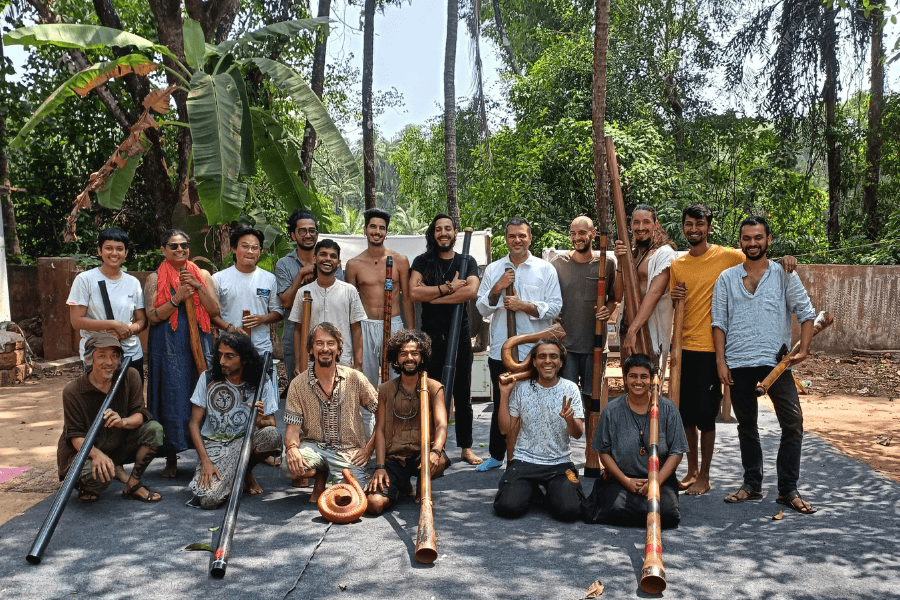
That conversation grew during the 2020 lockdown, when Colaco performed at an online didgeridoo festival in Portugal. Encouraged by friends who wondered why India had no similar community, he and Mumbai-based friend Akash Dayal launched Didgeridoo India on Instagram. It has since grown into a platform showcasing players and hosting workshops with musicians from India and abroad.
Now, Colaco hopes to take his journey to Australia — not simply to perform, but to learn about the instrument’s Indigenous roots.
“I always imagined my first trip to Australia would be to learn from the Elders rather than to perform for them.”
If he eventually gets the opportunity to play on an Australian stage with their blessing, he says, it would be “a full-circle moment”.
“It would be the greatest honour for me as a contemporary didgeridoo player from India,” he says simply.
READ ALSO: When Nandini Menon took Bharatanatyam into the Dreamtime