




Fifteen years ago, I was a student at Delhi University (DU). Growing up in Delhi meant the reflexes came before the reading lists: keys between the fingers on the walk from the bus stop, a phone call timed to the length of a dark stretch, a text to loved ones that said only “reached”. We called it ‘common sense’ and handed it down to each new batch. women’s protest in Delhi
Last Wednesday 23 September, hundreds of women from Lady Shri Ram, Gargi and other Delhi University (DU) colleges marched from near LSR’s back gate to SD Office Road near Moolchand. They were protesting the gang-rape of a 17-year-old girl in Aastha Kunj Park, near Kalkaji Mandir. They raised their voices over women’s safety in Delhi, with a sharp focus on the streets around Delhi University. Their demands were the ones we’ve made years ago: streetlights on the stretches everyone knows are dark, CCTV that actually records, patrols that treat the lane as public space.
The response they got was laughable. Their classes were moved online, police vans installed at the gate and in the name of justice, a suspect shot in an encounter. One placard said it best: Moral policing women will not stop rape.
What disturbs me is not how new this looks. It is how familiar it has become.
View this post on Instagram
women’s protest in Delhi
In December 2012, a young physiotherapy student was gang-raped on a moving bus in Delhi. The country called her Nirbhaya, the fearless one. I was a DU student then, one of thousands who packed India Gate through that bitter winter demanding change. Change came on paper: a committee, tougher laws, a fund in her name.
Twelve years later, in August 2024, a 31-year-old trainee doctor was raped and murdered while on duty at a medical college in Kolkata. Bengal named her Abhaya. Women took back the night across the state, and doctors went on strike for weeks.
Nirbhaya and Abhaya were among hundreds and thousands violated. We keep naming our dead for their fearlessness, while denying the living their basic safety. Years of marches, vigils and amended statutes, and woman’s safety in India is still a question mark.
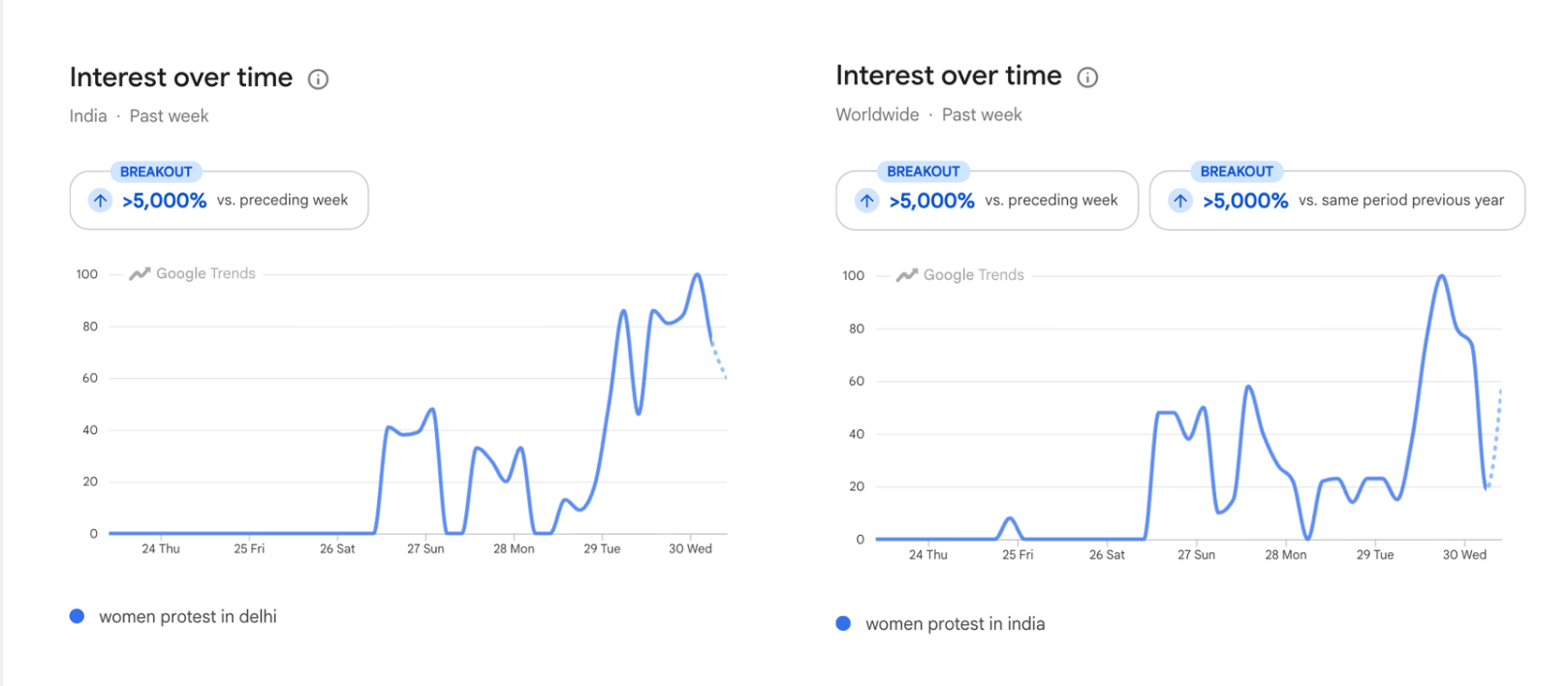
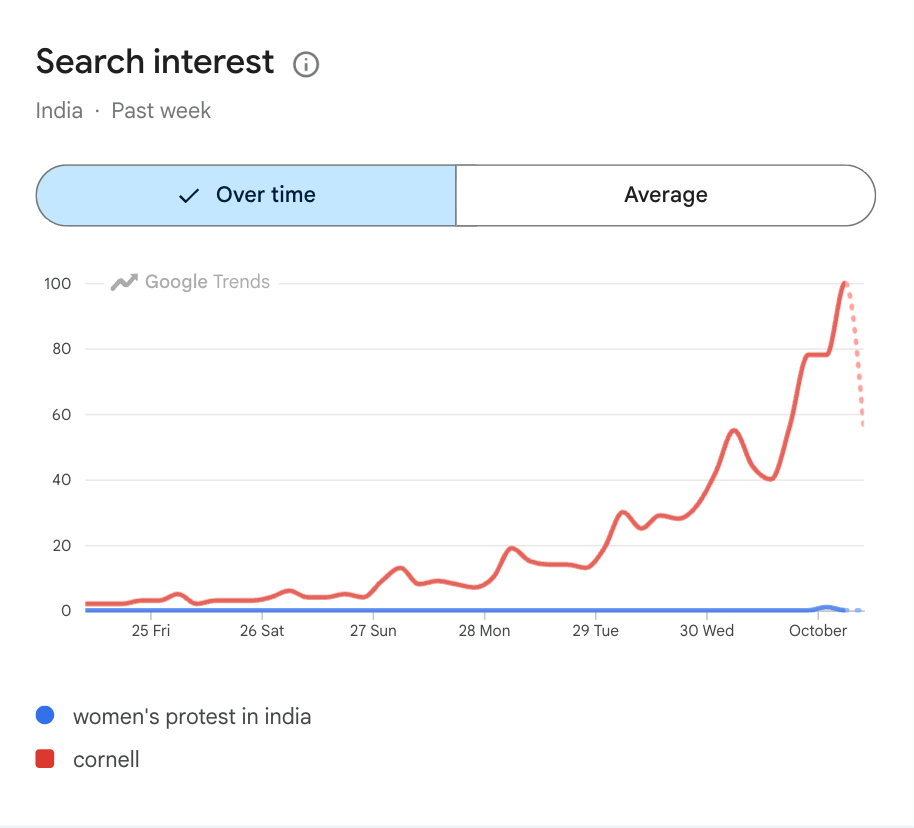
Google Trends shows searches in India for “women’s protest in Delhi” are up more than 5,000 per cent around the time the protest took place. Worldwide, “women’s protest in India” is up by the same margin. But for two days after the march, Indian interest sat at zero. It stirred on Saturday and peaked on Wednesday, 30 September, a full week after the women walked. Intriguingly, search interest in India for ‘cornell’ is higher than that of ‘women’s protest in india’.
The five-year view is bleaker. Indian searches for “women’s safety” shot up in August 2024, the month of Abhaya, then sank back within months. They spiked again around the turn of this year and have slid ever since. Searches for “sexual assault” barely move. Outrage rises like a flare and falls like one. The violence stays level: the National Crime Records Bureau counted about 4.71 thousand crimes against women in 2023, with more than 1.3 thousand rape cases pending trial.
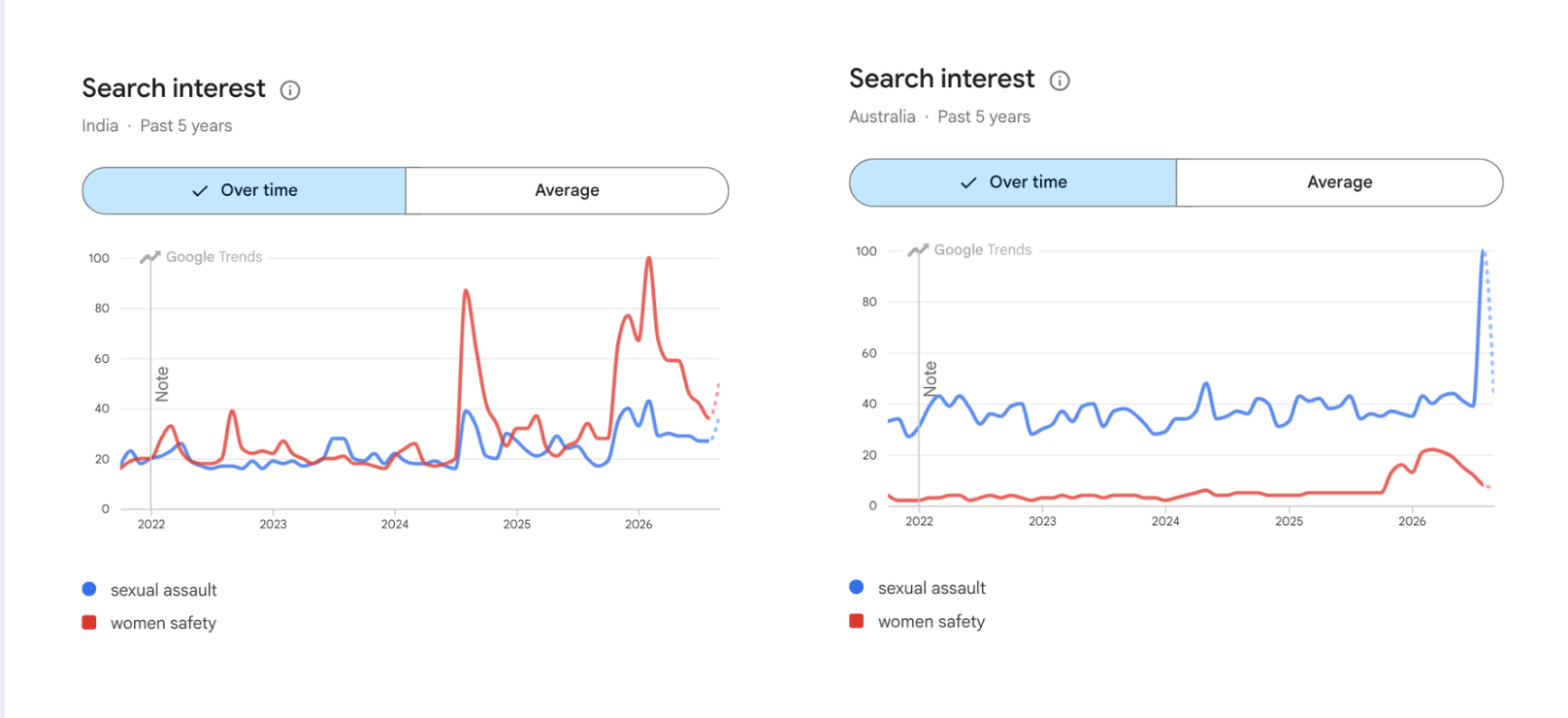
Australia’s graph, drawn over the same five years, looks different. Search interest in “sexual assault” held steady, then jumped in recent weeks to its highest point in the period. “Women’s safety” barely registers. Indians search for a condition we still have to ask about; Australians search for the name of the crime. One graph reads like a question, the other like a charge sheet.
Women’s protest in India
Australia hasn’t fixed the problem either. In April 2024, after a run of killings, tens of thousands marched across Australia, and Prime Minister Anthony Albanese called violence against women a ‘national crisis’. Money followed, including a $925 million Leaving Violence program. By November, Counting Dead Women had recorded 62 women killed that year, up from 2023. This September, Domestic, Family and Sexual Violence Commissioner Micaela Cronin said she was “deeply worried“: sexual violence hit a 33-year high in 2024 and has since fallen by less than 1 per cent.
View this post on Instagram
Put the graphs side by side and the lesson is simple. Attention is not scarce. Both countries can summon it within days, by thousands of per cent. What neither can do is keep paying attention long enough for real change: better street lighting, working CCTV, police who prevent crime and courts that deliver justice.
Fifteen years on, I no longer call our old caution common sense. It was a tax, paid nightly, on streets that were never finished. The women of DU are refusing to pay it. For those of us watching from Sydney, Melbourne, Delhi, or elsewhere the least we can do is keep searching, keep asking, keep the momentum going, after the graph goes flat.
READ ALSO: Violence against women in Australia worsens, politicians keep quiet