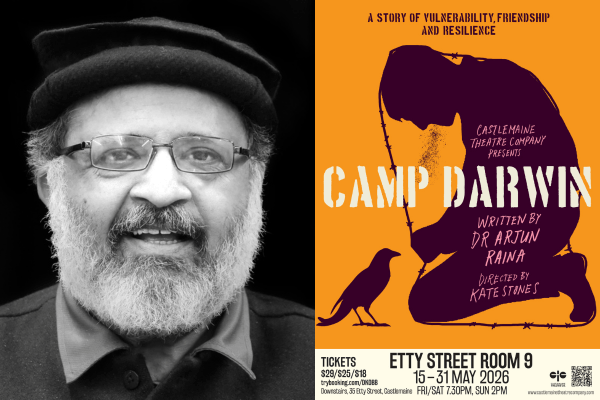
Though over six years ago, Arjun Raina still remembers his first moments on Australian soil, after being evacuated from India during the Delta wave of COVID.
Stepping off the plane in Darwin, he was escorted to Howard Springs Quarantine Facility, where he would spend the next two weeks amongst equally harried return travellers.
“There was a big, strong policewoman who kept threatening us to stay three feet from each other, otherwise there’s a $5,000 fine and ‘we apply that very strictly at the camp’,” he recalls.
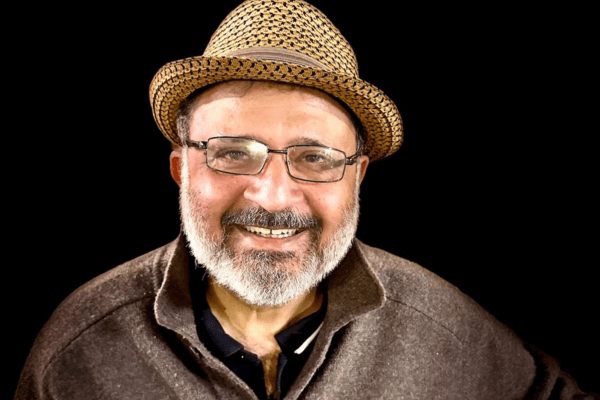
It’s within the strict regimentation of this experience, which he jokingly refers to as a ‘regime’, that his latest play Camp Darwin finds its genesis.
Told over fourteen days, the play follows six Australians from diverse backgrounds, as they navigate cabin fever, the prospect of having COVID and interpersonal tensions, all while the outside world shuts down around them.
“It was an incredibly stressful time… you are under Australian regimentation. As one of the characters says, we’re very good at creating these prison systems because that’s what we started off as – a penal colony. So, it’s a very efficient quarantine system with all its carrots and sticks,” Raina muses.
“I don’t have an experience of Australian prisons. But there is an element that you are an inmate. There’s an element you obey rules. There’s an element you do it in a precise way. The limitations were there.”
As the ‘inmates’ are tested, the threat of the mysterious ‘Red Zone’ quarantine looms, an inclusion from Raina’s own experience which lends the drama a sense of ever-present pressure.
“If on day 13 the test comes positive, then you go into the Red Zone for another 14 days…We had no idea whether the Red Zone had any porches or whether you were put into a laboratory and operated on to discover what COVID was,” Raina explains.
But despite being a work mined from the ‘lived experience of the entire COVID spectrum’, Raina is keen to point out it’s ‘not just a play about COVID’.
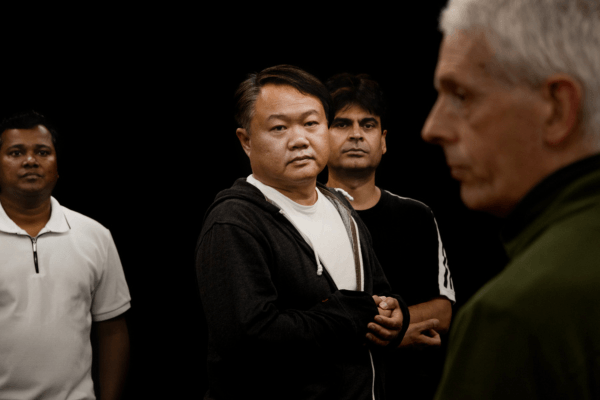
Camp Darwin
“Naturally if people are going to be together [for 14 days], they’re going to find ways of singing songs and telling jokes,” Raina notes.
Cooped up in isolation for 14 days, Camp Darwin examines human connection and resilience in the face of unprecedented circumstances, something which Raina believes Victorian audiences are yet to confront.
“As Indians, we have no problem dealing with the toughness of [COVID] and seeing a story about this. But here you have to keep saying ‘no, no, it’s not confronting, it’s about human resilience,” he asserts.
“People [here] say, Oh God, COVID, we don’t want to deal with COVID, we just want to go down and have our beers and get back to our partying.”
Held captive together, Camp Darwin offers a rare chance to explore the commonalities between six Australian men from vastly different walks of life.
“To show brown men and white men, not in subservience or not in obvious very violent conflict, but in a social space together, becomes very interesting,” Raina says.
“It’s very rare that you have white men and brown men and black men all equal. They are all equally in the same situation, and they are negotiating the same reality, finding the same sense of resilience and humour and affection and fun together.”
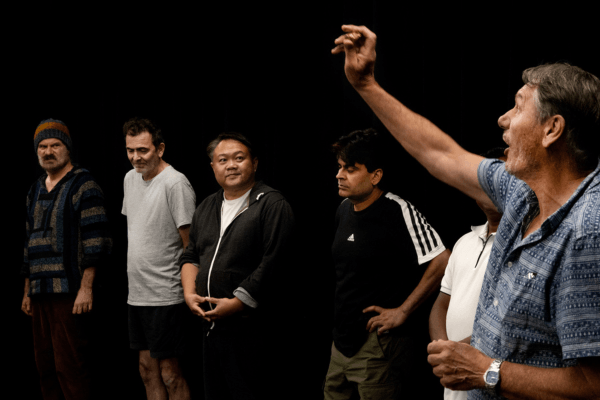
Resisting the urge to write conventional multicultural stories, Raina will be the first Indian Australian programmed on Castlemaine Theatre Company’s stage.
“This is the first time a playwright of colour is telling a story in Castlemaine, which is a very white town. I’m very aware of the interplay between the races,” he says.
“[Audiences] are going to enjoy the fact that they’re going to see these six characters of different cultures together, not necessarily in an aggressive, sort of anti-racist kind of way, but it’ll be a new experience.”
The Gisborne-based playwright hopes seeing an inclusive multicultural story will break down existing cultural siloes and encourage a new understanding of humanity.
“Unicultural performances, in a way, are celebrated; of which Counting and Cracking was one of the most celebrated, where there were no white characters, that community did not engage with the mainstream,” Raina contends.
“This is a fabulous effort by [Director] Kate Stones to bring in a playwright of colour, to bring in a multicultural cast – there are enough people wanting the breaking of the white citadel in a way.”
READ ALSO: A review of Arjun Raina’s Straight From the Horse’s Heart