


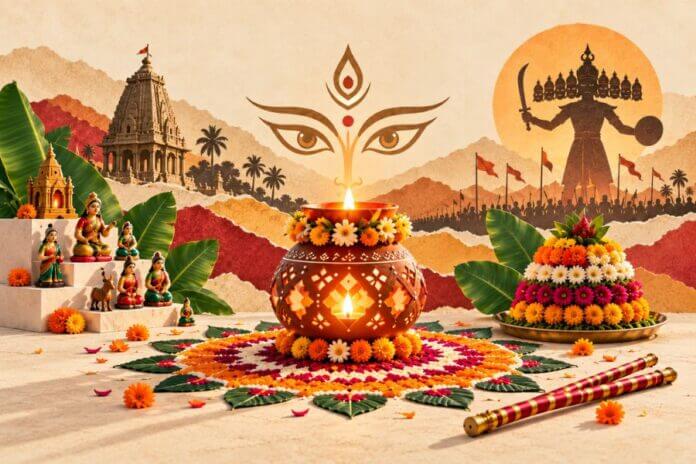

Navratri celebrations in India
Navratri means “nine nights,” and the name is about the only thing that stays fixed. Across India the festival celebrates the feminine principle of nature (by honouring the goddess in her many forms), but each region does it differently. In some places people dance, in others they fast, and elsewhere they build, pray or walk to a temple. Move a few hundred kilometres and the same nights have a different sound, smell and rhythm.
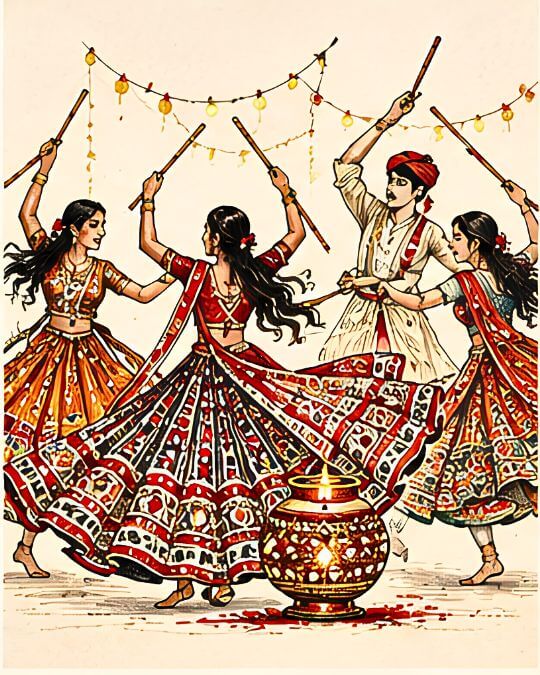
In Gujarat, Navratri is danced. Every evening, women in mirror-worked chaniya cholis and men in kediyus form wide circles around a garbo, an earthen pot pierced with holes and lit from inside by a single lamp. The garba starts slowly and builds. Later the dandiya sticks come out, clacking in pairs, and the circles keep turning well past midnight.
In Bengal, the last five days carry the festival as Durga Puja. It really begins earlier, at dawn on Mahalaya, when households switch on the radio recitation that has announced the goddess for generations. Then the pandals (makeshift temples) open. Some are temples of bamboo and cloth, others elaborate art installations. Evenings bring dhunuchi naach, men dancing with smoking clay censers balanced in their hands.
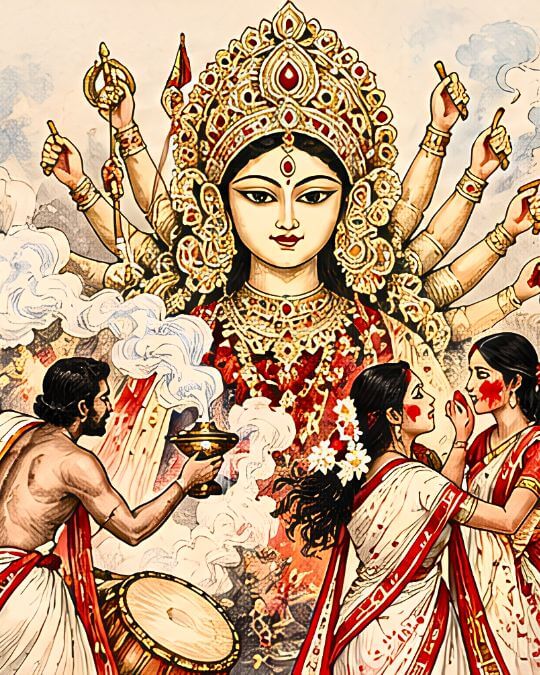
The Bengali Puja ends with sindoor khela. On Dashami, the last day, married women smear vermilion on the goddess’s forehead, offer her sweets, and then turn and colour each other’s faces red. The mood is joyful and sad at once. Hours later the idols are carried to the river, drums beating, as everyone calls out for her to return next year.
Odisha shares Bengal’s devotion to Durga but adds its own craft. In Cuttack, the city’s silver filigree workers dress the goddess and her pandals in shimmering chandi medha, intricate silverwork that draws crowds from across the state. Some neighbourhoods have done this for decades, and each tries to outshine the next. The city glints for a week.
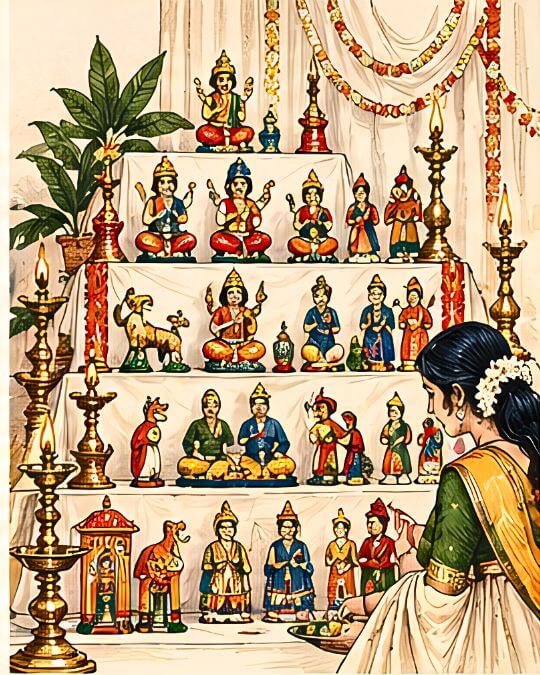
Tamil Nadu brings the festival indoors. Families set up the Golu, an odd-numbered flight of steps crowded with dolls: gods, saints, wedding processions, village scenes, and sometimes a cricket team. Each evening women visit one another’s homes to admire the display. They leave with kumkum, betel leaves and a small packet of sundal, a spiced chickpea dish made fresh every night.
In Karnataka, Mysuru turns Navratri into a royal spectacle. The palace is lit with nearly a hundred thousand bulbs, and on Vijayadashami the Jamboo Savari procession winds through the city. Its centrepiece is an elephant carrying the goddess Chamundeshwari in a golden howdah. The tradition goes back to the Vijayanagara kings, and the city still treats it as a state occasion.
Telangana celebrates with flowers. During Bathukamma, women stack seasonal blooms, including marigold, celosia and the yellow tangedu, into tall conical towers on brass plates. In the evenings they gather in circles, clapping and singing folk songs to Gauri. On the final day the flower towers are floated on lakes and ponds, and the water turns bright with colour.
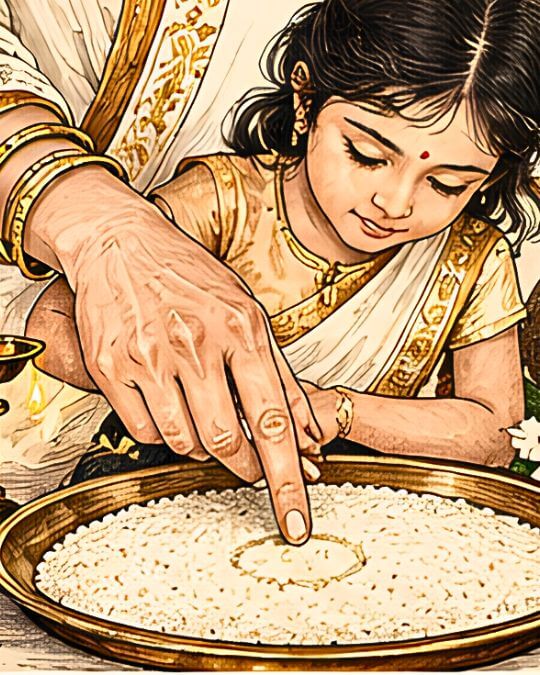
Kerala marks the end of Navratri as a festival of learning. Books, tools and instruments are placed before Saraswati for Pooja Vaypu, and no one studies or works until the goddess releases them. On Vijayadashami, at Vidyarambham, small children trace their first letters in a plate of rice, with a grandparent or teacher guiding their finger. For a Malayali, it is where education begins.
Maharashtra begins with Ghatasthapana: an earthen pot is installed at home, seeds are sown around it, and they sprout over the nine days. Pilgrims crowd temples at Tuljapur and Kolhapur. In Mumbai, many people dress in a different assigned colour each day of Navratri. Offices, local trains and newspaper front pages all quietly follow the colour of the day.
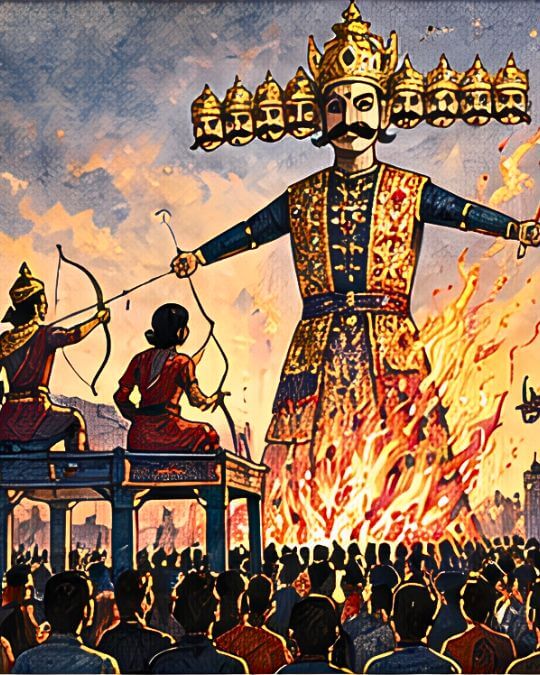
Across Uttar Pradesh and much of the north, Navratri builds towards Dussehra through Ramlila. Neighbourhood stages present the Ramayana night by night. At Ramnagar, near Varanasi, the performance lasts a month and spreads across the town, with the audience walking from one scene to the next. On the tenth day, Ravana’s effigy goes up in flames and fireworks.
In Punjab, Delhi and Haryana, Navratri is often a festival of fasting. Kitchens switch to kuttu (buckwheat) flour, sabudana (sago) and rock salt, and onions and garlic disappear for nine days. On Ashtami or Navami, families hold kanjak, inviting young girls home as forms of the goddess. Their feet are washed, a red thread is tied on their wrists, and they are served halwa, puri and black chana.
Himachal‘s Kullu Valley begins Dussehra just as the rest of India ends it. On Vijayadashami, hundreds of village deities are carried down mountain paths in decorated palanquins to pay respects to Raghunath, the valley’s presiding god. For a week, the Dhalpur grounds fill with the gods, their bands of drums and long horns, and the people who walked down with them.
Chhattisgarh‘s Bastar Dussehra is something else again. It stretches over roughly seventy-five days, is among the longest festivals anywhere, and has nothing to do with Ravana. It honours the local goddess Danteshwari, and tribal communities lead its rituals. A huge wooden chariot, rebuilt each year by hand, is pulled through Jagdalpur by the villagers.
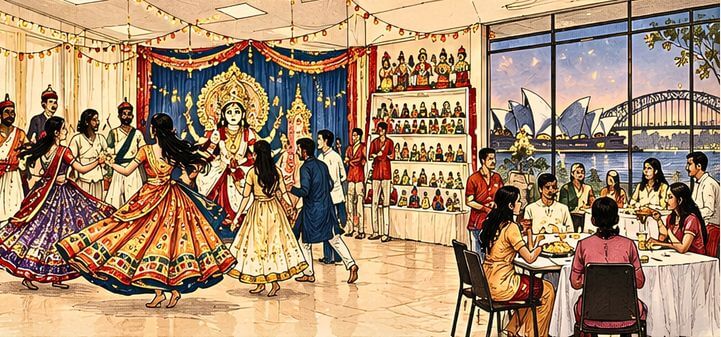
The diaspora has carried all of these with it. In Sydney and Melbourne, community halls fill with garba circles on Saturday nights, Bengali associations build pandals in school gymnasiums, and Tamil families set up Golu steps in suburban living rooms. The details shift with each region, and the goddess takes a different form in each, but every version comes back to the same nine nights.
Read Also: Harsheni’s article
Navratri celebrations in India