




There is something unsettling about Kohrra. Not just the crime. Not just the silence between two lines of dialogue. But the uncomfortable truth that lies beneath its soil. Punjab, in Kohrra Season 2, is not the postcard of mustard fields and wedding songs. It is a place where violence breathes quietly, where grief becomes routine, and where human beings can disappear without consequence.
AT A GLANCE
- Film/Series: Kohrra Season 2 (Netflix)
- Director: Faisal Rahman and Sudip Sharma
- Cast: Mona Singh, Barun Sobti, Mandeep Ghai, Rannvijay Singha and Anurag Arora
- Rating: ★★★★☆
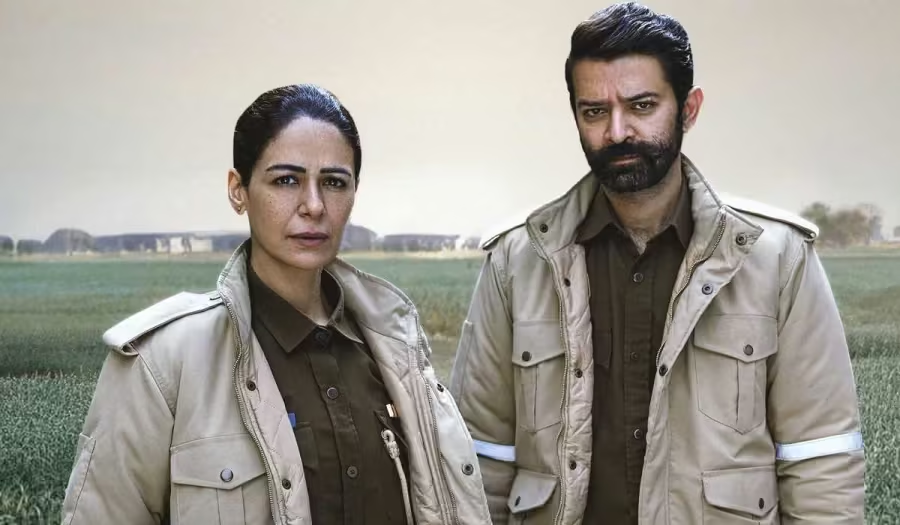
Created by Sudip Sharma who also is also credited for the screenplay of Shahid Kapoor and Alia Bhatt starrer Udta Punjab, Kohrra Season 2, at its heart, is a whodunnit. The murder of an NRI woman in the fictional town of Dalerpura brings together Inspector Dhanwant Kaur, played with quiet devastation by Mona Singh, and Amarpal Garundi, the returning cop still battling his own fractured morality. Their investigation peels back layers of family secrets, betrayal, and emotional abandonment. But as the fog lifts, the show reveals something far more sinister.
Because Kohrra is not really about who committed the murder. It is about why such violence feels inevitable.
What begins as a crime investigation slowly expands into a damning portrait of systemic exploitation in Punjab. The narrative exposes the hidden machinery of bonded labour, where migrant workers from states like Jharkhand and Chhattisgarh are trapped in invisible prisons. Some are literally chained. Their existence is reduced to labour. Their suffering was erased by indifference.
There is a moment in the series that stays with you long after the credits roll. A warehouse fire reveals chained men burned alive. They were never meant to be free. They were never meant to be seen. The horror is not cinematic. It is structural. It reflects a reality that exists within India’s own borders.
Kohrra refuses to sensationalise this suffering. Instead, it presents it with terrifying calm. The show makes you sit with the discomfort. With the knowledge that prosperity in one part of India is often built on the silent exploitation of another.
Even the subplot of a migrant worker from Jharkhand searching for his missing father speaks to this invisible diaspora within the country. Men who leave home to survive but never truly arrive anywhere. Their absence becomes permanent, their stories unfinished.
This is where Kohrra becomes more than a crime drama. It becomes a meditation on power, caste, labour and grief. It ties personal tragedy to systemic violence, reminding us that crime is rarely isolated. It grows from structures designed to protect privilege and suppress vulnerability.
The cast
Mona Singh is extraordinary as Dhanwant Kaur. She does not perform strength. She embodies exhaustion. A woman navigating a crumbling marriage, a hostile workplace, and a society that constantly questions her authority. Her pain is internal, her dignity fragile. And yet she persists.
Barun Sobti’s Garundi complements her with equal restraint. Their relationship evolves slowly, built on mutual recognition rather than trust. They are not heroes. They are witnesses. Each and every supporting character and cast add intrigue.
Kohrra’s pacing is deliberately slow. It allows silence to speak. It allows trauma to linger. It forces viewers to confront the emotional cost of violence. Not just for the victims, but for those left behind.
By the end, the murder may be solved – but nothing feels resolved.
Because Kohrra understands something most crime dramas do not. Justice can close a case. But it cannot dismantle a system.
The real tragedy of Kohrra is not the crime itself. It is the world that made it possible.
And once you see it, you cannot unsee it.
Read More: Indian films and series releasing in February 2026