




There are films that arrive with noise. Then there are films that become the noise. Dhurandhar: The Revenge sits firmly in the latter category. It doesn’t ease you in, it engulfs you. Loud, unapologetic and often overwhelming, this sequel is less interested in subtle storytelling and more invested in scale, spectacle and sheer cinematic domination.
Directed by Aditya Dhar, the film builds on the political and emotional groundwork of its predecessor, but quickly escalates into a full-blown revenge saga drenched in power play, nationalism and personal vendetta. The narrative moves with urgency, sometimes too much of it, leaving little room to breathe. At nearly four hours long, Dhurandhar: The Revenge is not just a film, it is an endurance test. It demands patience, and more importantly, stamina. And yet, there is no denying the ambition.
AT A GLANCE:
- Film: Dhurandhar (Theatres)
- Director: Aditya Dhar
- Screenplay: Aditya Dhar
- Cast: Ranveer Singh, Akshaye Khanna, R. Madhavan, Sanjay Dutt, Arjun Rampal, Gaurav Gera, Rakesh Bedi, Danish Pandor, and Sara Arjun
- Rating: ★★★1/5 ☆
Ranveer Singh, the storm at the centre
At the centre of this chaos stands Ranveer Singh, not acting, not performing, but devouring everything in sight.
This is easily one of his most committed performances. There is a feral intensity to his portrayal that rarely dips, a simmering rage that feels both internal and explosive. Whether he is silent or erupting, Singh commands attention. He does not share the frame, he owns it.
There is a certain unpredictability to his performance that works in the film’s favour. You are never entirely sure which way he will swing, and that tension keeps you hooked even when the narrative begins to stretch itself thin. Early reactions calling this one of his career-best performances do not feel exaggerated.
He is the film’s spine. Without him, the spectacle risks turning hollow.
Power, politics and the problem of excess
The film operates in extremes. The violence is graphic, the emotions heightened, and the messaging unmistakably loud. It does not attempt nuance as much as it asserts its presence. Characters often feel like extensions of ideology rather than fully realised individuals, delivering lines that sound more like declarations than conversations.
But perhaps that is the point. Dhurandhar isn’t interested in being delicate. It wants to provoke, to overwhelm, to dominate your senses.
However, even with this conviction, the film occasionally tips into excess. The narrative stretches itself, scenes linger longer than they should, and the lack of restraint becomes increasingly visible as the runtime unfolds. What begins as gripping slowly edges into exhausting.
Where the sequel falters: the missing music
One of the most surprising areas where Dhurandhar: The Revenge falters is its music. This is particularly striking because the first instalment had set the bar so high that the absence here feels almost jarring.
The original film understood the power of music not just as an accessory, but as a storytelling device. It elevated scenes, heightened tension and often carried sequences into memorability. In the second instalment, that instinct seems diluted.
There are several moments in The Revenge that demand music, that almost cry out for a sonic layer to match the scale of what is unfolding on screen, but are instead left underwhelming or oddly silent. The result is a visible drop in impact. Sequences that should have felt gripping begin to feel stretched.
This is most evident in the extended fight sequences, especially those between Hamza and Iqbal. On paper, these are high-stakes confrontations. On screen, they begin with intensity but gradually lose momentum. The action is technically sound, the choreography precise, but the lack of a compelling background score makes them feel tediously long. Without music to anchor the emotion or elevate the stakes, the scenes linger longer than they should.
The contrast with the first film is impossible to ignore. A gunfight sequence in first instalment, Dhurandhar 1, became iconic largely because Ramba Ho played in the background, turning a moment of violence into something stylised, almost poetic. The music did not just accompany the action, it transformed it. In The Revenge, similar opportunities exist but remain underutilised. The silence here does not feel intentional, it feels like a missed opportunity.

A grand canvas with uneven depth
The supporting cast, featuring seasoned performers especially Arjun Rampal, Sanjay Dutt create impact, but it is Rakesh Bedi’s buffoonery in serious situations that steals the show. The screenplay does not always give them the room to breathe. Characters come and go, making an impact in moments but rarely leaving a lasting emotional imprint. In a film this expansive, that feels like a gap.
The world-building is ambitious. The stakes are high. But the emotional depth does not always match the scale.
Technically, however, Dhurandhar: The Revenge is mounted on a grand canvas. The cinematography leans into darker palettes, capturing both brutality and beauty with equal conviction. The production design adds layers to the film’s universe, making it feel lived-in and expansive. The action sequences, despite their pacing issues, are choreographed with precision and designed for visual impact.There is intent in every frame. There is vision, even when the execution wavers.
Final verdict: ambition over restraint
What works is conviction. What falters is restraint. The film oscillates between being gripping and exhausting. There are stretches where you are completely absorbed, and others where the narrative feels indulgent, almost unwilling to let go. It demands your attention, sometimes by force rather than engagement. And perhaps that is where Dhurandhar: The Revenge ultimately lands. It is not designed to please everyone. It is designed to dominate.
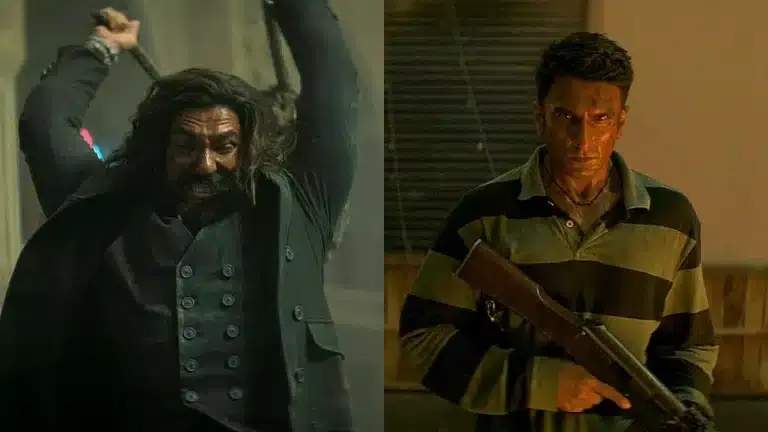
And then there is the unmistakable undercurrent of propaganda. Dhurandhar: The Revenge wears its political gaze boldly, at times blurring the line between storytelling and sermonising. There are moments where the narrative feels less like a film unfolding and more like a position being reinforced. Nationalism here is not subtext, it is text. The good and the bad are sharply defined, leaving little room for moral ambiguity. While this clarity may resonate with some audiences, it also reduces complexity, turning a potentially layered political drama into something more one-note. It is in these stretches that the film feels less like cinema and more like messaging, where spectacle and ideology begin to merge a little too comfortably.
For audiences willing to surrender to its excesses, there is a certain thrill in watching a film this unhinged in ambition. For others, it may feel like too much, too loud and too long. But one thing is undeniable. Ranveer Singh ensures you cannot look away.
Dhurandhar: The Revenge may not always strike the right note, especially where it matters most sonically, but it never once plays safe. And in a cinematic landscape often driven by caution, that in itself feels like a statement.
Read more: Why March suddenly belongs to Dhurandhar 2