


As a child growing up in a small village in Punjab, India, Dr Amandeep Hansra remembers how difficult it was to access healthcare.
She does not remember being vaccinated or visiting a general practitioner.
When she fell ill, her family had to travel what seemed like hours to reach a hospital, with the expense adding to the burden.
Looking back, however, she recognises that those experiences helped shape the doctor she would become.
“As a child, you don’t have the language for ‘health inequity’. You just notice that people have very different options when they’re unwell,” she tells Indian Link. “I think that has stayed with me. I’m interested in who can access care, who misses out, and whether we’re designing services around the people who need them most. That thread runs through much of the work I’ve done since then.”
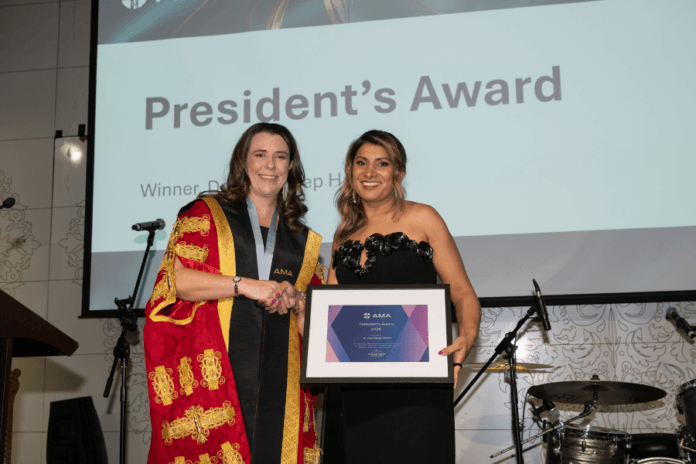
Today, Sydney-based Dr Hansra’s career spans general practice, telehealth, digital-health leadership, entrepreneurship and mentoring. In August this year, the Australian Medical Association (AMA) recognised her contribution to medicine with its President’s Award.
View this post on Instagram
LEARNING TO CARE
Dr Hansra’s understanding of healthcare began at home. Her mother was a nurse, and watching her work offered lessons that no medical textbook could fully capture.
“I think the biggest lesson was that caring happens in the little things – how you speak to someone, whether you listen, whether you help them feel comfortable enough to tell you what’s really worrying them,” she says.
“People really need the human touch in healthcare as it is such a vulnerable moment in someone’s life.”
Clinical knowledge and technical skills are essential, but Dr Hansra believes the experience of being cared for matters just as much.
“Medical school gives you knowledge and clinical skills, but watching my mum helped me understand how desperately people need someone who actually cares. People remember how you made them feel when they were frightened or vulnerable.”
It is a perspective that has stayed with her through roles that have increasingly involved designing and delivering healthcare services on a much larger scale.
Her early career, however, did not follow a predetermined route.
Dr Hansra enjoyed so many areas of medicine during her junior doctor years that choosing a specialty was difficult. General practice ultimately offered the breadth she wanted, allowing her to work across different areas of medicine while developing lasting relationships with patients.
“I liked understanding what was happening around the presenting problem – their family, their work, their circumstances,” she adds.
POSSIBILITIES IN TELEHEALTH : Dr Amandeep Hansra
In 2011, Dr Amandeep Hansra became involved in telehealth at Medibank while helping establish its GP Helpline. What interested her was a practical problem: how to make it easier for people to reach a doctor.
Someone living in a remote area, working inflexible hours, caring for family members or struggling to travel to an appointment might find it difficult to access conventional services. Telehealth offered another way to connect with a clinician.
“I wouldn’t say I had some grand prediction about where it was all heading. I could see a practical opportunity to make care easier to reach,” she recalls. “The questions were how to do it safely, how to support clinicians and how to make it fit with the rest of someone’s care.”
But Dr Hansra is careful not to present digital services as a solution to every healthcare problem.
Her work with rural and remote communities, Aboriginal and Torres Strait Islander people, refugees and people experiencing homelessness has shown her how factors outside the consulting room influence whether someone can seek help.
“Housing, money, culture, transport, language, discrimination and previous experiences of healthcare all influence whether someone can get help – and whether they feel safe asking for it,” she explains. “Technology can make parts of that easier, but it needs people, relationships and properly resourced services around it. A digital service still has to earn someone’s trust and not cause any further inequity.”
PRESCRIBING NEW POSSIBILITIES
Dr Hansra’s career subsequently expanded into healthcare leadership, including becoming CEO and Medical Director of Telstra’s ReadyCare and taking on the role of Chief Clinical Adviser at the Australian Digital Health Agency.
Moving from individual consultations to decisions affecting entire services required a different set of skills.
“In a consultation, you can often make a decision and act on it. In a leadership role, you’re working across diverse teams, budgets, technology, policy and competing priorities,” she informs.
Her overall experience eventually inspired Creative Careers in Medicine (CCIM), a community designed to help doctors explore professional possibilities beyond the conventional clinical route.
Dr Hansra wanted to create the kind of community she had wished for when navigating her own career. Traditional medical pathways were well documented, but practical advice about alternative careers was harder to find.
“I wanted doctors to be able to ask questions without feeling that being curious about another career meant they’d somehow failed at medicine or let people down,” she says.
CCIM offers doctors examples of different career paths, connections and opportunities to learn from people who have already made the transition. The community has grown to more than 25,000 doctors.
“Happy clinicians leads to better patient outcomes and a healthier health system.”
Ask Dr Amandeep Hansra what her initial reaction was to the AMA’s President Award, and she says it was “pure disbelief”.
“My first thought was, what me? Surely others have done more impactful things to deserve this,” she says, adding, “But I was incredibly honoured and genuinely surprised.”
READ ALSO: Dr Raji Krishnan of Perth: AMA President’s honour 2025