The war in the Middle East has dominated attention in recent weeks. Debate will continue over its causes and consequences, but events like these can leave the world feeling uncertain.
Rapid, unpredictable change unsettles people. In recent months, that unease has been amplified by shifting signals from political leaders, where announcements are made, revised, delayed, or reversed. News travels instantly – particularly through social media – and reactions are just as swift. The result, in the short term, is confusion, and a sense that events are slipping beyond control.
It is easy, in such moments, to feel overwhelmed. A cycle of negative headlines can make it seem as though everything is moving in the wrong direction. Yet this is not new. Uncertainty has always been part of the human story.
There is an old saying: if your head is in an oven and your feet are in a freezer, on average you should feel fine. In reality, of course, you would be deeply uncomfortable. It is a reminder that averages and surface impressions can mask lived experience. Right now, that sense of dissonance is widely felt. Middle east war
At such times, a broader perspective can be grounding. Periods of upheaval – wars, global health crises, and rapid change – have come before, yet humanity has continued to move forward.
The all too common sight of a house razed in Lebanon. (Source: UNICEF)
Middle East war
Consider global health. Diseases such as smallpox once caused widespread devastation, until sustained scientific effort led to their eradication. More recently, the rapid development of mRNA vaccines during COVID-19 drew on decades of research. These breakthroughs were not sudden; they were built on persistence, collaboration, and a shared commitment to progress.
The same pattern is visible in technology. The World Wide Web transformed how people connect and share knowledge, opening up possibilities that were once unimaginable.
Even after periods of profound conflict, progress can emerge. In the aftermath of the Second World War, efforts to rebuild and promote cooperation led to frameworks such as the Universal Declaration of Human Rights – an attempt to define shared standards of dignity and fairness.
And there are individuals whose leadership has shaped such moments. Nelson Mandela, after years of imprisonment, chose reconciliation over division, helping guide South Africa towards a more unified future. His story is a reminder that even in times of deep conflict, progress remains possible.
Perhaps that is what we hold on to. Not the noise of the moment, but the longer arc of how societies respond, adapt, and rebuild. The present may feel unsettled, but it is not without direction. Progress is rarely linear, and rarely loud – but it continues, often quietly, beneath the surface.Middle east war
India has several new years: this is not breaking news to most Indians. But the details behind them might surprise you. It surprised me — a Gujarati Indian, who had spent all her life celebrating the New Year in November. Moving to a bigger, multicultural city like Sydney, I realised what the chaos is about in April.
Between 13 and 15 April, various Indian states mark their New Year — celebrating different harvests, speaking different languages, yet arriving at the same date.
This is not magic, but math. The Solar cycle was the decider here. These festivals, Puthandu (Tamil Nadu), Vishu (Kerala), Pohela Boishakh (West Bengal), Bohag Bihu (Assam) and Baisakhi (Punjab and Haryana), are the “I’ll be there at 7 sharp” people.
Somewhere in the world right now, there’s an HR manager staring at two requests — one from a Bengali and one from a Punjabi, for two different New Year celebrations, with a Tamilian quietly drafting a third. They’re probably going to google, “how many Indian New Years are there?”
Numerous day-off requests for different festivals on the same day from employees (Source: Canva)
However, not everyone got the Sun memo. There are some festivals that come around the same time, but never on the exact same dates. Are they just late to the party? Think again. These ones follow the moon instead, and the moon, romantic as it is, runs about 11 days shorter than the solar year. Left unchecked, your harvest festival slowly drifts in winter. So ancient Indian astronomers added an extra month to balance it out. Problem solved, more or less. These festivals, Ugadi (Andhra Pradesh, Telangana, Karnataka), Gudi Padwa (Maharashtra, Goa), Navreh (Kashmir), and Cheti Chand (Sindhi New Year) are “I’ll be there at 7-ish” people.
This took me by surprise as Gujarati New Year always falls in October or November after Diwali in winter. As a mercantile state, Gujarat runs on commerce and not crops. At our New Year festival, we pray to Goddess Lakshmi, and perform Chopda Pujan (where traders close their old accounts books and open new ones), wishing for wealth and prosperity. Hence the New Year follows the accounts and not the harvest.
While everyone else is clarifying that their New Year is not on Diwali, Gujaratis are the ironic exception who actually do celebrate their New Year near Diwali. We are the people who accidentally went to a different party.
New Year resolutions that are long forgotten by June (Source: Canva)
But, if I’m being honest, I always felt that the Gujarati New Year got buried between Diwali and end-of-the-year chaos. Having a new year in Spring and then celebrating another one in December seems like the perfect balance of parties in between working.
Every January 1, people around the world pick up pristine new diaries and chart out bold transformations — only for the enthusiasm to fade by February.
India’s multiple new years solved that problem. Miss one? Don’t worry, we’ll just catch the next one.
Now in Sydney, far from my roots, my curiosity is teaching me more about ancient astronomy than geographical proximity ever could.
Asha Bhosle performing at the Sydney Opera House in 2016 (Source: Neeru Saluja)
Reading Time: 5minutes
RIP Asha Bhosle
There is a particular quality to voices that have survived everything, a kind of earned fullness, like a river that has taken the long route to the sea and arrived, still moving, still singing. Asha Bhosle had that quality. She recorded more than 12,000 songs in multiple Indian languages across a career that stretched seven decades, a fact that staggers the mind when you try to hold it whole. But what the numbers never quite capture is what it costs to keep going. To outlast fashions. To outlast rivals. To outlast, with characteristic stubbornness and grace, your own grief.
She was born Asha Mangeshkar, a classical singer and actor Dinanath Mangeshkar. After his death, the family relocated to Bombay, where Asha began singing professionally as a teenager. Her elder sister Lata was already becoming the sort of legend that fills all available space in a room. Asha, at sixteen, eloped. She took the surname of her first husband. She became, for a time, the wrong story, the one people told as prologue to the real thing. RIP Asha Bhosle
What the prologue left out was that she was, from the beginning, interested in a different kind of song.
While Lata inhabited the classical-devotional ideal of the chaste Hindi heroine, pure, aching, immaculate, Asha went elsewhere. She sang the cabaret numbers. The midnight songs. The ones that moved hips. She sang ghazals with whisky in them, folk songs with earth on them, pop songs with the whole glittering West rattling inside. All genres fell within her reach, giving her a versatility that kept her relevant across multiple generations of listeners and filmmakers. Critics who called this slumming didn’t understand that she wasn’t descending. She was expanding, finding the full lung capacity of what a woman’s voice in Indian cinema was permitted to hold.
R. D. Burman and Asha Bhosle (Source: Bollywood Shaadis)
The collaboration with R.D. Burman in the 60s, 70s, and 80s was where she caught fire and never entirely let it go. The composer and the singer, creative partners first and then husband and wife, built something between them that belonged to no single decade. Songs including “Dum Maro Dum,” “Piya Tu Ab To Aaja,” “Chura Liya Hai Tumne” and “Mera Kuchh Saaman” became indelible markers of the era. The partnership was widely regarded as one of the most creatively fertile in Indian film music. “Mera Kuchh Saaman,” Gulzar’s intricate, almost impossible lyric about a woman reclaiming the scraps of herself from a finished love affair from the 1987 film Ijaazat, remains one of the most technically demanding songs in the Hindi film canon. She delivered it with such devastating plainness that you forgot to notice she was doing something no one else could.
R.D. Burman died in 1994. She kept singing.
Her reach was never simply subcontinental. In 1991 she joined Boy George on “Bow Down Mister,” one of the first high-profile collaborations between a Bollywood playback singer and a Western pop artist. In 2002 she appeared alongside R.E.M. frontman Michael Stipe. In 2005, the Kronos Quartet recruited her to sing on an album of R.D. Burman’s songs, introducing her voice to global concert hall audiences. That same year, The Black Eyed Peas sampled her recordings on their international hit “Don’t Phunk With My Heart.” Cornershop sang “Brimful of Asha” and an entire generation of British South Asian children heard their world reflected back at them in a pop chart for the very first time. The song topped the UK Singles Chart in February 1998. RIP Asha Bhosle
Brett Lee and Asha Bhosle
Then there was Brett Lee. It sounds, on the surface, like a curiosity: one of the most decorated voices in Indian music history recording a duet with an Australian fast bowler. But it was also entirely, characteristically Asha. “You’re the One for Me” (known in Hindi as “Haan Main Tumhara Hoon”) was written by Lee during the 2006 ICC Champions Trophy in India, reportedly composed in thirty minutes between practice sessions. The song tells the story of a westerner trying to woo an Indian girl, with Asha playing the role of an advisor teaching him Hindi in his attempt to impress her. The single debuted at number four on the charts and reached a peak of number two. Lee called her the Aretha Franklin of Indian music, and described the experience as “a tremendous opportunity to work with an absolute legend.” Bhosle, for her part, was characteristically matter-of-fact about the whole thing. “I have been an avid cricket fan, so naturally I know almost all cricket players,” she said. “I knew Brett Lee could sing and strum. He’s young, good-looking, intelligent and a singer.” She didn’t need the collaboration to mean more than it did. She simply heard something she liked and said yes. That lightness, that willingness to play, was itself a kind of artistry.
All of this, and she still wasn’t done. In 2023, she marked her 90th birthday with a live concert in Dubai. Earlier this year, she featured on “The Shadowy Light” in the Gorillaz album “The Mountain.” Ninety-two years old, still laying down new tracks, still reminding anyone who needed reminding that she had never been anyone’s supporting act.
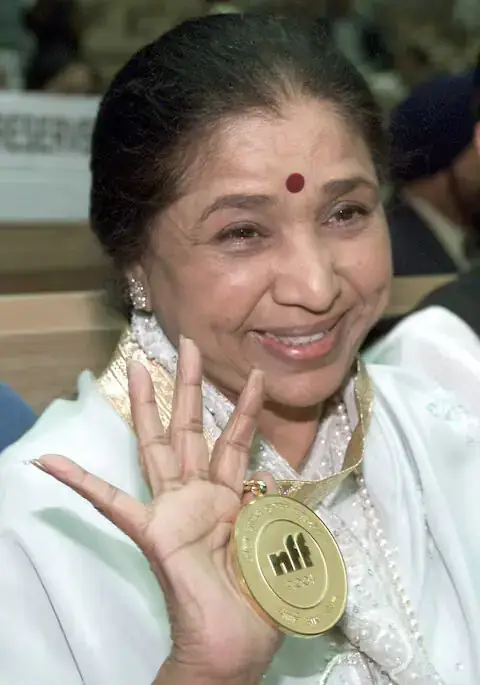
At the National Film Awards
The honours accumulated: the Dadasaheb Phalke Award in 2000, India’s highest film honour; the Padma Vibhushan in 2008; and in 2011, formal recognition by Guinness World Records as the most recorded artist in music history. She opened restaurants. She appeared on television. She lived, abundantly and on her own terms, the kind of life that no one writing her early chapters could have predicted. RIP Asha Bhosle
She passed away on 12 April 2026, following multiple organ failure, at Breach Candy Hospital in Mumbai, the city she had adopted and remade, in some small way, as her own. She was 92.
There is a peculiar thing that happens when you lose a voice you have known your whole life. It doesn’t feel like an absence, exactly. It feels more like a room you’ve always moved through freely that suddenly has walls. The voice was so much a part of the air that you forgot it was made by a person, a person who chose, over and over and over, to keep making it.
Asha Bhosle chose. That is perhaps the simplest and most radical thing to say about her. In a world that offered her a very specific path, she chose differently. She chose the songs no one else wanted. She chose the composer who made her incandescent. She chose to stay on stage long past the point when leaving would have been dignified and easy. She chose, in 2006, to record a song with a fast bowler because she felt like it, because she heard something worth singing.
She chose the joy of it, stubbornly, until the very end. RIP Asha Bhosle
The music remains. Play any of it and the walls come down. The voice finds you again across whatever distance, across decades, across the diaspora, across the particular grief of losing someone you never met and nonetheless somehow knew.
Dum maro dum. Take a breath, take another. It was never just about smoke.
It was always about the refusal to stop.
Indian Link pays tribute to Asha Bhosle. Our thoughts are with her family, and the millions of listeners around the world who grew up listening to her voice.
There is something quietly poetic about manifestation, especially when it unfolds across continents, languages, and the fragile confidence of an artist daring to begin again. For Prashasti Singh, that moment is now.
Standing on a stage at the Melbourne International Comedy Festival (MICF), she is no longer the wide-eyed observer she once was in 2023, sitting in the audience and wondering if she would ever belong inside the circus of it all. Today, she does. And she knows exactly what it took to get here.
“I had this feeling – they are inside, and I am outside,” she recalls of her first MICF experience. It wasn’t just about access; it was about language, identity, and the unspoken hierarchy of global comedy circuits. As a Hindi comic, Prashasti had built a formidable voice back home. But festivals like MICF demanded something else: a leap into English, into unfamiliar rhythm, into vulnerability.
So she did the one thing comedians do best – she rewrote the punchline.
Divine Feminine, Singh’s first full-length English stand-up show, is part Indian story, part human story… and, by her own description, a party by the end. Originally written and performed in Hindi, she reconstituted it entirely in English for a global festival audience, jokes and all. The show runs at the Westin, Melbourne, as part of the Melbourne International Comedy Festival, Tuesday to Saturday at 7.40pm and Sunday at 6.40pm, until April 12.
Finding fame
Singh first found fame in 2018 as one of the top three finalists on the debut season of Amazon Prime Video’s Comicstaan and has since built one of Hindi stand-up’s more recognisable careers. She has appeared on Netflix’s Ladies Up, Comedy Premium League, and released the popular YouTube special Door Khadi Sharmaaye.
An Indian Institute of Management Lucknow graduate who walked away from a marketing career to do comedy, she draws much of her material from that exact biography: small-town Amethi, corporate life, and the specific texture of being a woman in her thirties. Over the years she has toured consistently across continents and extensively within India. Divine Feminine (in English) is her first time taking that work to an international festival stage.
Lost in translation, found in laughter
The shift from Hindi to English was not merely linguistic; it was existential. “I have a comedic brain in one language,” she says candidly. The fear wasn’t of failing jokes, but of losing instinct. Yet somewhere between trial shows and discarded lines, she discovered something quietly empowering – she may be sharper in Hindi, but she is far from lost in English.
Her show, Divine Feminine, carries that duality. Rooted in Indian experience but shaped for a global audience, it lands, unexpectedly and beautifully, even with those far removed from her world.
“One of the biggest surprises,” she admits, “is when an older Aussie man tells me he loved the show.” It is in these moments that comedy transcends its demographic, reminding both performer and audience that humour, at its core, is deeply human.
The art of letting jokes die
Behind the effortless laughter lies a graveyard of jokes. Prashasti’s process is almost ritualistic in its honesty: “I make a lot of bad jokes to get to one good one.” Some die quietly in trial rooms. Others linger, waiting to be reborn in another context, another show, another year.
Comedy, in her world, is not about perfection. It is about persistence. And instinct.
Melbourne: Where work feels like play
For Prashasti, performing at MICF is not just about the stage; it is about the city that holds it. Melbourne, with its parks, cafés, and cultural pulse, becomes both playground and classroom.
“I love being employed here,” she laughs, half-joking about the freelance artist’s paradox,ie, half a day of work, the rest spent soaking in a city that makes ambition feel possible. There is humour in the everyday too, in libraries that feel “too crowded for Australia,” in parks that Indians treat like luxury experiences, and in one universal immigrant truth – we’re not stealing jobs, we’re chasing clean air.
Beneath the laughter lies a more complex truth, one that Indian comedians increasingly grapple with. In a world where offence is unpredictable and reactions disproportionate, Prashasti speaks of a deeper loss: not just of free speech, but of free thought. “You develop a personality that takes a roundabout way of saying things,” she reflects. The fear is not always external; it becomes internalised, quietly shaping what artists dare, or don’t dare, to say.
Even on international stages, that hesitation lingers. And yet, she persists.
Because humour, for her, is not escape. It is coping.
“I think a lot of female humour is coping humour,” she says, almost matter-of-factly, born not from the need to impress, but from the need to survive. To laugh at a world that often refuses to be fair.
Vulnerability, the new punchline
What MICF has given her, perhaps more than anything else, is exposure to a different kind of comedy, one that leans into vulnerability rather than away from it. Watching artists like Lara Ricotti and Josie Long, she found herself moved, not just amused. “You can speak from the heart, be emotional, and still make people laugh,” she says, as though discovering a new grammar of storytelling.
It is a lesson she is still absorbing, one that may shape the next version of her voice.
(Source: Supplied)
A tagline for the journey
If there were a tagline for this chapter of her life, Prashasti Singh has already coined it, with characteristic wit: Now available in both languages.
It is funny, yes. But it is also quietly profound. Because this is not just about language. It is about expansion, about stepping into spaces that once felt out of reach, about reclaiming voice even when the world asks you to soften it.
Somewhere between Hindi and English, between India and Australia, between fear and freedom, Prashasti Singh is doing what comedians do best.
At 13, I genuinely believed the worst thing that could happen on a holiday was losing internet.
So when I found out The Ghan would have limited signal – and not many other kids my age – my excitement quickly turned into panic. A long train journey without Wi‑Fi sounded like a very slow way to be bored. But within hours of stepping onboard, I realised something: the disconnection I was worried about wasn’t a problem. It was the point.
Sarayu and The Ghan (Source: Supplied)
From the start, everything felt a little unreal – in the best way. The staff made us feel welcome straight away, and even small touches like the complimentary bag of goodies made it feel special. I remember thinking this wasn’t going to be an ordinary trip.
Then we saw our Gold Class cabin. It was tiny – especially compared to how massive the train looked from the platform. For a moment I wondered how we were going to survive for days in such a compact space. But the cabin was clever. During the day it was seating; at night it transformed into bunks with a ladder. While we were at dinner, staff quietly switched it over so when we returned the beds were ready, the lights were soft, and a chocolate waited on each pillow. At 13, that chocolate felt like luxury.
My favourite place onboard was the Outback Explorer Lounge. It was where the train felt most alive – people chatting, laughing, watching the Outback slide past the windows. Without my phone as a distraction, I ended up talking to people I’d never normally meet and listening to life stories that made the journey feel richer.
And then there was the food. The Queen Adelaide Restaurant made every meal feel like an occasion – three courses even for breakfast – with native Australian flavours throughout. I tried dishes I would never have ordered at home, including crocodile dumplings, barramundi with sweet potato noodles and caviar, and kangaroo with rosella chutney. I also loved every dessert. Meals slowed time down. You weren’t just eating – you were sitting, talking, noticing.
Off the train, the journey somehow got even better. In Katherine, we chose the Nitmiluk Gorge cruise. The cliffs felt towering and ancient, the water impossibly clear, and along the way we saw Aboriginal rock art. It was beautiful in a way I didn’t yet have words for – I just knew it was special.
In Alice Springs (Source: Supplied)
The next day, The Ghan stopped at Alice Springs (Mparntwe). We explored the town, visited a war memorial, and an art gallery where Indigenous artists were working. Watching artists create in real time made the experience feel alive. Later, we visited Simpsons Gap (Rungutjirpa), a place so striking it made everyone go quiet.
That evening brought one of my biggest core memories: dinner at Telegraph Station. It began with a camel ride and unfolded into a night of great food, live music, and a blacksmith demonstration that sent sparks flying into the dark. Sitting under the stars, talking to people at our table, I remember thinking how rare it felt to experience something so shared.
Simpsons Gap (Source: Supplied)
Our final full day took us to Coober Pedy (Umoona), an outback mining town where many homes are underground. We visited dugouts and an old miner’s dugout, then stopped for a Greek‑style buffet lunch in a cave. After lunch, we tried opal mining, and I uncovered tiny pieces of opal called pock, which felt like treasure because I’d found them myself.
No trip to Coober Pedy is complete without visiting the Breakaways. The colourful mounds looked like a painted landscape, layered and unreal. Nearby is the Dingo Fence, the world’s longest fence, stretching 5,614 kilometres. The Breakaways also come with one final surprise: flies. If you go, bring a fly net. Seriously.
When the journey ended, I felt sad in a way I didn’t expect. I’d boarded worried about going offline. Instead, I’d learned how good it feels to be fully present – to notice a place properly, to talk to strangers, to watch the landscape change without needing a screen.
Now, looking back, I realise The Ghan didn’t just take me across Australia. It taught me how to travel – and how to notice the country, and the people in it, a little more.
Another interest rate rise and a spike in fuel prices is placing increasing pressure on household budgets. Many households are also seeing the impact of the war in the Middle East on the price of groceries.
Now the weekly food shop requires more planning, brand swaps and deciding whether to cut back on non-essentials.
So how can you reduce grocery costs without compromising taste and nutrition?
Plan meals around what’s on sale and in season
Food prices fluctuate week to week, so planning meals around what’s low-cost or on special can make a difference to grocery bills.
A simple starting point is to buy fruit and vegetables that are in season. These are typically cheaper because they are more abundant and require less storage and transport. In cooler months, this includes vegetables such as pumpkin, carrots, potatoes, broccoli and cauliflower, along with fruits such as apples and pears.
Groceries in season are cheaper than off-season, imported ones (Source: Canva)
A practical shift is to “reverse meal plan”. Instead of starting with a recipe, identify what foods are affordable that week and build meals around them. Compare unit prices (per 100 grams or per litre) rather than shelf prices, to identify the best-value options.
Supermarket catalogues, apps or social media accounts such as @Wholesavers and @Supermarket.swap can help identify discounts and compare prices across retailers.
Many staples – including olive oil, cleaning products and pantry items – also follow predictable discount cycles every four to six weeks, making it worthwhile to delay non-urgent purchases.
Shopping habits matter too. Spend 15 minutes before shopping to check the fridge, freezer and pantry, then write a list to limit impulse purchases.
Online grocery shopping may make it easier to track spending and stick to a list, while digital tools can help generate meal ideas using ingredients already at home, such as Woolworths’ online planning tool.
Stretch expensive ingredients and save leftovers
You don’t need to remove meat or dairy entirely to save money. Instead, combine them with lower-cost ingredients.
Mince is a good example: lean beef mince often costs around A$18–20 per kilogram, while dried lentils are closer to $4–6. In practice, this might mean using half mince and half lentils in meals such as spaghetti bolognese, tacos or shepherd’s pie. The flavour and texture remain familiar, but the cost per meal drops and fibre intake increases.
Meal prepping to avoid impromptu food expenses after long days (Source: Canva)
Adding vegetables such as carrots, capsicum and peas can further reduce the amount of meat used. Increase your intake of plant-based foods such as legumes is also associated with lower blood pressure and a reduced risk of heart disease, stroke and type 2 diabetes.
Cooking habits can further extend savings. Using a “cook once, eat twice” approach – doubling recipes and saving leftovers for lunches or freezing for later – reduces reliance on more expensive convenience foods and can improve diet quality. Soups, stews, curries and pasta sauces are especially suited to batch cooking.
Rethink convenience and reduce waste
Convenience foods consistently cost more per kilogram than their basic equivalents. Pre-sliced meats and cheeses, pre-diced vegetables and marinated products often carry a price premium. Whole chicken breast may cost around $14 per kilogram, for example, while pre-cut strips can exceed $20.
Reducing grocery costs can be as simple as buying foods in their original or minimally processed form. Choose whole vegetables instead of pre-chopped options, or plain meat with a homemade marinade rather than pre-marinated products.
Small swaps also add up. Using concentrated stock instead of liquid cartons lowers the cost per litre, buying yoghurt in bulk reduces the cost per serve, and using a spray bottle for oil can help limit unnecessary use.
Buying whole foods instead of pre-chopped or store-prepped (Source: Canva)
Rethink your pantry staples
Some of the most affordable foods are also the longest-lasting. Staples such as lentils, beans, chickpeas, rice, oats and pasta are relatively inexpensive, versatile, and form the basis of many healthy meals. Grains and legumes provide some of the lowest-cost sources of nutrition per serve, making them central for budget-friendly diets.
Buying these items when discounted and storing them for later use can help with food costs over time. Retailers such as Aldi often offer particularly low prices on staples, and buying in bulk, where storage allows, can further reduce costs. Budgeting groceries
Other long-life options can also reduce costs and waste. Powdered milk is often cheaper than fresh and stores well, while frozen fruit and vegetables are typically less expensive than fresh, are nutritionally comparable (and sometimes superior), and last far longer.
Use rewards programs, but know their limits
Supermarket rewards programs can help some households save, especially for those able to shop consistently and track offers.
While there are valid concerns about loyalty programs, such as pushing shoppers to buy things they don’t need, you can activate bonus point deals online before shopping to earn points on items you’re already purchasing. Programs such as Woolworths Everyday Rewards EXTRA offer double points and a 10% monthly discount for frequent shoppers. Budgeting groceries
Other strategies include checking discounted products nearing expiry. Harris Farm Markets’ Save Me Stacks often discounts products by up to 50%, while the Friend of the Farm program provides 5% off vegetables and access to weekly specials and “imperfect picks”. Budgeting groceries
Buying meat directly from farmers and freezing it can also reduce costs, though this requires freezer space and is not accessible to all.
Eating well on a budget isn’t just about individual choices – access to time, transport, cooking facilities and local food environments all shape what households can realistically buy and prepare.
For many lower-income families, healthy diets can be unaffordable. Around 3.5 million Australian households experienced food insecurity in the past year.
While individual households can make small tweaks to their trolleys to save at the checkout, we need broader policy action to reduce the cost of healthy foods and support household incomes.
This article first appeared on The Conversation, written by Lauren Ball, and Professor of Community Health and Wellbeing at University of Queensland and Emily Burch, Accredited Practising Dietitian and Lecturer at Southern Cross University. Read original article here.
Indian Link has won the Best Multicultural Publication Award at the NSW Premier’s Harmony Dinner 2026 a proud milestone celebrating years of storytelling, community connection, and cultural representation. In this video, Rajni & Pawan Luthra share what IndianLink is all about from amplifying diverse voices to building a platform that connects and empowers the Indian-Australian community and beyond.
This is the fifth time Indian Link has won this award, and it marks our 33rd award since the awards were instituted in 2012.
As the Strait of Hormuz remains blocked, and the price of diesel surges, the trucking and transport industries are continuing to feel the pinch.
Today’s news of a brief ceasefire is promising but may not be enough for workers who are ‘weeks away from going out of business’ according to transport advocates.
“It is critical that we see fuel costs paid for by the top of the supply chain—the retailers, manufacturers and mining giants that are already increasing costs for customers, while truck drivers and businesses are struggling to hold on,” he said.
‘An uncertain future’
Transport operator Amar Singh says the fuel shortage is resulting in an ‘uncertain future’ for workers, reduced shifts and redundancies continuing as transport companies divert their income towards petrol.
Morale is low amongst transport business owners and workers, forced to choose between fuel and workers’ wages.
“You feel and hear the pain in their voice…it’s a horrible position to be in,” Singh recounts.
With recently migrated Indian-origin truck drivers making up over five percent of the largely casual and shift-based industry, the fuel shortage has been particularly dire for those still establishing themselves financially.
“In our trucking meetings, I’ve heard from many people even offering to take a pay cut from the company to make sure that they can get some money in, rather than being told that they had to stay home,” explains Singh.
Amar Singh
“You feel that in the general conversations around our tea or coffee breaks, they’re concerned about how they’re going to work.”
Even despite the fuel excise cut, diesel prices have soared to almost 350 cents, nearly double what they were in February 2026.
“I’ve heard from companies that their fuel bill for a week has gone up – say it’s a fleet of 25 to 30 trucks – by almost $50,000 on top of the normal spend,” Singh explains.
“No business has that much sort of running cash around, and that is the scary part.”
‘Bite the bullet and fill up’
The founder of food relief charity Turbans4Australia, Singh says the fuel shortage has caused them to lose volunteers and abandon pick-ups and deliveries of donations.
This has meant they will soon ‘have to send people away’ from their food relief service, an alarming prospect during an already strained economic period.
“There’s only so much reserve stock we have…unfortunately people are going to have to go elsewhere to seek that relief,” Singh says.
Earlier this month, the government passed the Fairer Fuel Bill, allowing the Fair Work Commission to fast-track emergency applications from transport operators.
Many regional bowsers have surpassed $4 for diesel. (Source: Unsplash)
A hearing is underway at the Fair Work Commission, where the Transport Workers Union have applied for a road transport contractual chain order, encouraging major retail clients to take greater responsibility for fuel prices.
Singh warns this latest proposal could devolve into ‘robbing Peter to pay Paul’ if major retailers pass on even more of their fuel costs to consumers.
He hopes instead to see the government freeze heavy vehicle tolls and fuel prices for the transport sector and activate disaster recovery funds for small trucking businesses.
With no intervention in sight, Singh and other transport operators are forced to work through constant uncertainty.
“It does make you think every time you fuel up…but it’s something you can’t really live without, so you have to bite the bullet and fill up and try to keep doing what you’re doing at a smaller scale,” he says.
While an official announcement is still pending, it is expected that PM Modi will be in Australia on 8 July for 48 hours after his first ever visit to New Zealand in the preceding two days.
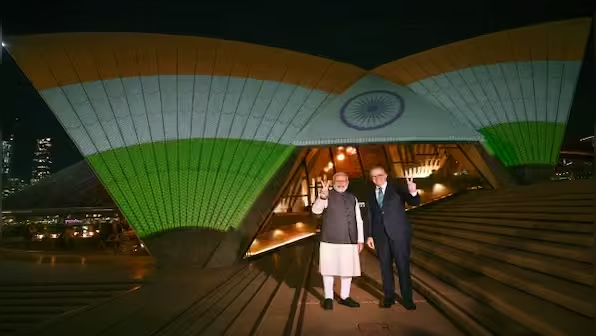
This will be his third visit to Australia. His previous visits in 2014 and 2023 were hailed as landmark diplomatic visits with PM Albanese introducing PM Modi as the Boss and the Sydney Opera House illuminated in the tricolour.
However, uncertainties on the world stage continue to remain a caveat.
“Of course, we need to be mindful about the fast-changing global geopolitics which can cast a shadow over any planned visit, but at the moment, it is all systems go on the visit,” said a source who did not wish to be identified.
No official announcement has yet been made by the Australian Dept of Foreign Affairs and India’s Ministry of External Affairs or its Ministry of Trade and Commerce. It is expected that details will be officially confirmed once the new Indian High Commissioner Nagesh Singh takes up his role this month.
This visit down under, should all go according to plan, will start with a visit to New Zealand on 6 July.
It was 40 years ago that an Indian Prime Minister last visited New Zealand.
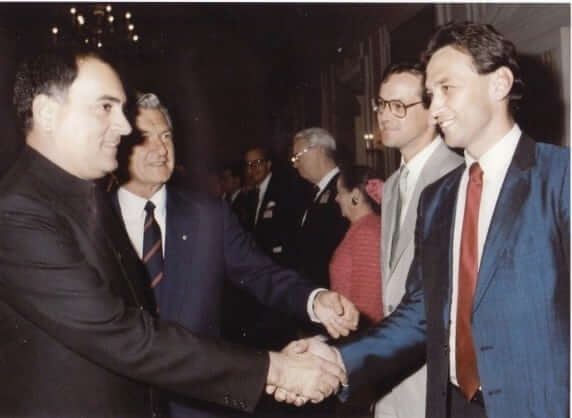
Rajiv Gandhi’s 1986 visit to Australia (Source: File Photo)
Prime Minister Rajiv Gandhi travelled to Wellington in 1986, at a time when global politics were defined by nuclear tensions and ideological blocs. That trip was shaped less by trade and more by shared principles. New Zealand had just declared itself nuclear-free, straining ties with traditional allies, while India championed global disarmament as a leader of the Non-Aligned Movement. The visit underscored common ground on anti-nuclear policy and independent foreign policy thinking, even though economic engagement remained limited.
Should PM Modi’s visit go ahead, India-NZ ties are poised for a reset after nearly four decades, reflecting how geopolitics and priorities have evolved since the Cold War era.
During the PM’s visit to NZ, it is expected that the Free Trade Agreement (FTA), will be formally signed. The two countries concluded FTA negotiations in late 2025 after years of stalled talks, marking a major step forward in bilateral relations.
Once implemented, the FTA is expected to significantly boost trade by reducing or eliminating tariffs on a wide range of goods and services. It will likely benefit sectors such as agriculture, technology, education, and services, while also improving market access for businesses on both sides.
NZ negotiations with India have so far not secured greater progress towards dairy trade liberalisation. (Source: Unsplash)
Earlier negotiations between 2010 and 2015 had failed, mainly due to disagreements over agriculture, particularly dairy. The renewed progress reflects changing economic priorities and a growing interest in strengthening ties in the Indo-Pacific region.
The Indo-Pacific has emerged as a central arena of global competition and cooperation, bringing countries like New Zealand into sharper strategic focus for India. Both nations share concerns about regional stability, supply chain resilience, and the need for diversified partnerships.
Another key shift is the rapid growth of the Indian diaspora in New Zealand. Once relatively small, this community has become economically and politically influential, adding a new dimension to bilateral ties. At the same time, trade discussions have regained momentum, with both sides interested in unlocking opportunities in agriculture, education, technology, and services.
Despite these positive signals, challenges remain. Geographic distance, limited trade complementarities, and differing regulatory frameworks continue to slow progress. Yet the broader trajectory suggests renewed intent.
As both countries navigate a more complex global order, the absence of a prime ministerial visit since 1986 stood out as an anomaly.
PM Modi’s 2026 visit would not only be symbolic but could also mark a turning point – transforming a historically cordial relationship into a more strategic and economically meaningful partnership.
After two days in New Zealand, PM Modi is expected to arrive in Australia on 8 July to spend two days in Sydney.
At a time of challenging international issues, it is expected that the discussions will be on strengthening the Indo-Australian relationship.
It is to be noted however, PM Modi’s planned visit comes amid signs of strain within the Quad grouping, which also includes the United States and Japan. While leaders continue to emphasise cooperation, differences over strategic priorities and global alignments have slowed momentum.
Items high on the agenda will be trade in critical minerals, and also, a focus on the ongoing need of Australian capital for India’s infrastructure development. Both PM Modi and PM Albanese have framed this as a mutually beneficial partnership – supporting India’s growth ambitions while providing Australian investors with access to one of the world’s fastest-growing major economies.
However, taken together, Modi’s visits and Albanese’s outreach to India highlight a maturing partnership – one that remains resilient bilaterally, even as broader regional frameworks face growing uncertainty.
Away from politics, what the Indian diaspora here would be looking forward to, would be another opportunity to hear directly from Mr Modi.
With only 48 hours or less in Sydney, odds are shortening that his address to the Indian diaspora will be on 8 July.
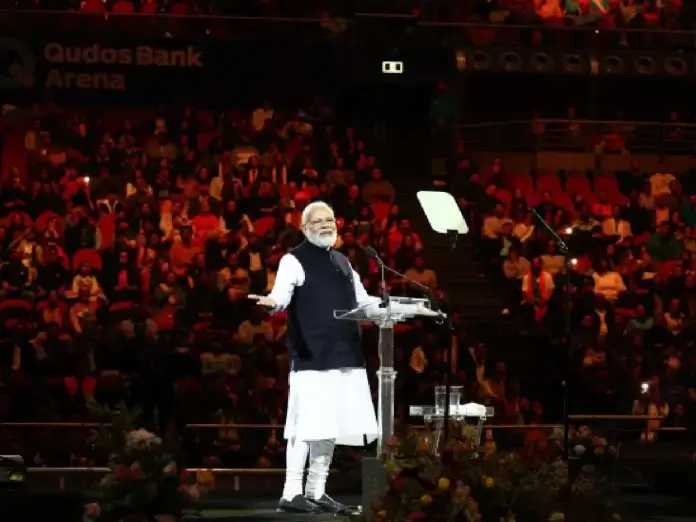
Thousands of fans of Indian Prime Minister Narendra Modi welcome him at Allphones Arena Sydney, Nov. 17, 2014. (AAP Image/Jane Dempster)
His address to the community in his previous visits to Australia in 2014 and 2023, highlighted the growing importance of diaspora engagement in India’s foreign policy.
In 2014, Modi addressed a large crowd at Sydney’s Allphones Arena (now Qudos Bank Arena) during his first visit as Prime Minister.
The event marked a historic moment, as it was his first major outreach to the Indian community in Australia. His speech focused on India’s economic potential, democratic values, and the role of the diaspora as a bridge between India and Australia.
The enthusiastic reception signalled a renewed sense of connection among overseas Indians and set the tone for future engagements.
Australia’s Minister for Foreign Affairs, Senator Penny Wong and India’s External Affairs Minister, Dr Jaishankar and India’s NSA Chief Ajit Doval at the Qudos Bank Modi reception, 2023. (Source: Twitter)
Nearly a decade later, in 2023, Modi returned to the same venue to an even larger and more energetic audience. Over 20,000 people attended, creating an atmosphere often compared to a rock concert.
Anthony Albanese famously remarked that the welcome rivalled that of Bruce Springsteen.
Modi’s speech then emphasised themes such as democracy, diversity, and friendship, often summarised in catchy phrases like “democracy, diaspora, and dosti.”
While the 2014 speech symbolised a new beginning in India-Australia relations, the 2023 address reflected a new maturity and growing strategic alignment.
Three years later, amidst global trade and security uncertainty, PM Modi’s message will be closely heard not only by the Indian diaspora but also by political leadership worldwide.
The name ‘Shakespeare’ almost inevitably comes to mind when we think of literature. Whether on stage or on the page, his works have endured across time: when you consume literature, you inevitably consume Shakespeare, either directly through his works or by means of adaptations and inspired pieces.
With themes of love, power, free will and vengeance, Shakespeare’s plays became universally relevant. Beginning exclusively as performances in theatres, Shakespeare’s plays eventually made their way to the world of movies in 1899 through an English silent film, King John. Indian cinema enters the frame in interesting ways here. Shakespeare’s plays reached India following the English Education Act of 1835 that mandated the use of English Language as the medium for education, and the plays were integrated into the curriculum. Now, with Indian movies having regular roots in Indian epics and inspiration commonly drawn from theatrical forms alongside their staple engagement with high-staked drama, conflict, romance and revenge tales, Indian cinema’s exploration of Shakespeare was almost inexorable.
Recreating, altering and reimagining the original texts, these must-watch movies portray Shakespeare on the big screen with mastery, depth and of course, a perfect touch of Indian cinema’s vibrance.
HAIDER (2014)
Based on Hamlet
Starring: Shahid Kapoor, Tabu, Shraddha Kapoor, Kay Kay Menon
Set against the backdrop of the 1995 insurgency in Jammu and Kashmir, the film follows a a young student and poet, Haider (Shahid Kapoor), who returns to Kashmir to make sense of his father’s disappearance, but soon gets embroiled in the state’s political tension. The film shares plot parallels with the play – a son seeking to avenge his father who was deceived by his uncle, who then married his mother – fusing personal vendetta and political chaos. Hamlet’s iconic phrase uttered in a moment of existential doubt “To be or not to be” is transformed into a political question here amidst a state of crisis “Hum hain ki hum nahin” (Are we, or are we not?). A bold, haunting and intense reinterpretation.
In this adaptation of the tale of the infamous forbidden lovers, the Montague and Capulet clans are recast as two rival Gujarati families, the Rajadis and Sanedas. An opulent and larger-than-life retelling with majestic production designs, this version follows Ram and Leela who fall irrevocably in love but are forced apart by a violent ancient feud raging between their gangster families. Tragic and emotionally intense, the film depicts the sometimes irreconcilable interests of true love and family loyalty, and the consequences that follow.
Two sets of identical twins. One new town. Sounds familiar! In this Bengali adaptation, a merchant (Kumar) and his servant (Bandopadhyay) visit a small town for a business meeting. In a comedic turn of events, they are mistaken for two locals, who happen to be their actual twin brothers whose existence they had been unaware of. Riddled with confusion and plenty of laughter, the film effectively brings the Shakespearean comedy to life in its own unique style.
JOJI (2021)
Based on Macbeth
Starring: Fahadh Faasil, Baburaj, Basil Joseph
In this brilliant Malayalam retelling of Macbeth, Joji (Faasil) is an engineering school dropout who desires to become wealthy without having to work hard. Exhausted from living a life fearing his overbearing and dominating father alongside being prodded by his sister-in-law, Joji murders his father. Driven by his crazed pursuit for freedom and power, his own sins and deceit eventually catch up to him – he and Macbeth shared the same doomed fate. Shakespeare in Indian Cinema
OMKARA (2006)
Based on Othello
Starring: Ajay Devgn, Kareena Kapoor, Saif Ali Khan, Vivek Oberoi, Konkona Sen Sharma
While Shakespeare’s play followed the estrangement of Othello due to skin colour, Vishal Bhardwaj’s adaptation Omkara represents this phenomenon through caste discrimination. Set amid political conflict in rural India, this film recounts the story of Omkara (Devgn) who appoints Kesu (Oberoi) as his lieutenant instead of his loyal right-hand man Langda (Ali Khan), leading to Langda’s rage of jealousy and his subsequent descent as the antagonist. Constructing a vengeful manipulation of Omkara’s thoughts, Langda wreaks a bloody and chaotic tragedy, similar to Othello’s plot. A powerful study of envy, loyalty, love and betrayal, Omkara is an almost verbatim reiteration of the Shakespearean classic, and a must-watch.
ZULFIQAR (2016)
Based on Julius Caesar and Antony and Cleopatra
Starring: Prosenjit Chatterjee, Kaushik Sen, Parambrata Chatterjee, Dev, Nusrat Jahan
A fused adaptation of Shakespeare’s two tragedies, Julius Caesar and Antony and Cleopatra, this Bengali action-crime drama is set in the docks of Kolkata. The film reimagines the Senate as Syndicate, a powerful organisation that illicitly governs the city’s many events. The ascend to dominion of Syndicate’s chief member Zulfiqar (Prosenjit Chatterjee) triggers a fury of jealousy, leading to an unforeseen betrayal by his best friend Basheer (Sen). Following the vengeance for this fatal betrayal by Zulfiqar’s trusted right-hand men Tony (Parambrata Chatterjee) and Markaz (Dev), Akhtar and Laltu Das, the film continues to explore Akhtar’s desire to attain dominance. Director Srijit Mukherjee seamlessly weaves Shakespeare’s other tragedy, Antony and Cleopatra, into the film through the romantic relationship between Markaz and Rani (Jahan). Combining themes of power, loyalty, love and violence, Zulfiqar delivers a high-octane narrative. Shakespeare in Indian Cinema
This Malayalam reinterpretation of Macbeth tells the story of Chandu Chekaver (Kapoor), North Malabar’s legendary warrior. Upon a sorceress’s prophecy that Chandu would become a powerful commander, he gets immersed in a relentless pursuit of dominance and political leverage. Blinded by his maddening ambition, Chandu turns against his own clan and masterminds the downfall of his comrade Aromal (Padmanabhan). Reflecting Macbeth’s tragic end, Chandu’s act of evil leads to his ultimate descent.
In Gulzar’s retelling, two pairs of identical twins who are separated at birth eventually encounter each other years later. Their father Raj Tilak (Dutt) names both his twin sons Ashok (Kumar) and his adopted twin sons Bahadur (Verma). An unfortunate incident divides the family, causing one child out of each twin pairs with Tilak and his wife respectively. When both Ashoks and Bahadurs grow up, they end up in the same city, leading to baffling moments and riots of laughter, making Angoor one of Bollywood’s most iconic comedies. Shakespeare in Indian Cinema
The saga of the ever adored star-crossed lovers travels to the fictional town of Almor in this romantic action film. The Chauhans and the Qureshis are rival families haunted by a legacy of political enmity, yet this friction disintegrates in the hearts of Parma (Kapoor) and Zoya (Chopra) who develop romantic feelings for each other. Despite an initial betrayal, Parma and Zoya’s relationship slowly blooms, but it is heavily opposed by their respective families, pushing them to flee and seek refuge. Wretched and fuelled by emotional intensity, the final standoff stands testament to the devastating pains often experienced by interfaith companions.
MAQBOOL (2003)
Based on Macbeth
Starring: Irrfan Khan, Tabu, Pankaj Kapur, Om Puri, Naseeruddin Shah
This acclaimed reimagination of Macbeth witnesses the Scottish tragedy’s transposition into the Mumbai world of crime. It tells the story of Maqbool (Khan), the right-hand man of Jahangir Khan (Kapur). The Witches from the original text appear in the form of two corrupt policemen (Puri and Shah) who foretell that Maqbool will claim rule over the underworld from his leader. Maqbool and Jahangir’s mistress Nimmi (Tabu) are secretly in love — Maqbool, persuaded by Nimmi and his own desire for power, murders Jahangir and asserts his rule as Don. Haunted by immense guilt and paranoia, Maqbool and Nimmi’s moral corruption turns calamitous for the couple.
QAYAMAT SE QAYAMAT TAK (1988)
Based on Romeo and Juliet
Starring: Aamir Khan, Juhi Chawla, Goga Kapoor, Dalip Tahil
A brilliant take on a romance tragedy, this cult classic narrates the story of Rajveer (Khan) and Rashmi (Chawla) who fall in love, unaware of their families’ enmity resulting from a past dishonour and murder. Rajveer and Rashmi attempt to salvage their relationship, eloping to a deserted fort, but their opposers eventually catch up to them. Succumbing to fierce familial restrictions, the lovers meet their deadly fate. QSQTeffortlessly mirrors the classic play in its passion and intensity. Shakespeare in Indian Cinema