

Australia India travel links rejuvenated through a forum to promote India’s myriad festivals

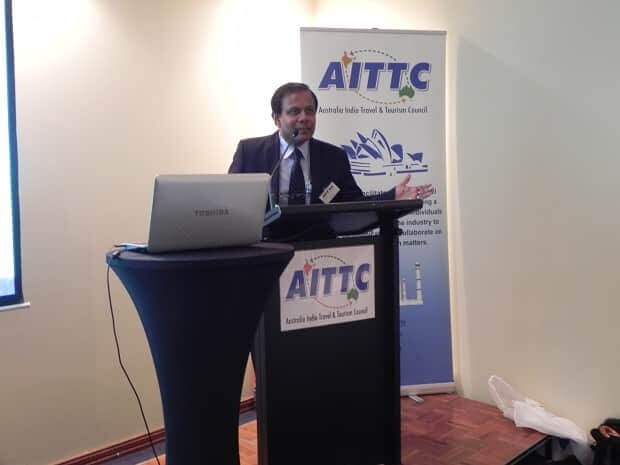
Australia India Travel & Tourism Council (AITTC) is focused on promoting and re-branding travel and tourism ties between Australia and India. Very recently, Managing Director of Tourism Australia Andrew McEvoy suggested that, “the key to unlocking India’s long term potential is improved air access and capacity. Direct flights to Australia are critical to securing a share of the 50 million Indian nationals who are expected to travel overseas by 2020.” In relation to this, Madhu Dubey, Director, India Tourism was invited to present new perspectives via a colourful audio-visual presentation which focused on Festivals of India to a select audience on August 7 at the Grace Hotel in Sydney.
The event was attended by over 50 officials from NSW Travel Agents and Tour Operators and specially invited dignitaries. Also present was David Elliott, Member for Baulkham Hills; Arun Kumar Goel, Indian Consul General, Sydney; Prof Richard Allen, Head of Transplant Australia; Ian Cameron, co-Chairman of AITTC; and officials from India Tourism Department.
Sandip Hor, Chairman of AITTC kicked off the proceedings by emphasising the progress made by the organisation and introduced the new Executive Committee comprised of travel and tourism professionals in Australia. AITTC has the advantage of reciprocity from important travel and tourism organisations from India. He pointed out that amongst the top 50 world-renowned festivals, 7 or 8 Indian festivals figure prominently.
“This is in additional to the widely known tourist attractions, such as the Taj Mahal, the snow clad peaks of Kashmir, the charms of forts and palaces in Rajasthan and the backwaters of Kerala,” he stated.
Hor highlighted a most significant development, Air India recommenced daily flights from Delhi to Sydney and Melbourne by the end of August.
Hor then invited Elliott to address the audience. Elliott said that he felt privileged to be associated with the AITTC as he has a substantial population of Indian diaspora in his constituency. “I have experienced excellent Indian hospitality on my visits to India,” he said, emphasising that he continued to encourage stronger links with India to his Liberal/National party governing New South Wales.
Madhu Dubey held the audience spellbound by her presentation on Festivals of India. The country celebrates over 1000 festivals all round the year, which are categorised as national, religious, harvest related, social, tourism related and local festivals. She spoke briefly about the importance of Independence Day, Republic Day, Diwali, Dussehra and Ganesh Chathurthi which are celebrated nationwide, and bring millions of people together. Dubey underlined the role of various religions in the Indian secular environment and festivals such as Kumbh Mela, Durga Pooja, Eid, Buddha Poornima, Krishna Janmashtami, Gurupurab and Christmas that have a huge following.
India being predominantly agricultural, also celebrates harvest related festivals like Baisakhi, Lohri, Onam, Pongal and Bihu. She described the happy auguries provided by celebrating Holi, Makar Sankranti, Raksha Bandhan, Bhai Dooj and Karva Chauth which serve to strengthen community, family and marital bonds. Dubey brought out the fanfare associated with the kite festival, the mango festival, the Suraj Kund festival, the Pushkar camel fair, the Jallikattu and boat races of Kerala. Her presentation raised repeated and enthusiastic applause.
Arun Kumar Goel then spoke about multinationals like Sony Corporation who are interested in sponsoring some Indian festivals. He also spoke of the importance of the Goa carnival and the bullock-cart races in Punjab which may be regional, but created considerable interest. He spoke of kabaddi as the sport which India introduced to the Asian and Commonwealth Games, and the unique role of India in introducing polo and chess to the world. He concluded by looking forward to the Pravasi Bharatiya Diwas conference to be held in Australia in November 2013.
Travel talk on festivals of India
A winning kick
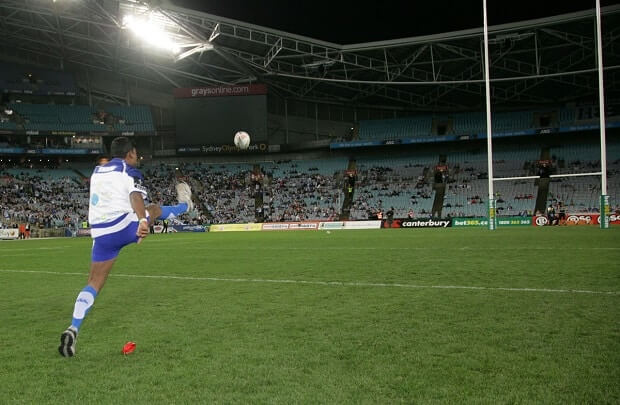
Student from rural India is flown to Sydney in an attempt to score a goal for Canterbury Bulldogs, writes RITAM MITRA

Shivanand Swami, a 29-year-old business networking student from rural India, was not who most spectators expected to see attempting to kick a goal during the last home game of the season for the Canterbury Bulldogs. But it was Swami who lined up for a shot at goal during half-time, attempting to win $1 million as his prize for winning a trading competition run by one of Canterbury’s corporate partners, Easy Forex. Although he missed out on the grand prize, Swami walked away with $20,000 and was certainly one of the highlights for the thousands of rugby league fans who were cheering him on at ANZ Stadium in Sydney.
Swami hails from the Parbhani district in the Indian state of Maharashtra, where he lives with his parents, two brothers, two sisters and their families. Although he makes a living distributing Luminous-branded batteries while studying business networking, he has always had an interest in the foreign exchange and commodity markets. Swami won the competition by making forex trades based on daily market trends. By using guaranteed profit rates, he ensured that 100% of his trades were profitable. He beat thousands of other traders from around the world, including runners up from China and Australia.
Having lived in Parbhani his whole life, winning a luxury trip for two to Sydney was the first of many firsts for Swami when he heard that he won the competition. To begin with, although he would be kicking a rugby ball for the chance to win $1 million, there was a slight problem; he had never heard of rugby league before, let alone kicked a rugby ball. “When I found out that I won the competition, I was excited and was practicing and learning the game, and felt proud that I was visiting Australia for the first time”. In addition, Swami is the first person in his family to ever visit Australia.

However, it was almost over before it began, Swami’s visa was cleared just five hours before his flight was due to depart. To help prepare him for the kick, competition organisers Easy Forex arranged for Swami to have a special session with none other than rugby league legend, Hazem El Masri, who is 300 points clear of Andrew Johns as the leading point scorer in NRL history.
There was, however, a catch; El Masri was not allowed to teach Swami to kick, but only demonstrate by kicking a few goals himself.
“It was interesting,” said El Masri. “I had to try and teach him something without actually telling him about it. I wish him the best of luck”. Asked for his assessment of Swami’s performance leading into the big kick, El Masri had a simple piece of advice. “Get angry! I needed him to get angry, but he’s just too nice”.
On the night, Swami was decked out in official Bulldogs gear, and looked every bit the professional player. “I was obviously nervous when I went for the kick,” he said. “I am disappointed I missed the chance to be a millionaire, but I very much enjoyed the Australian tour. I like Australia very much and the Australian people are very good and cooperative people”.
Unfortunately, as it turned out, Swami’s kicking game let him down and he missed out on the grand prize, but the experience has opened up a world of opportunity for the passionate trader. With his $20,000 in prize money, he plans to open a food processing unit in India and start a forex trading institute in order to teach beginners and advanced traders the best way to trade foreign currencies. The Chief Executive of the Bulldogs, Raelene Castle, was delighted that Swami still received a $20,000 prize. “It was a great spectacle to see Swami out there on the field at half-time, said Castle. “It was great to hear the crowd get behind him”.
Swami himself was still elated with the experience. “I’m so happy I have won this money! I am very grateful to Easy Forex for giving me the opportunity to come to Australia for the first time and see the game of rugby league. This prize will help my family back home in India.”
Although he plans on helping others with the money and his impressive knowledge of the trading markets, there are exciting new things on the horizon for Swami himself. “I am looking to move overseas rather than live in India and I would like to pursue a career in forex and stock market trading”.
Swami does, however, have a score to settle with the rugby ball after missing out on the grand prize. “Mostly [rugby league] is not played in India, but I like the game and I will practice when I am home so I can play this game much better”.
Indian Consulate and its office

An estimated $9 million property owned by the Indian government lies vacant while Sydney’s Indian consulate pays rent. Who is responsible for this waste of thousands of dollars?

India is the 7th largest country in the world and the second most populous. It is the world’s second largest importer of arms. A nascent superpower, it will pass the US economy in size, by 2050 and will be hot on China’s trail. A land of contrasts, as grinding poverty exists in a country which boasts of 61 billionaires and almost 7,900 people with assets of over US $30 million.
Apart from the USA and Japan, India is the only country to have indigenously built a super computer and is among the handful of countries to have launched its own satellites and missiles. In fact, India makes missiles which are three times the speed of USA Tomahawks and harpoons. Almost half the world’s outsourced IT services come from India, around $50 billion.
And, tell me, is the Indian Consulate in Sydney a mission that reflects the above?
In fact, the Consulate has had to move its offices thrice in the past three years. The Indian government appears to have spent almost $9 million in buying premises for the Sydney Consulate in Castlereagh Street over two and a half years ago, but have still not been able to acquire possession. It needs to be forensically investigated and responsibility fixed urgently for this glaring anomaly.
Imagine paying millions in rent, foregoing over a million dollars in interest costs and then spending tens of thousands of dollars in moving premises not once, not twice but three times and still not having an office that they can call their own, despite having paid for it years ago.
It is hard to believe that an aspiring world super-power has a non-descript office in a non-descript building in one of the world’s great cities. Foreign Missions are supposed to inspire awe or at least convey a sense of professionalism as they are the first impressions a visitor forms. The mission’s office should also have a sense of permanence. Take London, where India House has been our headquarters in the UK for over 83 years.
The Indian Consulate in Sydney is also one of the oldest government of India offices abroad, established in 1941 when it started as the Trade Commission of India. Is it not strange that for 70 years, the government of India neither purchased an office building for the Consulate, or a residence for its Consul General?
But, there are stranger things in the property sagas of Sydney’s Indian Consulate. There is the mystery of an empty house in Killara. This was reportedly purchased in the mid-80’s for a senior official (not the Consul General). The house was certainly not a smart buy back then because of difficult access, but despite that it is probably worth five times what the Indian government would have paid for it, thanks to the buoyant property market in Sydney. Currently, an average home in Killara would easily be worth well over a million dollars. To think that the government of India is the proud owner of a dilapidated, empty (at least for three years) bhoot bungla on Sydney’s prestigious North Shore is astonishing.
And things get curiouser, still. About three years ago, the Consulate bought another residence, this time for the Deputy Consul General, in North Ryde. One can safely guess there would not have been change from a million dollars for it.
So, we have the strange situation of the Indian government owning two homes in Sydney and a multi-million dollar office. However, the office is still not occupied and one of the two homes is lying vacant too.
But, one can have some hope. The new Foreign Secretary of India was the previous High Commissioner to Australia, Smt Sujatha Singh. A clean, no-nonsense officer who is certainly one of India’s brightest and best. A review and a clean-up of Sydney’s Augean stables is required. Responsibility must be fixed for the mess and if there have been sins of omission, or commission, punitive action taken.
This column approached Mr Arun Goel, the current Consul General for comments on the above issues, but he politely declined to elaborate, but did point out that all of these decisions had occurred prior to his taking charge in May 2012.
Five steps India must take to restore global confidence
RAHUL SINGH suggests some macro-level actions to reverse the depressing escalation

The recent Global Competitiveness Report 2013-14, ranking India at No. 60, leaves no doubt that these are exceptionally dire times for the Indian economy. This World Economic Forum report of Sep 4 puts India 31 places below its emerging market peer China and barely ahead of Russia; it is India’s lowest rank in this survey.
Concerns on India’s lack of transport, information and communications technology (ICT) and energy infrastructure are “largely insufficient and ill-adapted to the needs of the economy”. This is truly a reflection on India’s lack of commitment to economic development.
The report highlights serious concerns voiced by Tata Sons Chairman Emeritus Ratan Tata last month, when he said: “We have lost the confidence of the world. We have been slow to recognise that in the government.”
The current economic scenario is no less grave than the 1991 crisis. The government is in a state of policy paralysis. A trust deficit irks foreign companies in India. Economic growth tests a new low every month. Independent studies talk of rampant corruption.
The government in an Ostrich-like approach refuses to address serious threats, terming these as a momentary phase that shall pass soon. Economists and business groups call it a policy paralysis and leaderless politics.
The political will is at its lowest in the last few decades, operational efficiency of the government is analogous to the pre-liberalization era and there is visible negotiation for development between inclusive growth and economic growth. However, they ought to go parallel. Since India cannot remain impervious in this globalised and integrated economic eco-system, it has no option but to change and be dynamic in its performance.
The government cannot function on a low performance index for long; it has to be accountable to deliver and be responsible for inaction. The extremely poor Balanced Score Card of Indian government performance demands drastic change before India loses to lowest, if it is still in offering amongst emerging markets.
Here are a few macro-level actions to fix the situation, to arrest the fall and to reverse the depressing escalation:
* First, policies and institutions for restoring global business confidence in India and ensuring ease of operations for business are a must. While it is good to have the attention of the opposition on issues of corruption, social security, and inclusion, it is equally obligatory on its part to extend cooperation to create a dynamic economic eco-system that can speed up growth.
A Business Advisory Council comprising business leaders, management experts and economists is needed urgently to work on policy issues only along the lines of National Advisory Council.
* Second, reforms for doing business and sustaining business are needed on a continuous basis to balance foreign investments. A focussed annual reform plan needs to be introduced. This will help in introducing reforms and managing the developments in the domain. Infrastructure, manufacturing and the supply chain should have an annual execution plan to create a great eco-system. A piecemeal approach does not work and builds no resilience.
* Third, India needs to get started on the path of economic diplomacy besides focussing on the diplomacy of terrorism and security. The fact is developed markets have influence today, but emerging markets will influence tomorrow; so we need to better our relationship with emerging markets. The US diplomatic corps in India is bigger than the Indian diplomatic corps globally. India’s diplomatic capability is disproportionate to its responsibility.
* Fourth, the government should give bigger responsibility to chambers of commerce and the chambers need to share their research and opinions with the government as a bridge between the government and industry. They also have to take up larger responsibility in marketing the nation on behalf of the government and building Brand India.
* Fifth, India needs to introduce single window entry solution policy like few other countries. Countries with a growth risk are looking towards a 25-year plan while India is not even looking at the next five years. India needs to change this and move forward if it wishes to be a significant player in the economic history of the 21st Century.
India, Australia and Southeast Asia
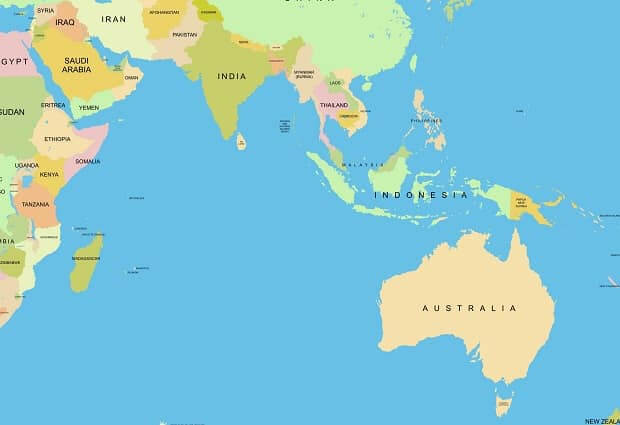
An Asian regional relationship needs to be enhanced and maintained, beyond traditional ties

When World War II ended, the great slogan in Europe was ‘Freedom’. The Nazi assault on freedom was the justification to go to war against them. But when the same war ended in Asia, former colonial powers attempted to reimpose their rule over their former colonies. A glaring example was General MacArthur’s promise of freedom for the Philippines, which was ultimately kept. The two prominent examples of attempted reconquests included the French in Vietnam and the Dutch in Indonesia.
British troops landed in Jakarta with the intention of helping the Dutch to reconquer their former colony in what was arrogantly described as a ‘police action’. It is significant that Bob Menzies, the then Prime Minister of Australia, went against the British action. He teamed up with the then Indian Prime Minister, Jawaharlal Nehru, who was helping the Indonesians to safeguard their newly won independence, and denounced any attempts to re-subjugate Indonesia.
It was the joint initiative of Australia and India in the United Nations which led to the Dutch withdrawal from Indonesia. Menzies had realised the importance of neighbouring Indonesia to Australia. The echo of this sentiment is found in former Prime Minister Howard’s statement that there is no country more important to Australia, than Indonesia. So when he became Australia’s Prime Minister, the first country that Howard visited was Indonesia, and not Britain as had been the norm till then. Prior to this, Paul Keating, as Prime Minister of Australia, had been criticised for having close dealings with Indonesia.
For India, Indonesia is very much its cultural child, its genetic and cultural links with that country being strong and enduring. It was Biju Patnaik, a well-known Indian politician, who personally piloted Indonesian leaders to safety when the Dutch were out to seize them.
In the nineteenth century, both France and the Netherlands had advanced their colonial pursuits in Southeast Asia. During that period their archaeologists had been researching the past of their newly conquered colonies. The tropical jungles of those countries were overgrown and covered large areas where ancient monuments lay. These included Angkor Wat in Cambodia and Borobudur in Indonesia.
Clearing the forest growth was an arduous task. Modern space science methods have been used and have greatly helped to uncover the precise geometry of both Angkor Wat and Borobudur. Angkor Wat is the world’s largest Hindu temple. Its intricate bas-relief carvings reveal the stories of Hindu mythology. Built by the Emperor Suryavarman II, Angkor Wat derives its inspiration from Southern India with regard to design as well as artistic origins. Angkor Wat is an important World Heritage Site. The Archaeological Survey of India has being carrying out restoration work from 1986.
Hinduism and Buddhism converge in Southeast Asia. There may be those who seek to point out that there are ‘great differences’ between Hinduism and Buddhism. However, they need to remember that the convergence of those two religions takes place even in Muslim-majority Indonesia. In Thailand and in Cambodia the royal houses are traditionally Hindu, whilst the general populations are Buddhist. Important occasions have ceremonies conducted by Brahmin priests. Recently, the ceremonies for the funeral of King Norodom Sihanouk of Cambodia were Hindu. A similar situation exists in the royal houses of Bali.
India’s national emblem is the Ashoka pillar. It has been reconstructed from various bits and pieces found in historic sites in India. However, Thailand has several well-preserved Ashoka pillars such as in Chiang Mai.
Borobudur is arguably the world’s biggest Buddhist monument. Built in the ninth century, it encapsulates Mahayana Buddhist philosophy. Constructed during the Shailendra dynasty, it demonstrates the influence of the Gupta dynasty of India. The Gupta Dynasty excelled in several fields such as science, agriculture and the arts. Indonesia remembers its Buddhist past. It has incorporated the Pancha Sila (the five Buddhist principles) into its educational system and its relationships with other countries.
The Shailendra Dynasty covered the central plains of Java as the Medang Kingdom, as well as the famous Sri Vijaya Kingdom. Hinduism and Buddhism flourished side-by-side. In Borobudur, the pilgrim goes through a symbolic journey which marks the ‘three worlds’ of Buddhist cosmology: the world of desire (Kamadhatu), the world of forms (Rupadhatu) and the world of formlessness (Arupadhatu). The monument is large and extensive, and has nearly 1500 panels carved into its walls.
India needs to reinvigorate its relationship with Southeast Asia, for which the cultural base already exists. These countries are also strategically important to Australia. India has a large enough navy to patrol the eastern rim of the Indian Ocean. Its growing naval power should enable it to also have patrols in the Western Pacific as well. News reports suggest that India is building a large aircraft carrier. The sinking of the submarine INS Sindhurakshak has jolted India from any complacency, and it is determined to bring its current ageing fleet up to date.
Put spring on your plate

Put away those recipes for hearty winter soups, heavy roasts and try out some lighter, fresher options

Although the weather seems to be a bit confused, thinking that it was Spring a while back, it’s officially here. And what a beautiful start to it with plenty of sunshine.
This means it’s time to stop cooking heavy meals, and swap them for lighter, fresher, healthier options. It’s time to get the salads bowls back out, clean off the barbeque and put away the slow cooker.
Mango and prawn salad
It’s coming up to mango season (finally!) and when combined with prawns, you know that the warm weather is finally here. This is a quick and easy one. Perfect for throwing together after guests have arrived for a dinner party or taking on a picnic.
Serves 4
1kg uncooked large king prawns
1 fresh long red chilli, chopped finely
2 tbsp light soy sauce
2 tsps sesame oil
2 tsps finely chopped fresh coriander root and stem mixture
2 cloves garlic, crushed
5g fresh ginger, grated
1 large mango, sliced thinly
1 large red capsicum, sliced thinly
1 Lebanese cucumber, sliced thinly
½ cup loosely packed fresh coriander leaves
2 green onions (green shallots), sliced thinly
lime dressing
1/3 cup lime juice
2 tsp fish sauce
1 tbsp grated palm sugar
Devein and shell prawns, leaving tails on. Combine sauce, oil, chilli, coriander, ginger and garlic and prawns in a bowl, and chill in refrigerator.
For the dressing, combine all ingredients in a screw-top jar and shake well.
Cook prawns in a hot frying pan until the colour. Combine prawns with dressing and remaining ingredients in a salad bowl.
Asparagus all wrapped up
Serves 4
16 asparagus spears, trimmed
4 very thin slices prosciutto, cut in half lengthwise
A pinch of salt
Freshly ground pepper to taste
1 tsp extra-virgin olive oil
Toss asparagus with oil, salt and pepper in a medium bowl. Wrap 1 length of prosciutto around the middle of 4 asparagus spears if you want a bunch, and repeat.
Oil the grill rack. Grill the asparagus bundles, turning once or twice, until the asparagus is tender and charred in spots, about 10 minutes.
Pea and mint salad with a dash of fresh goat’s cheese
Serves 4
2 medium red radishes, sliced thinly
1 medium red apple, sliced thinly
½ cup (80g) shelled fresh peas
1 small radicchio, leaves separated
5 small pale celery stalks, sliced thinly
½ cup loosely packed young celery leaves
1 small frisee lettuce , trimmed
½ cup loosely packed fresh mint leaves
220g goat’s cheese, sliced
honey mustard dressing
1 tsp wholegrain mustard
1 tbsp olive oil
1 tblsp honey
1 tblsp lemon juice
Salt and freshly ground black pepper to taste
Boil or microwave the peas until just tender. Drain, them and refresh under cold water, and drain again. Combine the peas with the remaining ingredients in a large bowl.
Combine all of the honey mustard dressing ingredients in a screw-top jar and shake well. Just before serving, drizzle the honey mustard dressing over ingredients and lightly toss.
For an extra in season touch to any meal, add some edible flowers. For a salad you could use nasturtiums, and for a dessert, try a sprinkle of pansies. Just remember that pansies’ pistils and stamens must be removed prior to being eaten. There are plenty of other options, but these two are easy to add to a meal.
Spring fashion fun

Ideas for your own warmer weather wardrobe, inspired by the runway

Love admiring trends, but worry about how they will look on you? Those were exactly my thoughts too, until I recently attended a Spring/Summer fashion event. And ever since my head has been reeling with ideas!
I’ve always loved the concept of runway to real way. I can already imagine you thinking, “How does one actually wear the clothes showcased on the runway by those skinny models?!” Well, that is exactly what I love to do; interpreting runway inspired styling ideas for you and me. So here’s my take on Spring/Summer 2013, hot off the runway, and made all too easy to incorporate into your wardrobe.
1. Black and white
If you are a fashionista, trend spotter or fashion blog reader you probably already know that this is a BIG one! So what’s new about this trend? If you are a believer in black being safe to hide your flaws and white is only for the slim figured, then I’d suggest you get ready to experiment a little. While black is certainly safe and reliable, white can be given a chance with free flowing material and interesting texture. Plus, it’s absolutely perfect for the upcoming warmer months. The way to rock this trend is to try black on black, or white on white, instead of just a standard white blouse with a black pencil skirt. Let me explain – try a black lace blouse with cream fitted pants and a black necklace (for black on black) or a white sheer dress, with white sandals and a striped clutch (for white on white). Other interesting ways to work this are black and white polka dots, or the evergreen black and white stripes and even variegated stripes.
2. Citrus hues
Lounging on the deck with a lemonade is such a lovely interpretation of a spring day! It’s time to bring that refreshing touch to your wardrobe. Think lemon yellow, lime and tangerine. They look incredible when paired with white, or even denim jeans. You could also add this colour to your accessory for the day, I’m talking bags, necklaces, bracelets, scarves or even bright flat sandals to contrast your pretty maxi dress. I’m a big fan of neon highlights and I recommend you add one tiny piece, such as studs or a bracelet, or even nail colour in a neon-ish green or yellow, just to make the look extra bright (if you’re in the mood for it).
3. Animal prints
Who says animal prints are only for Autumn/Winter? There is no such rule; the only rule is to pick a lighter hue, like leopard spots on a white background or reptile print/ texture in a pastel shade. So this spring, wear your favourite animal print pants with a light colour top, dainty ankle strap sandals and a white bag and be ready to turn heads because you’ll not only look gorgeous but right on trend too! Another style tip for wearing animal prints is to keep the rest of the outfit subdued so you don’t go ‘over the top’ with it.
4. Printed accessories
If you are thinking “spring equals floral” and wondering if that is a trend far too out of date, then don’t hold that thought! Florals as far as I can remember will never be out of date in spring. The unusual thing, which I find quite creative this season, is that the floral print will be far trendier on accessories, than clothes, with the exception of printed pants of course. Floral printed wedge heels, Aztec print scarves and delicate print bags are what you’ll notice around, so go and indulge in these. Try and balance printed accessories with plain tops, dresses and pastel blazers, or mix prints if you like; such as stripes and florals, or dots and zig zag prints.
Whether you love trends or you don’t really care, you just can’t ignore the sights around, enticing you to try something maybe just a little bit different. So when you find yourself in that situation, you might think of this article and hopefully it will help you make a stylish decision for your spring wardrobe!
Memories of former Fiji
A vanished world comes alive for Fiji Indians at Blacktown book launch, writes ASHA CHAND

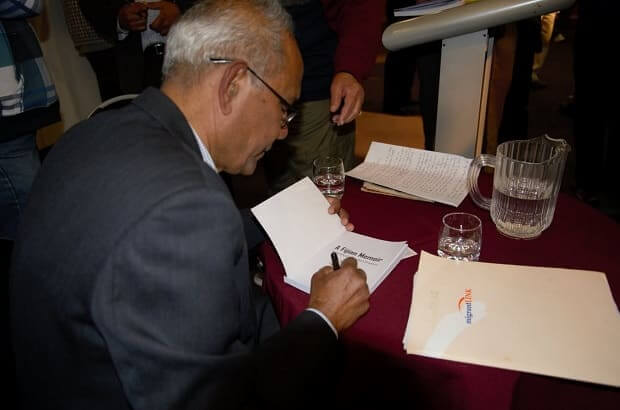
A crowd of more than 200 Fiji Indian Sydneysiders took an emotional trip back to Fiji when they converged at the Blacktown City Library recently for the launch of Pratap Chand’s book, A Fijian Memoir: Footprints of a Girmitya’s Grandson.
Chand, a former education minister in Fiji’s Labour Government and a schoolteacher turned trade unionist, recollected the living experiences of village life amid the perils of dire poverty. Through 15 chapters of his book he presented the carefree spirit of the Fiji Indians, their resourcefulness, capacity to share, celebrate and mourn together, and their value for education.
Brij Lal, Professor of Pacific and Asian History and director of the School of Culture, History and Language at the Australian National University, launched the book amid much pomp and ceremony.
Speaking at the launch, Pratap Chand said the book was his first attempt at ‘writing by remembering’. The project took him a few years to complete as he had to shift priorities, especially when his wife became ill. “I also took time away from the project to care for and raise my grandchildren,” he said.
Chand said he was grateful to his ‘teacher colleagues’, trade union supporters as well as those who believed in his work ethics when he was a government minister in Fiji. Apart from family and friends, the largest support for the launch was from former teachers from Fiji, most of who either worked with Chand or served under him when he was a minister. Roshan Lal, formerly of Waibuka, Ba who attended the event said that he remembered the leading role Chand played in ensuring children attended school.
“We always wanted to do the right thing as students because kaka (uncle) would always question us about our progress at school. We used to be scared when mum would tell us about his visits to our village,” he stated.
Chand recalled how he would travel to villages in the outback where the Fijian communities would lay the red carpet for his welcome. “These villages could not afford much but they would put on a grand show because a government minister was coming to their village. I took pride in serving these villages through better education for their children,” he stated.
Chand said he remembered his own childhood in Fiji as being filled with adventure and fun. He said although they had very little, the Indians in Fiji always worked hard and reached out to help those within their networks. “The Indian community was focused on education and we as a community in Sydney today are benefiting from that investment,” he said.
Prof Lal, a living testament of the power of education, was then invited to launch the book which was sold out on the day,
Reminiscing on the life that was, Prof Lal, himself a son of Fiji who has attended international forays as a voice on Fiji’s history and politics, said the book was an archive of memories of a world disappearing before our eyes.
Touching on the fundamental demographic change that has reshaped Fiji since the 1987 military coup, Prof Lal said that in the 1970s Indians comprised around 50 per cent of the country’s population. “They were the outright majority of the population, with all the fears and phobias that that generated. But now their numbers have declined to around 32 per cent, and going further down, while the iTaukei (indigenous Fijians) now are around 60 per cent of the population”.
Prof Lal predicted that with the changing shifts in the centre of gravity, a time will come when people will find it difficult to believe that Indians were once a majority in Fiji.
He lamented, “The best and brightest have left; those still in Fiji would leave if they could. Now, Sydney, Melbourne, Brisbane, Auckland, Wellington and Vancouver are the new beacon of our people”.
Pointing to these ‘massive’ changes and transformations, Prof Lal called on the audience to pen their own memoirs. “If we don’t write about ourselves, who we are, where we have come from, our hopes and aspirations and fears; who will?” he stated.
Presenting the essence of the book which he initially read in its embryonic form almost a year ago, Prof Lal said at its most basic level the book presented the story of a personal journey; the story of a boy growing up in pre-modern times, without electricity or running water, reading by the flickering wick lamp in the silence of a thatched bure, completing primary school and through sheer effort and determination completing university education and making forays into public life.
“In the course of telling his story, Pratap makes a vanished world come alive. He writes about games children played in the village (gullidanda, suri and hopscotch), about festivals that celebrated life, and the rituals and ceremonies that mourned its passing,” Prof Lal said.
The close-knit communal life that Chand described and celebrated in his book was typical of Indo-Fijian villages all around the country. This life, however, has disappeared in many places as cane leases have not been renewed and evicted tenants have drifted to the mushrooming squatter settlements fringing urban centres all around Fiji, where between 15 to 20 per cent of the total population lives.
“The book is in a very real sense, Pratap’s tribute to that vanishing world that so formed and deformed our lives. Pratap uses his personal experience to reflect the broader forces and influences of history and the processes of social change of which he has been a part, of which he is a product,” he stated.
Prof Lal explored Chand’s antecedents, explain the concepts of girmitiya, and girmit (indenture) in detail. He touched on Chand’s treatment of education, stating that it was written “with intimate familiarity, from the inside as a student, teacher and administrator”. He mentioned the changes in literature that had shaped Fijian education, citing examples from traditional English and Hindi readers. “Pratap is absolutely right to emphasise the centrality of education in our lives,” said Prof Lal.
The highlight of the launch was when Professor Lal showed the audience his own treasured collection of first books, to amazed applause as the majority of attendees had also read the same textbooks.
Prof Lal then enumerated on university education, as propounded by Chand in his book. He explained how opening of the University of the South Pacific in 1968 led to greater opportunities for higher education among the youth of Fiji. “Tertiary education was made available to children from poor homes who could not afford to go abroad. That was how I was able to go to university; that is how Pratap did. The USP was the central catalyst for the emergence of the Fijian middle class of which both us are a part,” he stated.
Chand plans to launch his book in Brisbane and Auckland before the end of this year. “I am waiting for more copies to be published,” he said.
Timely wake-up call for a wounded nation
Satyagraha: Timely wake-up call for a wounded nation, writes SUBHASH K. JHA

Film: Satyagraha
Cast: Amitabh Bachchan, Ajay Devgn, Kareena Kapoor, Arjun Rampal, Manoj Bajpayee, Amrita Rao
Director: Prakash Jha
Rating: ****
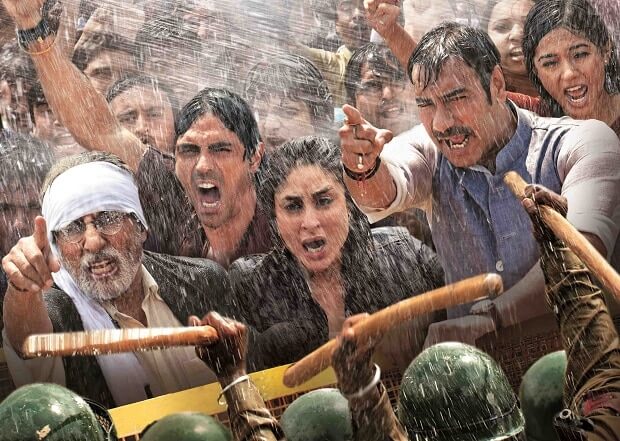
Prakash Jha’s Satyagraha bears no thematic relation to any of his earlier political dramas. It is certainly not a sequel to his Raajneeti, as has been reported in some sections of the media. And yes, it is most certainly based on the movement that Anna Hazare started against corruption. To say that Bachchan’s character Dwarka Anand in Satyagraha, lovingly called Dadujee by one and all, and Dadujee’s turbulent relationship with the go-getting NRI-turned-Gandhian-nationalist Maanav Raghvendra (Devgn) does not bear a resemblance to the Anna Hazare-Arvind Kejriwal equation, would be plain blindness.
What Jha and his very astute and politically informed co-writer and long-time collaborator Anjum Rajabali have done, is to collect together the thematic threads of Anna Hazare’s mass anti-corruption movement and weave it into a gripping, thoughtful, hard-hitting and inspirational drama which contains all the resonances of a newspaper headline, and wrap it up in the semantics of cinema with as little creative violence as possible even while addressing an inherently violent issue.
From the time Jha made his intensely political drama Damul, there has been a constant strife between the director’s personal political ideology and its rendition into cinematically interpreted language. Drama and emotions have always been Jha’s bete noire. In his predominantly brutal domain of interpersonal politics, the human drama is played out austerely, often at the cost of squandering away the chance to draw the characters’ innerscape in an elaborately-charted schema.
In Jha’s Aarakshan, we had seen that trademark emotional austerity in the way he portrayed Bachchan’s relationship with his screen-daughter Deepika Padukone. In Satyagraha, one feels the relationship between Bachchan’s character and his widowed daughter-in-law (Amrita Rao) could have gone a little further. But then Bachchan is the kind of extraordinary actor who can say so much about his character’s emotional environment in the most meagre playing-time. Here, he has that one moment with Amrita Rao when hearing her sob in the dead of the night, he goes into her room to console her… And we know the kind of deep bonding this powerful patriarch shares with his cruelly widowed bahu.
There is little time for emotions in Jha’s world of politics and national awakening. Dwarka Anand gets just one sequence to show how much he misses his son.
It’s the moment when he returns to the scene of his son’s death. The father’s anguish here is palpable, throbbing with unexpressed grief. And then before we can wallow in the moment, Jha’s editor Santosh Mandal mercilessly tears us away from this poignant scene of a father’s loss.
In my favourite scene, Bachchan shares a son-like camaraderie with Devgn’s character telling him how he would miss Devgn when he leaves the next day. It is a deeply contemplative moment where Devgn reacts to Bachchan’s supple emotions with rare care and attention.
Hold on to these infrequent episodes of emotional expression in this turbulent tale of awakening the nation’s conscience where there is no room for individual’s self-indulgence. In fact, Devgn’s growing fondness for the TV journalist Yasmin Ahmed (Kareena Kapoor, lighting up every frame) and the sudden burst of an acutely romantic song seems to belong to some other time-zone.
You see, there’s the business of the country’s future to be attended to. And who better at creating a cinema of socio-political reform than Prakash Jha? The director constantly wrenches away from personal feelings to focus on the broader picture.
Jha’s narration gets busy with the business of swooping down on huge crowds of anxious restless people looking for a way out of the country’s scam-frozen destiny. It’s a world built on the premise of socio-political reform that Mahatma Gandhi and Jayaprakash Narain dreamt of and Anna Hazare attempted to bring to fruition.
There’s an abundance of references to mobilisation of youth power through the Internet and mobile.
Satyagraha probes and questions the validity and motivation of any mass movement that is born out of an inividual’s genuine passion for reform. The pitfalls of such a mass movement are brought into play with a vinegary mixture of broad drama and subtle humour.
It is no coincidence that the film’s arch-villain is a politician portrayed as a kind of evil clown. Manoj Bajpayee plays the scummy ‘scammy’ brazenly corrupt politician with lip-smacking relish. His smirky villainous neta act works as a perfect foil to Bachchan’s controlled never-overdone messianic act.
Devgn, in the all-important role of the ambitious entrepreneur who becomes a catalyst for social change, could have taken his character much further down the road of self-articulation. On the other hand, Arjun Rampal has limited scope as a goonda-turned-self-appointed youth leader. He has great fun sinking his teeth into the rustic accent and boorish body language.
While the three main actors play off each other with supple grandeur, some other supporting actors and characters are played at much too broad a pitch to be effective. When a corrupt policeman takes off his uniform to join the mass movement, you feel the script is teetering dangerously towards over-idealism.
But the message must be, and is, loud and clear. It is time for the nation to chase away damnation before it’s too late. Jha’s film is a timely warning, a massive clarion call for the conscience, brilliantly manifested in Prasoon Joshi’s title song which tells us enough is enough, and listen… getting Gandhian on the cancerous community of corrupt politicians is a symptom of cowardice.
Satyagraha conveys the uncontrollable anger and energy of a nation on the brink. For telling it like it is and for creating a compelling film out of the raw material of present-day corruption, the film deserves a standing ovation.