



Australia-India sports collaboration
As Australian athletes topped the medal tally at the Commonwealth Games in Glasgow, the country’s sports industry has a US$130 billion reason to pay attention to Ahmedabad. The next Games go there, to the home state of Indian Prime Minister Narendra Modi.
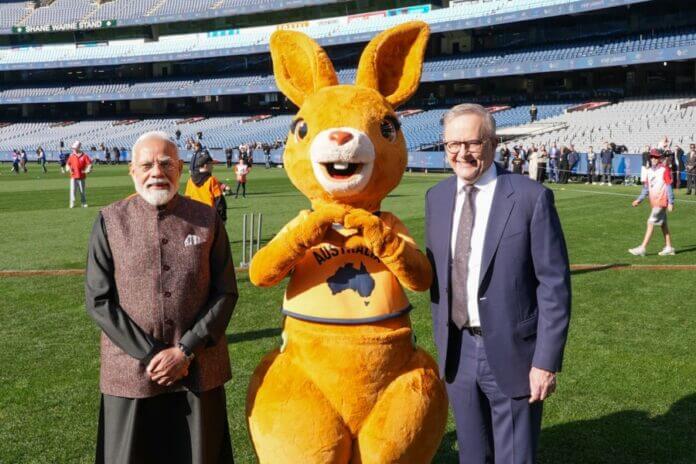
Prime Ministers Modi and Albanese used PM Modi’s recent visit to Australia to open a new chapter in Australia-India sports trade and collaboration. The India-Australia Sports Collaboration Roadmap, launched at the MCG during Modi’s visit, covers sports training and capacity building, sports science and technology, and sports industry and investment. Modi himself said the partnership would extend beyond cricket to sports training, sports science and technology. It is a significant step forward. The question, and it is the right question to ask, is whether this roadmap will be ceremonial or commercial.
Ahmedabad is not just hosting the 2030 Commonwealth Games. It is the centrepiece of India’s active bid for the 2036 Olympics, the Games that follow Brisbane 2032. The infrastructure spend is already underway. The Sardar Vallabhbhai Patel Sports Enclave alone, 350 acres of new sporting infrastructure, represents an investment of approximately A$830 million, with construction commencing this year. The broader 2036 Olympics blueprint runs to A$6-11 billion. And according to Deloitte and Google, India’s overall sports market will reach US$130 billion by 2030, encompassing infrastructure, technology, education and services, precisely the areas where Australia has proven, world-class expertise to offer.

Australia-India sports collaboration
Australian companies are already on the ground, and have been for some time. Populous, whose Asia-Pacific base is in Brisbane, is on the design consortium for the Ahmedabad sports precinct. Catapult Sports, ASX-listed and Melbourne-founded, supplies athlete tracking technology to India’s national football and hockey teams and multiple professional league clubs. Deakin University and Victoria University are running sports marketing and sports science programmes with Indian partners. Each has found its own path into the Indian market.
Which brings us back to the ceremonial versus commercial question. Australia and India signed an MoU on sports cooperation in 2014, renewed it in 2017 and again in 2023. Each time, the language was ambitious: sports science, athlete development, major event management. Each time, the commercial outcomes fell short of the opportunity. The roadmap announced during Modi’s visit is the fourth such framework in eleven years. It is welcome. But a document, however well-intentioned, does not win contracts. The infrastructure decisions shaping CWG 2030 and the 2036 Olympics bid are being made now, and the window to influence them is closing.
Sport also deserves attention on its own commercial merits. It sits in a uniquely clean lane in the bilateral relationship. Defence cooperation carries strategic complexity. Trade negotiations carry political risk. Critical minerals carry geopolitical weight. Sport is the one area both governments can move on quickly, cleanly and with genuine popular support on both sides. And unlike a one-off infrastructure handover, sports investment compounds. Venues need maintenance, technology needs upgrading, partnerships deepen with every season. The education export industry to India, now worth $9.4 billion annually, was built exactly this way, relationship by relationship, institution by institution, over decades. Sport is at that same inflection point, with a formal bilateral framework now attached for the first time.
Making this roadmap count requires three specific things: a coordinated Australian sports industry trade mission to India before year’s end, one that brings together industry and government as a single Australian team; sports services made an explicit priority in the Comprehensive Economic Cooperation Agreement, the landmark free trade deal currently being negotiated; and both governments committing to outcomes that go beyond goodwill, in a way previous agreements did not.
Australia topped the medals table in Glasgow. The real gold, though, for the Australian sports industry, is in Ahmedabad. Winning it will take more than a roadmap.
READ ALSO: Big Bash League in India: Modi and Albanese