


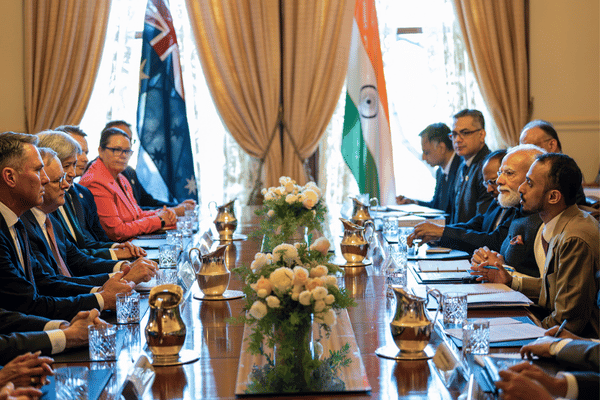
When Anthony Albanese and Narendra Modi shook hands in Melbourne on July 9, closing a stalemate that had outlasted three Australian prime ministers, the moment carried more weight than the modest paperwork suggested. No tonnage was announced. No price tag was attached. Yet the symbolism of Australia, custodian of the world’s largest known uranium reserves, finally agreeing to sell to India was unmistakable. It closed a chapter that began in 2014, when Tony Abbott first signed off on exports, only to watch the deal gather dust for over a decade over unresolved safeguards questions. Australia-India uranium deal
The numbers behind India’s uranium hunt
Australia is only the newest name on a list India has been quietly building for years. In March, Canadian miner Cameco signed a CAD 2.6 billion (about USD 1.9 billion) contract to supply roughly 10,000 to 11,000 tonnes of uranium ore concentrate to India’s Department of Atomic Energy between 2027 and 2035, nearly ten times the value of its 2015 agreement. Russia, meanwhile, remains India’s oldest and steadiest nuclear partner, holding a lifetime fuel supply contract for the VVER reactors at Kudankulam in Tamil Nadu, where units three and four are being fuelled even as construction continues on five and six. India also draws on Kazakhstan’s Kazatomprom and Uzbekistan. Against an annual national requirement estimated at around 1,900 tonnes, and domestic mines in Jharkhand and Andhra Pradesh covering barely 30 percent of that need, imports are not a convenience for India. They are the backbone of its nuclear ambition.
List of outcomes (18 in total) : PM @narendramodi’s Official Visit to Australia
🇮🇳 🇦🇺 pic.twitter.com/4YTiIEL1pt
— Randhir Jaiswal (@MEAIndia) July 9, 2026
Why the world hesitated for so long
To understand why Australia held out, you have to go back to 1974, when India tested its first nuclear device and framed it as a peaceful explosion, and to 1998, when Pokhran-II left no room for that ambiguity. Both moments triggered technology bans and uranium embargoes, because India has never signed the Nuclear Non-Proliferation Treaty, which recognises only five states as legitimate nuclear weapons powers, all of whom tested before 1967. India has long called that cutoff arbitrary, a line drawn to keep the club permanently closed. The freeze began to thaw only in 2008, when the Nuclear Suppliers Group granted India a waiver after intense diplomatic lobbying, largely on the strength of its civilian-military separation plan and its unblemished non-proliferation record outside the treaty framework. Since then, India has built its uranium supply chain one bilateral agreement at a time, each one requiring the buyer nation to satisfy itself, often against its own domestic political resistance, that the fuel would never cross into India’s weapons programme.
Clean energy is the real driver
Strip away the diplomacy and the story is fundamentally about decarbonisation. India currently draws just 3 percent of its electricity from nuclear power, but has committed to reaching 100 gigawatts of nuclear capacity by 2047, enough to light nearly 60 million homes, as part of its Nuclear Energy Mission for Viksit Bharat. Nuclear offers something solar and wind cannot: reliable baseload power, running day and night, without carbon emissions. For a country adding electricity demand at the pace India is, uranium has become as strategically important as oil once was, and considerably cleaner. Australia-India uranium deal
What it means for Canberra and Delhi
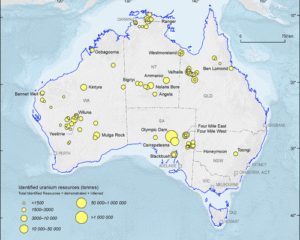
For Australia, this deal is less about the uranium itself, since Australia uses none of it domestically, and more about signalling where it wants to stand. It deepens a relationship already carrying weight through the Quad, critical minerals cooperation, and growing trade ties, at a moment when both countries are recalibrating around China’s shadow in the Indo-Pacific. For India, securing an uranium-rich, strategically aligned democracy as a supplier reduces its dependence on Russia at a geopolitically inconvenient time and diversifies a supply chain that cannot afford single points of failure. It is not a dramatic reset so much as a quiet vote of confidence, one that took twelve years to sign, but may end up defining the next decade of Australia-India ties far more than the ceremony in Melbourne let on.
READ ALSO: ‘A flat white with you, Melbourne’: PM Modi in Australia