


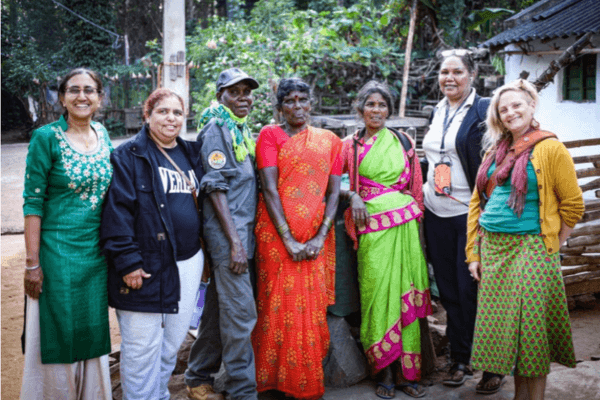

On a trip to Kerala’s Periyar Tiger Reserve, something clicked for Professor Kamaljit Sangha that led to a beautiful cultural exchange.
Having worked with Indigenous Australian communities for over 20 years, and Adivasi communities in the Western Ghats for around 10 years, the Charles Darwin University researcher in Ecological Economics noticed the similarities between the rituals she was observing at the reserve, and those of mob in Northern Australia.
This was the seed of ‘Wonderlands’, a project which saw 12 Indigenous Australian participants from the Kimberlys and Arnhem Land connect with 14 Adivasi participants from the Western Ghats, including Soliga and Mannan people.
“My hope was that they will share a lot of their natural resource management approaches and their practices… it was far beyond that, it was just beautiful,” Professor Sangha says.
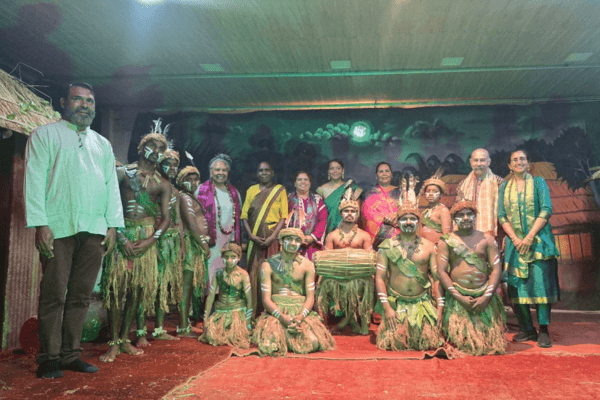
A cultural exchange for mutual empowerment
In early 2025, the Australian contingent spent two weeks in India, visiting places like Mysuru, Thekkady, and the Male Mahadeshwara Hills, to understand how Adivasi from these regions relate to the land.
Then, in March this year, the Indian team visited Australia, travelling to Kakadu National Park and Arnhem Land communities to learn about culture and land management from Top End mob.
Through sharing cultural rituals, experiences and knowledge on land conservation, similarities began to emerge across the two continents.
“The tribal people of the Western Ghats [said they] had special trees that they worship at certain times of the year – so throughout the landscape, except for a few big temples, you won’t see anything except a simple tree with some stones for worshipping,” Professor Kamaljit Sangha explains as an example.
“When we were talking, the Kimberley mob explained that they have boab trees throughout the landscape that they do special ceremonies under. How people connect with natural systems, with different components of nature, like waterways, specific plants, specific animals, that was common between both the groups.”
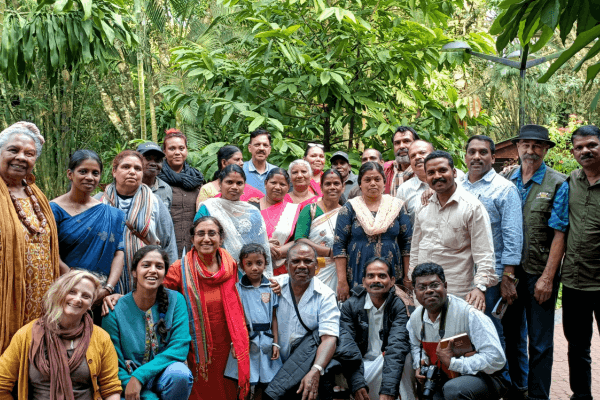
So powerful were the similarities shared on this rare cultural exchange that they transcended the language barrier.
“I think the language barrier didn’t bother them at all. Sometimes they could talk among themselves without any translation at all. That was the beauty,” Professor Sangha says.
But perhaps the biggest learnings were around how to tackle the challenges Indigenous communities globally face. While in India, the Australian group had the chance to learn from Adivasi-owned enterprises cultivating crops and artifacts for their financial empowerment.
“In remote areas [of Australia], it’s hard to do things; sometimes it’s totally dependent on a business or enterprise or the person who leads it. Once that person leaves, then the things fall apart again,” Professor Sangha says.
“How to empower local community people to take the in charge of what they want to do, that’s the biggest thing from the Australian perspective. There was a lot of that two-way learning, our group from here could see how these small-scale enterprises can help them progress.”
A slow, intentional research approach
Supported by CAIR’s Maitri Grant, and Charles Darwin University, the program allowed space for the two contingents to slow down and spend time with each other outside of research imperatives.
“I’m thankful to CAIR for being very accommodating and acknowledging this. We didn’t formulate this to just as an exercise, it was more about people-to-people connections,” Professor Kamaljit Sangha says.
“That’s something that the project has delivered – people are still in touch with each other on WhatsApp.”
Equally, the chance to set foot in another country was a life-changing experience for the participants, many of whom Sangha says had never been on a train or plane.
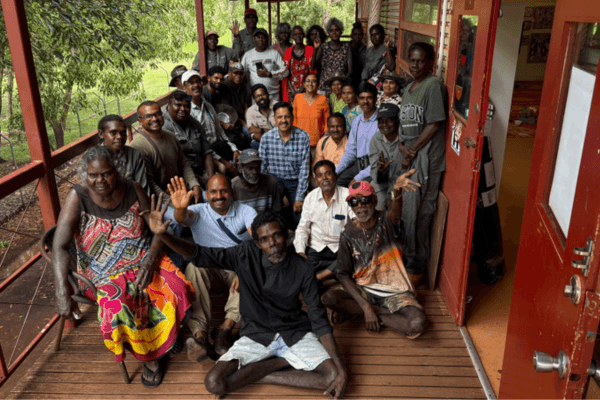
“I could see their excitement. I could see what it means to them, seeing the world outside and then seeing that other people are also like us. It gave them confidence,” Sangha reflects.
“The [Indian group] were all crying when they were leaving here. They said they just can’t believe they had the opportunity to come to another country.”
Most of all, the two groups delighted in having their culture and knowledge systems recognised a continent away.
“A couple of [Soliga] ladies felt very proud of singing their own songs,” she says. “Giving that recognition, it helps people to think that this is something valuable, we should do more of this and encourage them.”
“We need to create a platform for that kind of knowledge systems, because it’s beneficial for both Australia and India.”
READ ALSO: Hayley Millar Baker’s exhibition weaves together her Anglo Indian and Aboriginal identities