


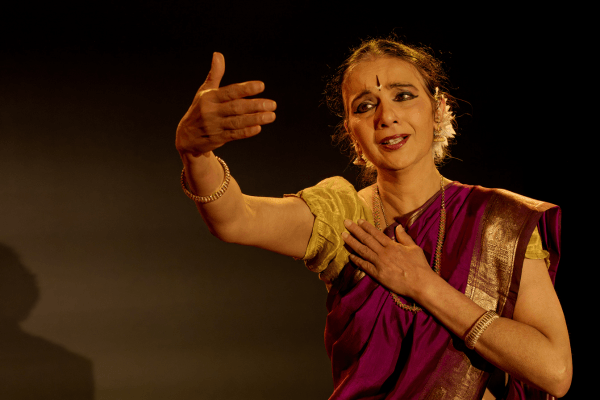

While serving on the board of a women and children’s shelter, Kersherka Sivakumaran often found herself navigating moments of cultural misunderstanding.
“There were a few instances where there were South Asian women who came to the shelter who ended up going back to their family or perpetrator…being a board member, you’d hear the report from the shelter manager,” she recalls.
“I remember feeling a bit uncomfortable with the way that they would talk about it –‘we tried translation services and they were being difficult’, or there would be sentiments around the fact their in-laws called, and they gave in to the pressure.”
Craving a more nuanced understanding of South Asian family violence experience, she decided to draw on her Bharatanatyam performance experience to bring authentic voices to life on stage, founding her company Behind Closed Doors (BCD) Theatre.
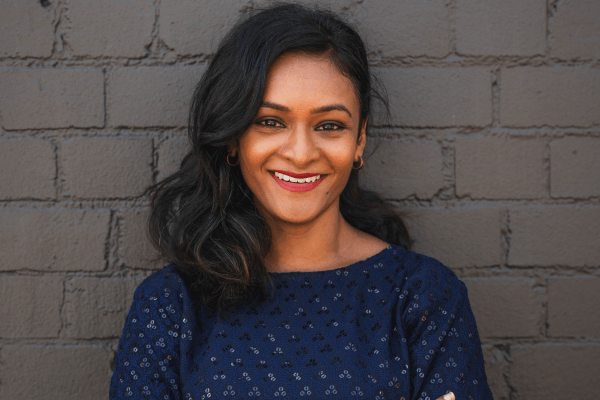
“I knew I wanted [to make a show] about women who stay in a DV situation for their children. Not necessarily to validate that decision per se, but to understand it, [so] we can then support them in viable solutions,” Sivakumaran says.
“For a lot of South Asian women, the idea of leaving [a relationship] doesn’t feel like an option. The system then says we can’t help you, which I don’t think should be the way.”
The result is And What Will People Say – a production which is just as much an ‘electifying theatrical experience’ as it is a community intervention. Receiving two nods at the Sydney Fringe Awards, the production is set to educate and spark much needed conversations about family violence amongst Melbourne audiences at fortyfivedownstairs later this week.
A beautiful form reveals an ugly truth
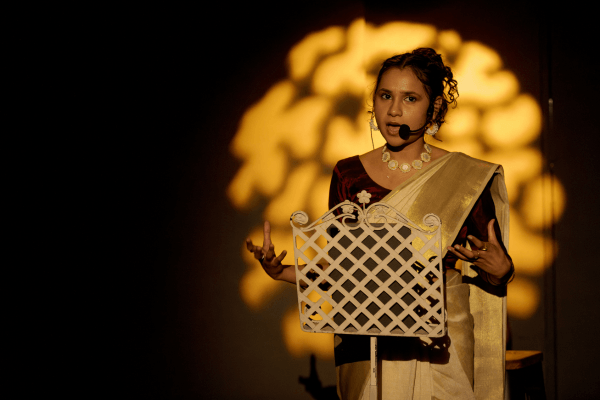
Inspired by Sivakumaran’s time dancing in Bhoomi: Our Country at a previous Sydney Fringe, And What Will People Say fuses classical dance with spoken word to present, without equivocation, the effects of domestic violence on a South Asian mother and her children.
“Even I sometimes struggle to follow a basic Rama Sita story; there are elements to Bharatnatyam that can be alienating or hard to interpret,” she says on the decision to use spoken word.
“In this case, I wanted to drive a deliberate change and be very intentional and articulate; the medium of spoken word helps to facilitate that very well, in that we are telling a very specific story. It’s open to interpretation how you receive that story, but the words are the words, and the story is the story.”
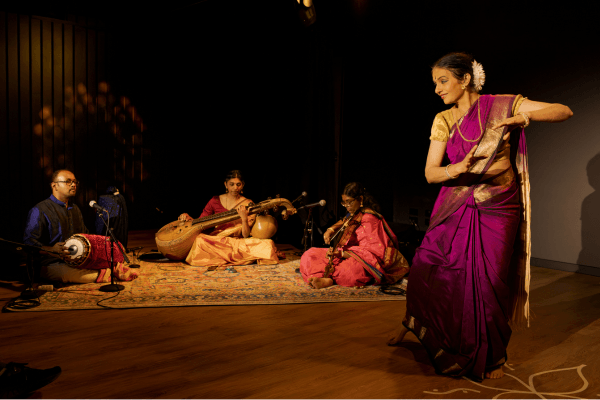
The show continues this juxtaposition of beautiful cultural form with challenging subject matter by embedding live Carnatic music into the performance to say what words and movement can’t.
“Music’s an intentional way for us to guide audience emotions – one part ends quite somber, and we use the music to elongate that somber feeling from the words into music,” Sivakumaran explains.
“There’s another part where it ends intensely, we could easily pile on that intensity and try to get people to cry or something, but we make a conscious choice to pull back a little bit.”
Wary of exploiting trauma and eager not to browbeat the message, Sivakumaran developed the show’s text in collaboration with frontline South Asian DV workers, to ensure it generates conversation and deep listening rather than spectacle or shock.
As such, the incorporation of dance, spoken word and music eases audiences into the confronting themes of the play, creating a space where constructive conversation can occur and wounds can begin to heal.
“I feel like what this show offers is the opportunity to connect on different levels – something will resonate for different people,” Sivakumaran says.
“I remember when I first did the show, a bunch of my friends came, who on face value, I would say had perfect, American TV upbringings. A lot of them were crying at the end, and I remember going up to them and asking why. They said there were so many tiny details in the show they had normalised [in their lives], and only after seeing it presented to them did they realise were problematic.”
Empowering people to break the silence
The aim, Sivakumaran says, is not necessarily to ‘solve’ anyone’s DV situation, but to plant the seed of healthy reflection so audience members feel empowered to start their journey.
“It’s not about making people leave or starting fights between children and parents. It’s about finding some constructive ways to deal with your own processing, and where it’s safe and possible to do so, have courageous conversations with family members, friends, to process these things,” she says.
Underpinning this aim is the focus on audience care, with professional help on standby, and a hot cup of chai and jalebis waiting at the door to whet the appetite for post-show dialogue.
“We want people to stick around for a little bit, let out some of that energy [post-show],” Sivakumaran says.
“We just don’t want people to go back into their cars and drive home when they’re maybe not feeling great. The minute something is free, it’s like permission to stay.”
So compelling is the work however, that Sivakumaran hasn’t needed to convince audiences to stick around and reveal their thoughts and feelings.
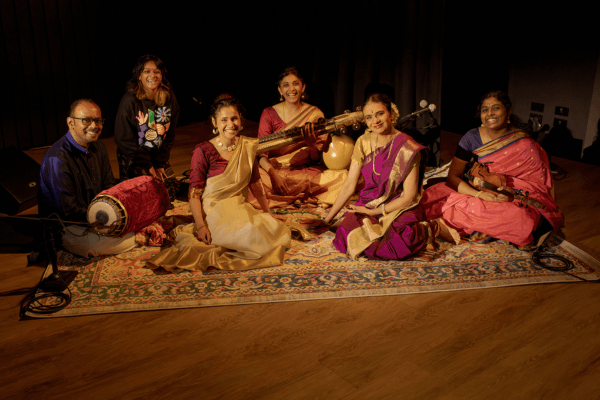
“I’ve had a surprising number of men come up to me and say they experienced domestic violence growing up,” she reveals. “Even when it comes to getting vox pops after shows, it’s a lot of men who have never thought of things from this perspective or even thought about their own experiences and how that was domestic violence.”
Though on the surface And What Will People Say draws from South Asian experiences and art forms, this creative approach to tackling the pressing domestic violence crisis has transcended the community it was originally made for.
“I’ve removed that label of South Asian…[it’s] genuinely broken a barrier of only being understood by or connecting with South Asian people. I’ve had so many people talk about how they’ve never viscerally felt such shifts of emotions,” Sivakumaran says.
But at its heart, And What Will People Say will always be about confronting the stigma that plagues our matriarchs and breaking through our generational silence.
“There’s a scene where the children use the D word, the word divorce – they’re like, ‘you can get divorced, what’s stopping you?’, and the mother’s perspective is laid out in a way that is non-judgmental. It’s recognising the barriers that exist, both the tangible physical barriers alongside the emotional barriers as well,” Sivakumaran explains.
“This piece is not about shaming or blaming. It’s meant to be a love letter to our community; there are truths that sometimes feel invalidated by the Western framing of this issue that we want to acknowledge and find ways to work with.”
BCD Theatre’s And What Will People Say runs from 9 – 12 July 2026 at fortyfivedownstairs in Melbourne.
READ ALSO: Indian Ink’s ‘Balloon Dog’ is Tagore for our trying times