


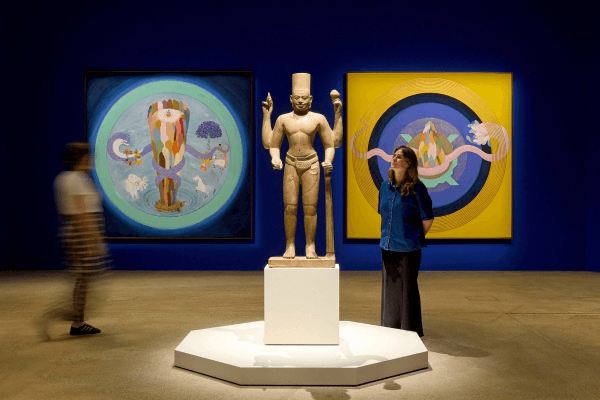

Avatar: Forms of Vishnu
Asleep atop a multi-headed serpent, floating in an ocean of cosmic milk. As a man-lion, a bird, a boar, a fish. As the dwarf Vamana, the prince Rama, and Krishna. These forms all belong to Vishnu, one of the major Gods of the Hindu religion. Blue-skinned and all-powerful, he is the second in the Hindu trinity – the Preserver (the other two being the Creator and the Destroyer). As the protector and restorer of order, Vishnu has appeared in countless forms across space and time: it is these endless incarnations that form the central conceit of the Art Gallery of NSW’s (AGNSW) new exhibition Avatar: Forms of Vishnu.
The largest presentation of South and Southeast Asian art that the Gallery has hosted in over 20 years, Avatar: Forms of Vishnu was curated by Melanie Eastburn, Senior Curator of Asian Art at the AGNSW, and Dr Chaitanya Sambrani, Associate Professor of Art History and Curatorial Studies at the ANU. It is a landmark exhibition for the AGNSW, with an impressive number of artistic traditions and cultures on display, featuring 200+ objects from over fifteen centuries and all across the Asian continent.
The Dashavatara: Vishnu’s ten incarnations
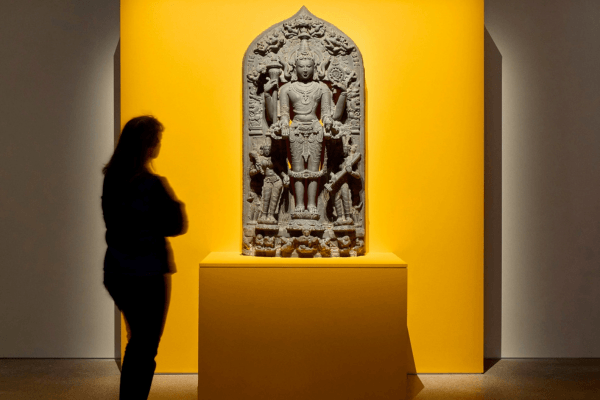
The gallery space is purposefully dim, evoking the sacred interior of a temple, with devotional Indian music filling the air. Welcoming visitors is the visually imposing sculpture Vishnu with attendants, from the Pala Dynasty (700s-early 110s). Set against a saffron backdrop – appropriately chosen for its sacred significance in Hindu tradition – the sculpture presents a powerful, fully embodied Vishnu.
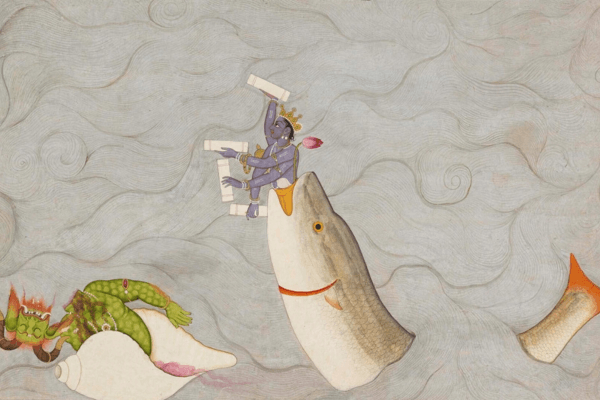
Inside, we get to see all ten forms, or avatars, of Vishnu (the ‘Dashavatara’). First up, an exploration of the early animal incarnations: Matsya the fish, Kurma the tortoise, and Varaha the boar. The story of Matsya is eerily similar to that of Noah’s ark. Both are deluge myths, featuring a single saviour who must build an ark to save humanity from certain death. The exhibition takes great pains to explain Hindu myths to its audience; as a result, one hopes that these parallels become evident to a wider range of people, and we can celebrate just how much common ground there is between cultures, religions and peoples.
Contemporary interpretations of Vishnu
Among the exhibition’s highlights is the Turtle avatar by artist Desmond Lazaro, whose stylised interpretation of the Churning of the Ocean of Milk is inspired by both Indian and Australian landscapes. Threaded through using lustrous, reflective paint, these works are bold and eye-catching in their use of colour and scale. Lazaro’s works tell the story of the Gods’ attempt to retrieve the amrita (an elixir of immortality) from the bottom of the ocean. Their first pass unearths the deadly poison Halahala, but their efforts are eventually rewarded with a host of treasures, and ultimately, the amrita. The moral narrative of this myth, that to reach the best of ourselves, we must confront the ugly, twisted parts, is one that is universally applicable, and Lazaro’s works successfully update this truth for our present day.
As we move from the animal forms to the hybrid Narasimha avatar (a man-lion form), another work of note beckons. Sumakshi Singh’s Thresholds, an installation of cotton and silk, frames a 13th century sculpture of Narasimha. Singh’s practice is novel: her ethereal, web-like installations investigate what endures when structure begins to come apart, probing the fragile boundaries between presence and absence.
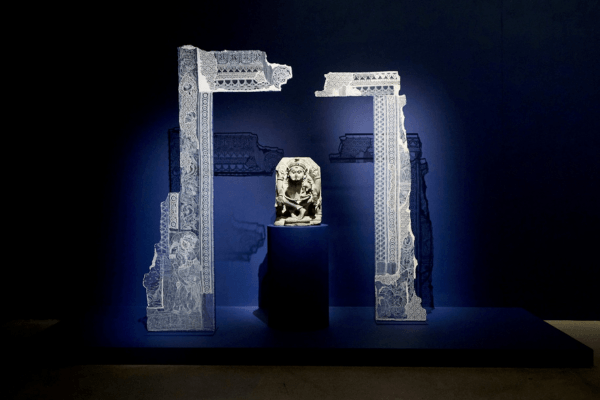
The story of Narasimha is one of liminality, as he must defeat his rival the demon Hiranyakashipu in the space between day and night, between earth and sky, between inside and outside. Singh’s artistic technique mirrors this sense of in-betweenness, and as her threadwork frames the original statue, Narasimha is given a new sense of meaning. This is where the exhibition is at its strongest. The confluence of the ideas Singh explores in her practice and the themes of the myth itself results in one of the exhibition’s most artistically and philosophically resonant moments, breathing new life into Hindu myths that have been retold for centuries.
Vishnu’s other halves
From here on, the focus shifts to the human avatars of Vishnu, and immediately, one of the exhibition’s most interesting artistic interventions becomes apparent – the incorporation of the feminine principle in Vishnu’s stories, his shakthis (strengths). There are separate rooms dedicated to the more well-known avatars Rama and Krishna, which also include depictions of their wives Sita and Radha, opening up traditional understandings of what Vishnu means. Artist Pushpamala N.’s work, for example, depicts the kidnapping of Sita by the demon Ravana in the epic Ramayana, through a staged, Bollywood-esque photoshoot where the artist herself plays Sita. Works like these centre the female characters at the heart of Indian myths, as the curators insist on women’s irreplaceability to Vishnu’s broader story.
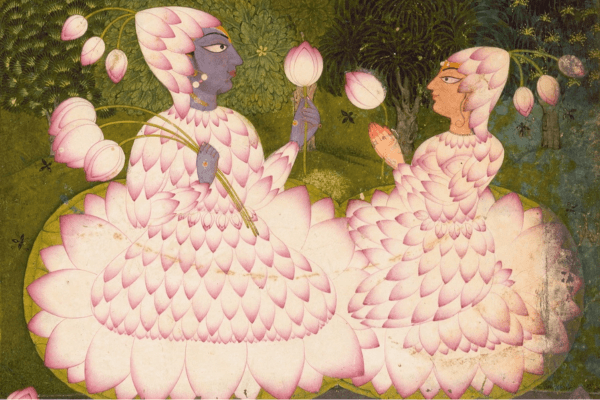
As one continues through the exhibition, the artworks presented become more diverse and eclectic. There are lintels from Khmer temples, Pichhwais (backdrop tapestries) and jewelry from India, a ballet costume worn by dancer Vaslav Nijinsky from the Parisian ballet company Les Ballets Russes, and embroideries from Indonesia.
How ancient Indian myths are represented in the exhibition
While the scope of the exhibition is wide-reaching, it can also be a little overwhelming. Moving from room to room, you are asked to reckon with dense mythologies, many of them probably unfamiliar. The wall text in the exhibition tries to remedy this and provides a thorough knowledge of traditional Indian legends and Gods, for which the curatorial team deserves credit.
While this level of detail is impressive, it is also slightly alienating. There is a lot of cultural, historical, and religious ground to cover, and the exhibition struggles at times to convey these mythologies both faithfully and accessibly. It is hard to understand exactly who the exhibition is pitched at; if you have no background knowledge of the subject matter, you could find yourself adrift, and if you are familiar with the stories being told, the exhibition’s explanatory material is perhaps too rudimentary.
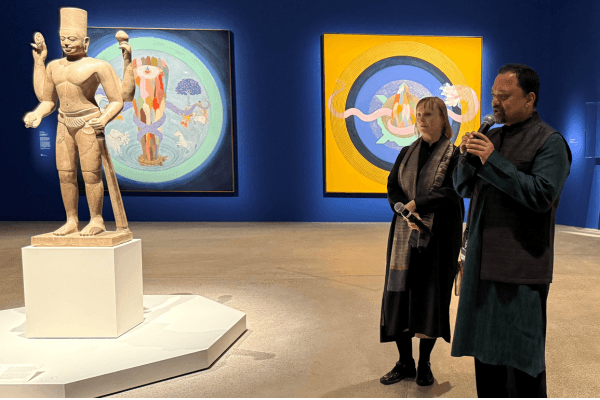
The exhibition is at its strongest when it is using art, rather than words, to explain Vishnu’s forms. At the centre of the exhibition is a giant LED touchscreen, which lights up with animated forms of contemporary Bengali artist Kalam Patua’s kalighat paintings of Vishnu. Viewers can interact with the screen as Vishnu’s avatars reveal themselves, presenting the information in a novel form that is more intuitive than the wall text that tries to summarise the complex narratives of the Bhagavad Gita, the Puranas, and the Mahabharata and the Ramayana.
The enduring relevance of Vishnu
Long after leaving the gallery, several themes resonate. Avatar: Forms of Vishnu represents a significant moment for Indian art and artists in Australia. It engages thoughtfully with and respects South Asian storytelling and artistic traditions, making the AGNSW’s decision to platform them especially significant at a time when cultural othering is increasingly prevalent.
By bringing Indian culture into the mainstream, the exhibition broadens understanding of the myths and legends that define one of Australia’s largest cultural groups, revealing their universality and fostering deeper connection.
The story of Vishnu is one of transformation, resonating strongly with our times. The exhibition ends with Kalki, Vishnu’s final prophesied avatar, who it’s said will descend after an age of darkness and usher in a new era of purity – a necessary message amid today’s geopolitical, cultural and environmental uncertainty.
Ultimately, this is the goal of the exhibition: to show us that the ancient stories of Vishnu are not fading in relevance. Rather, Avatar: Forms of Vishnu is an affirmation of how much we can learn from our oldest stories, and how engaging meaningfully and thoughtfully with our past can help us to navigate our present.
Avatar: Forms of Vishnu is currently open for viewing at the Art Gallery of New South Wales from 20 June to October 2026.
READ MORE: ‘Finding Dada’: Anindita Banerjee’s search for home