


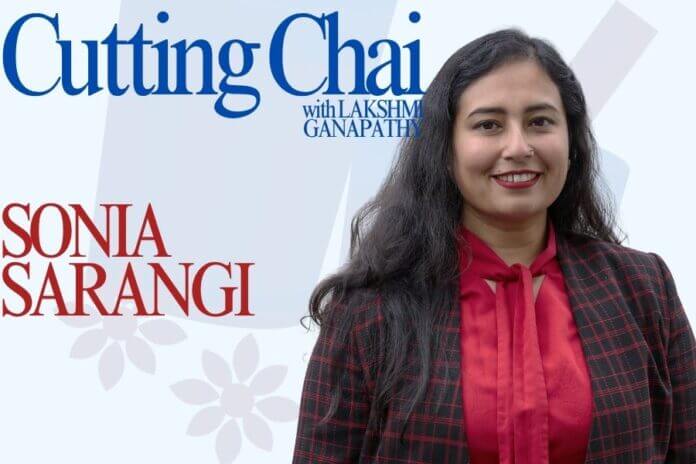

Cutting Chai with Lakshmi Ganapathy is a monthly series of bite-sized interviews with prominent South Asians showcasing their career and personality and celebrating their South Asian Australian identity.
This month we chat with SONIA SARANGI, an architect and co-founder of andever, who incorporate cultural heritage into the design process to create enduring homes. With over 18 years of experience across Asia and Australia, she also teaches at the University of Melbourne’s School of Design.
Lakshmi Ganapathy: Why is light and communal space so important in a South Asian home?
Sonia Sarangi: We are a collectivist culture, so communal space is a big thing – you’ve got people dropping in all the time. Our festivals also don’t limit themselves to a nuclear family; almost everyone’s an uncle or aunty.
I think if you are someone who lives those values, it becomes central to space. When people think of communal space, they often think it needs to be big. That’s not true – it just means the spaces need to bleed into each other and allow for that flexibility.
Whether it be ancient practices or just our preferences, I think the way a lot of older spaces were oriented before we had artificial light to extend our day [meant] the rhythm of your day was [influenced by] where the sun was moving. There’s also the preference for airflow; we don’t like our houses to be closed and stuffy, so even if it’s colder, we will open the window and get that breeze.
I think that awareness of daily ritual and the connection to light matters a lot.
Lakshmi Ganapathy: What makes a house a home?
Sonia Sarangi: I think somewhere where you can truly feel at ease following daily rituals and using the space. Often we don’t know the difference unless we lose it, and feel space constrains us.
For example, you’re making chai, but you don’t want to be cut off from everyone else, you want to be able to have a chat with someone as you’re doing that. If it allows you to enjoy that ritual in the way you want it to, that I feel is what differentiates a house from a home.
A lot of homes here assume we’re going to spend more time in our bedrooms separately, rather than being in a shared space…when it’s enforcing that, then it doesn’t feel like a home.
Lakshmi Ganapathy: Can culturally informed architecture solve our housing crisis?
Sonia Sarangi: I don’t think any one thing will solve our housing crisis. But what I will say is housing that allows choices and is aware of cultural preferences means you have a more robust housing stock where more people can see themselves.
Otherwise, you are essentially setting up homes to fail for the variety of people that could occupy them, so people will instead choose other forms of housing that perhaps are less sustainable, less well connected to neighbours, to transport. When that flexibility is not considered or designed in, you are forcing choices that put more pressure on housing supply.
Lakshmi Ganapathy: What’s something that you’re currently listening to, reading, playing, or watching that you want to shout out?
Sonia Sarangi: I just finished Maxine Beneba Clarke’s Foreign Soil, and wow! That book’ll rip your heart out. I feel like the timing of that book couldn’t have been more perfect with what is happening on our news waves now. It shows the truth of people who have ‘embraced foreign soil’ in so many definitions, and so many parts of the world.
Sonia Sarangi
Lakshmi Ganapathy: What’s a word that you like in a South Asian language and what does it mean?
Sonia Sarangi: Hejibo, which means ‘it will happen’ in Odia – like, you’re not quite sure, but you have faith that between your intention and the universe, it will kind of happen. You know, not everything has to be a five-point plan and a five-year plan kind of thing.
Lakshmi Ganapathy: And finally, Soan Papdi or Papdi Chaat?
Sonia Sarangi: Definitely Papdi Chaat. Making Soan Papdi is a science, but Papdi Chaat is an art – if you up the chutney to sev proportion, you get slightly soggy sev, you scrimp on the chutney, you get slightly crispier sev. I just love the variations of Papdi Chaat that exist; the way I make it is completely difference from how my friend makes it, you can mess around with it.
READ ALSO: Cutting Chai with Nakul Legha