


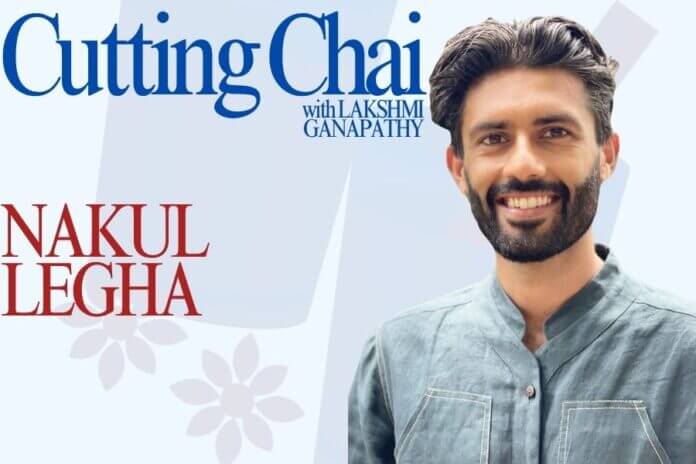

Cutting Chai with Lakshmi Ganapathy is a monthly series of bite-sized interviews with prominent South Asians showcasing their career and personality and celebrating their South Asian Australian identity.
This month’s guest is NAKUL LEGHA, the Head of Scripted content at SBS. He has commissioned new and diverse voices through their flagship Originals and Digital Originals slate, and overseen award winning productions including Four Years Later, Reckless and The People vs Robodebt. Previously at Netflix, he was a Creative Executive on Boy Swallows Universe, Wellmania and ONEFOUR: Against All Odds.
Lakshmi Ganapathy: Do you think growing up without television in Bhutan gave you a clearer sense of what genuine attention feels like?
Nakul Legha: I was an only child; you learned to appreciate the power of your own imagination and your own company, and you also learned to make friends with your neighbours. There was a language barrier with the people that we lived around, but you found other ways to connect with people. You also spent a lot of time outdoors just making up things.
That joy of connection, of knowing that you can find play and imagination in whatever you have, that resourcefulness, I think that’s true of every migrant experience as well; you make do with what you can.
It was the most magical upbringing in the foothills of the Himalayas, looking every morning at tranquil, untouched forests and wildlife. It felt like something out of The Jungle Book.
Lakshmi Ganapathy: You wrote for SBS Voices about being obsessed with talkback radio kings like Alan Jones as a child; what responsibility does our media have in helping people understand Australia?
Nakul Legha: I think powerful media and storytelling help create connection, through both friction and celebration. Media can and should challenge assumptions, and in doing so, build empathy.
The world that I’m in – scripted drama and series – the great joy is we can use the make-believe. We can use larger-than-life characters and genres that audiences love, like romance, crime, thrillers to expand the imagination of what Australia can be.
I think about one of our recent dramas, Four Years Later, which is a romantic drama across India and Australia, it’s in Hindi and in English; an Irish-Australian colleague was brought to tears watching this because it brought to life his own journey of migrating and romance from Ireland to Australia. It’s that kind of connection and the bridges that we can build, especially through drama, that I think is special.
Lakshmi Ganapathy: You’ve said previously that ‘SBS are not in the volume game’ – do you think we’ve become too focused on quantity rather than quality with the advent of streaming?
Nakul Legha: At SBS, we’re the smaller public broadcaster, but we have a very timely and urgent charter responsibility around social cohesion. For us, it’s about commissioning distinctive, creatively ambitious series that have that something to say – that cut through the noise and stay with people, that move hearts and minds. That’s the north star in everything that we commission here.
View this post on Instagram
Nakul Legha
Lakshmi Ganapathy: In these turbulent times, what is an ‘Australian’ story?
Nakul Legha: We spend a lot of time thinking about this. I think the best way I could frame it is in the same way there’s no one answer for ‘what is Australian cuisine’ when someone asks you what’s an Australian dish. An Australian story is one that looks and sounds as diverse as contemporary Australian audiences; the joy of that is that it can mean different things to different people.
Lakshmi Ganapathy: What’s something you’re currently listening to/reading/playing/watching?
Nakul Legha: Satinder Sartaaj. He’s playing a concert; my parents are going tonight to see him. I’ve been down in Canberra for Mother’s Day, and all weekend we’ve been listening to Satinder Sartaaj.
Lakshmi Ganapathy: What’s a word that you like in a South Asian language, and what does it mean?
Nakul Legha: Khatta meetha. I’m always thinking about food. Khatta meetha is great because it’s like the best of both worlds. I think that applies to so much of life – if you can have the best of all worlds, why not reach for it? It also speaks to great stories; they both challenge you and bring you great joy.
Lakshmi Ganapathy: And finally: Soan Papdi or Papdi Chaat?
Nakul Legha: Well, there are no rules to Papdi Chaat, and I love khatta meetha, so I’m going to sprinkle Soan Papdi on my Papdi Chaat and have the best of all worlds!
READ ALSO: Cutting Chai with Shaun Christie-David