


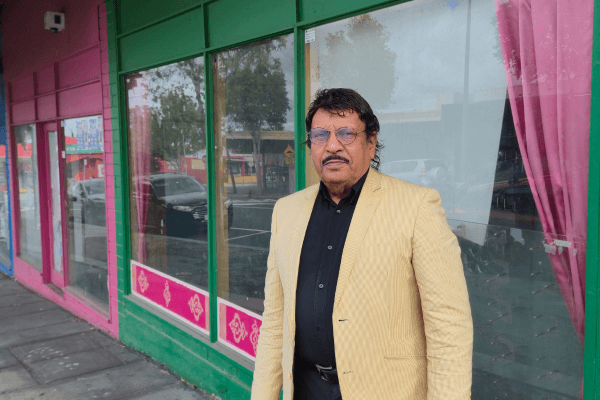

Little India in Dandenong has seen better days.
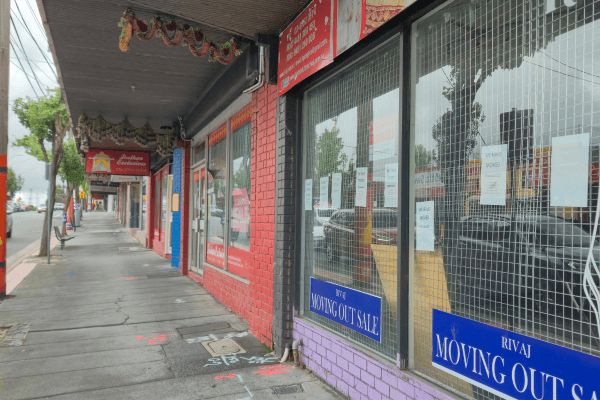
Despite being Saturday afternoon, the place is a ghost town, nary a window shopper in sight. The once vivid shopfronts now appear exhausted, the aroma of masala and agarbathi masked by the fumes of passing cars. Plastic floral garlands hang raggedly from the rafters, muddy and tattered.
Steve Khan, Vice-President of the Little India Traders Association, and shop owner since 1994, still remembers the golden days of the precinct.
“This was [bigger] than Blacktown [in NSW], once upon a time. There used to be people everywhere,” he recalls.
“It was a second home.”
So why is Dandenong’s Little India in such disrepair?
“People have lost interest because it’s going to be demolished – they’re surprised to hear we’re still here.”
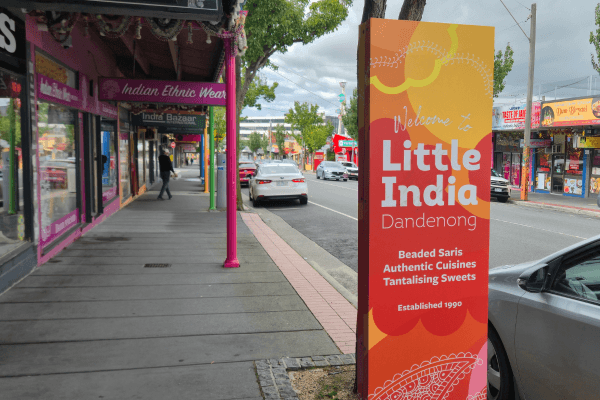
Khan is referring to Development Victoria’s 16-year plan to revitalise the area, which has loomed over traders since 2014. Titled ‘Revitalising Central Dandenong’, it could see small businesses like Khan’s Shalimar café potentially replaced by a supermarket chain, high-rise apartments or a cinema within a refreshed Little India precinct.
Though those behind the plan have promised they ‘don’t want to see Little India disappear’, it’s hard to imagine how the rustic charm of these family-owned businesses might survive within the sleek multi-story build proposed.
With Khan describing developer-trader consultations as ‘minimal’, the plan has left them sitting in limbo for over a decade. Khan says a clause in their leasing agreement even allows developers to evict traders with no compensation.
“This development, high-rise buildings and all, would be an attraction for (new businesses). What’s in these things for me?” says Khan about the plan.
“It’s just the government making things; it will be a symbolic thing with no feel of Indian atmosphere.”
Ironically, about 34 kilometres away, something analogous is unfolding.
As part of their Draft Budget for 2026-27, the City of Melbourne have allocated $1.2 million towards building a Little India precinct in Docklands.
Response to this proposal has been negative, with most responses to the draft budget questioning, amongst other things, the choice of location and seemingly top-down delivery.
Is this poetic coincidence or something more?
The Docklands Debate
With around 13 percent of Docklands’ residents being Indian born, City of Melbourne Councillor Le Liu says the harbourside region was chosen for Little India not only due to diaspora presence, but its centrality.

“It’s easier to put it in a place where it’s kind of neutral. Everyone comes to the city, cities belong to everyone,” Cr Le Liu says. “We are probably the better location…more logically we could be a better curated one. That’s not to say the Little India in Dandenong is not worthwhile.”
But many see the Wyndham or Casey areas as more obvious fits for a Little India precinct, the two municipalities home to the largest shares of Victoria’s Indian population. Steve Khan is equally unconvinced about the choice of location for the new precinct.
“I don’t know how many people would be interested; having a business in Docklands would be expensive compared to Werribee or Tarneit,” he notes.
“They might go there for entertainment, but I don’t think it would flourish as much as [something in] Tarneit, Truganina or Clyde.”
Professor Nikos Papastergiadis, former director of Melbourne University’s research unit in Public Cultures, says cultural connection to an area is essential for building a successful multicultural precinct.

“Traditionally, ethnic communities, like the Italians in Lygon Street or the Greeks on Lonsdale Street, were formed because entrepreneurs, social services and communities were proximate to each other,” he explains.
“It’s that idea of clustering, where because it’s convenient, people gather, and therefore services and shops also develop a certain concentration that enables them to then belatedly establish an identity.”
Professor Papastergiadis is skeptical of whether these conditions have been fulfilled in Docklands.
“I’m not sure there is a bottom-up services and commercial drive and community clustering that’s been formed,” he notes.
“I understand there is some degree of young Indian professionals and international students living in the area. But it’s not clear to me they are driving this new precinct. You then start speculating, as I must, since I don’t know the story of its formation, as to what is motivating its existence.”
Among the bigger blights to the proposal are previous failed attempts to retrofit the disastrously planned Docklands area. A suburb described as a ‘soulless wind tunnel’, Docklands is infamous for its concrete-laden high-rise vistas and lack of public infrastructure, patched over hastily with a cow sculpture here and Ferris wheel there.
Naturally, many Little India opponents have thus viewed the proposal as another attempt to inject life into the area at the expense of the Indian community.
“We can’t use it just to help improve Docklands…that’s the wrong focus and not the right reason to do it,” concedes Cr Le Liu.
Stressing the intent behind the precinct is to celebrate the Indian community’s contributions, he believes unclear messaging and consultation have led to such cynicism about the precinct.
“The surprise from Docklands residents and businesses there saying, without really engaging, we’ve kind of put Docklands [down] – that’s something that we probably haven’t done too well,” he admits.
“We’ve put the cart before the horse.”
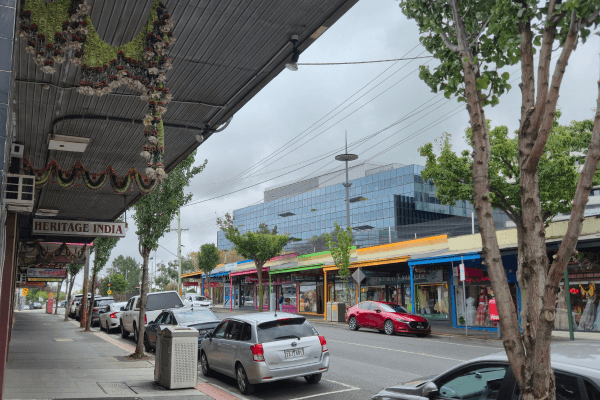
There is something to be said about a centrally located precinct’s potential to unite a diaspora scattered across the outer suburbs of Melbourne, but seemingly, not at the expense of functionality and fit.
Perhaps we can learn something by looking south…
Demolishing Dandenong
Seeking affordable housing during the 1990s recession, the first wave of modern Indian migrants flocked to Dandenong, touted then as a crime-ridden industrial township on the outskirts of Melbourne.
Little India Dandenong emerged organically as a third space for this fledgling community, quickly becoming the go-to place for anything from sherwanis to mithai over the next two decades.
“Coming to Little India was an outing…people used to come from other parts of Melbourne and spend the whole afternoon looking at clothes, buying groceries and having food,” Khan recalls
Formally recognised in 2015, the precinct spans two blocks across Foster and Mason Street and at its peak, was home to 37 South Asian owned businesses.
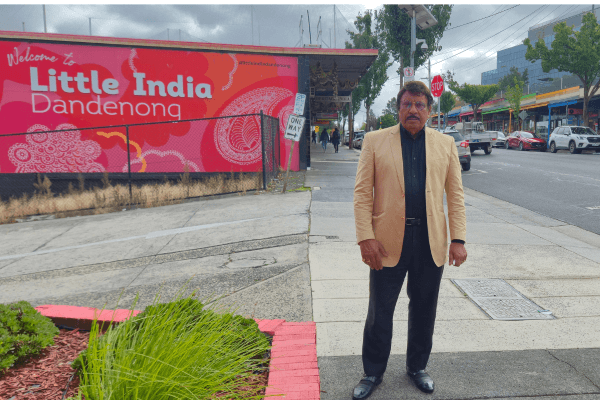
Crucially, it was these business owners who drove the formation of this precinct, shaping it into a hub to help South Asian migrants settle into life in Australia.
Professor Nikos Papastergiadis says it’s this coalescence of location, economic circumstances and community need that give rise to precincts like Dandenong.
“The restaurants that opened in Lonsdale Street had multiple functions for the Greek community. They were employment agencies as well as a community center,” he explains.
“There has to be a symbiosis between accommodation, culture and work; that was certainly the case in Dandenong for the Indian community.”
Migration has been crucial for re-writing Dandenong’s reputation, to the point where it was briefly envisioned as a ‘second city’ to rival NSW’s Chatswood or Parramatta.
Though this plan never materialised, the ‘Revitalising Central Dandenong’ proposal echoes these intentions with its desire to ‘transform central Dandenong into a vibrant and thriving economic hub.’
Since the Whitlam era, Professor Papastergiadis says, governments have recognised the benefits of investing in multicultural precincts.
But careless investment in an area can run the risk of destroying just what makes it special.
Having observed the Greek community of Lonsdale Street, most of whom have since relocated to Oakleigh, he cautions that precinct construction shouldn’t gentrify an area and drive away the very communities it serves.
“As these communities migrate outwards, these old precincts become empty display cabinets,” he notes.
“The dynamism of these places has been hollowed out; they’re not fulfilling the original function of this community centre and vibrant cultural life; they’re performing a different role.”
Professor Papastergiadis says the disparity between curated and organic precincts is marked: “One comes into being because it’s working. The other one you impose in the hope that it might work; this concept of build-it-and-they-will-come is a fantasy.’
The consternation over Dandenong’s planned revitalisation, and now, the proposed Docklands build seems to offer a cautionary tale against curated development; multicultural vibrancy isn’t something that can be constructed.
Cr Le Liu says council are aware of the perils of building a top-down precinct and are keen to hear out the Indian community and Docklands residents in further consultations.
“We can only lead or consult; I don’t think it’s our role to dictate,” he says.
“I would hope that just like with Chinatown, Koreatown and Lygon Street, it’s ultimately up to the community to get behind it. As I said to one group, you can either fight amongst yourselves and you’ll never get it up or come together…it’s in the interest of everyone to do this.”
That message, however, appears to have come too late for Little India Dandenong, many shops now standing derelict as traders move away.
Yes, the 30-year-old facades may need some attention, but not of the gentrifying kind.
“We are not against modernization. We just wanted more input,” Khan says.