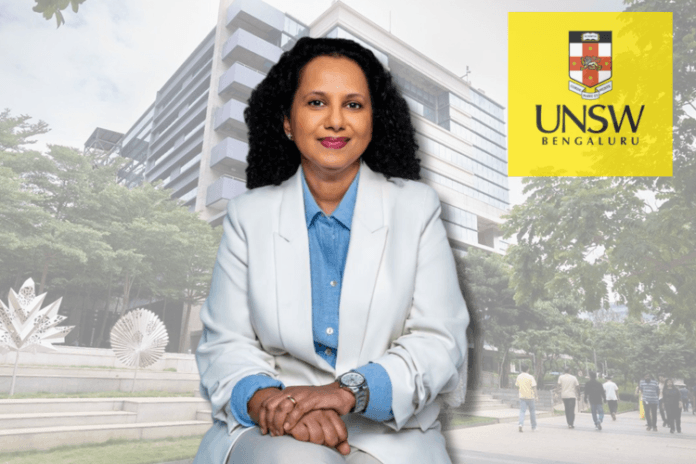

When Professor Payyazhi Vadakkekara Jayashree was asked to lead the new UNSW Bengaluru campus (set to open in August 2026) as Rector, it was not simply another senior leadership appointment. For the academic who began her journey at the University of Delhi before building an international career in transnational education, the role represented something far more personal: a chance to return to India and help shape a new chapter in its higher education story.
“It is deeply meaningful,” she says, “It is not often that one gets the chance to contribute to the founding of a campus of a top global university in India, at a time when India is reimagining the future of higher education, research, innovation and workforce capability.”
After years working across international education systems, including in Dubai, Jayashree believes India is no longer asking only how many students can enter university. Instead, the country’s focus has shifted to a more ambitious question: what kind of higher education will prepare graduates for the future?
That shift, she says, is what drew her to UNSW Bengaluru.
“What made me say yes was the rare combination of purpose, timing and possibility.”
UNSW Bengaluru, located in North Bengaluru’s Manyata Business Park, will enable Indian students to earn a degree from a global top 20 university without leaving the country.
View this post on Instagram
New campus, new beginning
Throughout her career, Professor PV Jayashree has worked in transnational education, but she rejects the idea that international campuses should merely replicate their home institutions overseas.
“Transnational education is not about replication,” she says. “It must listen carefully to students, employers, regulators and communities within the ecosystem in which it operates, while continuing to maintain academic equivalence.”
For Jayashree, UNSW Bengaluru offers the opportunity to build a campus that combines global academic standards with local relevance. Rather than viewing the appointment as another executive role, she sees it as an institution-building exercise that connects UNSW’s strengths with India’s ambitions and Bengaluru’s innovation ecosystem.
“I have seen how powerful it can be when it is done well – not as a simple offshore delivery model, but as a way of expanding access to high-quality education, strengthening transnational research and industry connections, building talent and teams, and creating genuinely global learning environments,” she shares
Full circle moment
The move also brings Professor PV Jayashree’s career full circle.
“India gave me my intellectual foundation. I studied at the University of Delhi, completed my PhD there, and began my academic journey in a system that shaped my sense of discipline, inquiry and public purpose.”
Most recently she served as Dean and Full Professor of Management at the University of Wollongong in Dubai.
Returning to India now, she says, is both “personal and professional”.
“There is something emotionally powerful about returning at this stage of my career. It allows me to connect the arc of my own life: being trained in India, building an international academic career in a transnational higher education context, and now helping to establish and scale a globally recognised university campus in India.”
For decades, she acknowledges, studying abroad has been associated with quality, independence and stronger career opportunities. But that equation is changing as international universities establish campuses in India.
“The proposition is not that staying in India is a compromise. The proposition is that students can receive a globally recognised education in India, provided the campus delivers on quality, experience, employability, research connection and international connectedness.”
Remaining in India, she argues, also allows students to stay connected to the country’s economy, employers and innovation ecosystem while benefiting from global academic standards.
View this post on Instagram
The future looks bright
For Professor PV Jayashree, culture at UNSW Bengaluru is the foundation on which everything else will rest.
“Culture is not created by statements alone. It is created by everyday decisions, behaviours and practices.”
She argues that inclusion, innovation and excellence are deeply interconnected, and that institutions can only thrive when people feel respected, supported and able to contribute diverse perspectives.
Beyond the campus itself, Professor PV Jayashree sees higher education becoming one of the defining pillars of the Australia-India relationship.
When the inaugural cohort graduates four years from now, Jayashree hopes they will remember more than their degree.
“I hope they will say that they were part of something pioneering. I hope they will say they received a rigorous global education, but also felt seen, supported and challenged as individuals.”
She hopes they leave not only with qualifications but with the confidence, relationships and sense of purpose to contribute as global citizens.
And two decades from now, if the campus has fulfilled its purpose, she hopes its legacy will extend well beyond classrooms.
“Twenty years from now, I would want UNSW Bengaluru to be remembered as a campus that helped redefine global education in India – by combining globally benchmarked academic standards, local purpose, applied research, inclusion, innovation and employability to nurture graduates, ideas and partnerships that advanced progress for all across India, Australia and the wider world.”
Read more: UNSW to open Bengaluru campus by August 2026