It takes a special kind of comedian to make South Asians laugh at the songs they grew up crying to. Indian-born comedian Ashwyn Singh has built an online following by translating Bollywood songs into hilariously literal English – and millions of people absolutely love him for it.
The Canada-based artist, whose ‘Desi Translations’ series has already racked up tens of millions of views, is now bringing Australian audiences a taste of his humour with his ‘Wrong Singh To Say’ tour, which runs across the country through May 24.
The title itself hints at the kind of material audiences can expect: sharp observations wrapped in silliness. But Singh insists the biggest laughs rarely come from controversy.
“The show criticises a few different governments and a few different, very popular personality flaws,” he tells Indian Link. “Every joke gets a cheer from a different part of the room, but the biggest laugh always comes from something silly that 99% of people wouldn’t disagree with.”
That contrast – moving from political commentary to hypocrisy in human behaviour within seconds – is what makes Singh’s comedy feel distinctive. One moment he is exploring themes of cultural identity, immigration, religion and family; the next, he is laughing at something deeply unserious.
But none of it is carefully engineered balance, he insists.
“Honestly, there’s no balance!” he says. “There’s just what I wanted to say and finding a way to say it that results in laughs.”
Not a people pleaser
Singh is not particularly interested in making himself more “palatable” for audiences. In fact, he actively resists it.
“The point is for them to connect with who I actually am, not someone I am pretending to be,” he says. “To the degree that I didn’t choose my existence, I refuse to feel remorse for it.”
That unapologetic authenticity has become central to Singh’s comedy.
If audiences sense warmth beneath the commentary, he believes it comes from sincerity rather than strategy.
“I’m not trying to make anybody feel any type of way,” he shares. “I’m just trying to get them to understand how I feel sometimes.”
Born in India and now based in Canada, Singh says his journey has been less about fitting into labels and more about escaping them. While he admits he code-switches occasionally in daily life, the stage is the one place he refuses to bend.
“On stage the whole point is to be myself” (Source: Supplied)
“On stage the whole point is to be myself, and to have the freedom to do so without having to bend in any direction,” he says. “I do what I want – no switches.”
His ‘Desi Translations’ Reels on Instagram may be wildly funny, but Singh realised early on that people were responding to more than just the punchlines.
“People do hold on to their childhood with a certain fondness, before it was adulterated by responsibility,” he says. “So I think that shines in some of the songs.”
Still, Singh’s comedy is not without risk. His material frequently touches on politics, mental health and global conflicts — topics that can spark backlash online almost instantly.
“I’m probably a little more careful now, just because I have more experience and know how people will react,” he says.
But caution has not replaced courage.
“I don’t think courage is the absence of fear though, I think it’s acting despite the fear that you feel,” he explains, describing his current approach as “controlled recklessness”.
An unfunny comic
Canada, India, Europe, and now Australia – he has performed across wildly different audiences. But which crowd has surprised him the most, we ask?
“London – just because I never expected it,” he confesses.
It would be the wrong Singh to say that he’s unfunny. (Source: Supplied) Ashwyn Singh
And after finding love both online and on stage, Singh cannot possibly choose which is harder – writing a sharp 30-second Instagram reel or sustaining a meaningful 90-minute live set.
“Neither is difficult,” he says. “Writing something sincere that you can stand behind and that connects with people is difficult, the format [whether Reel or live set] is irrelevant.”
So, how is Ashwyn Singh really like off-stage? The musician-cum-writer insists he is often far less entertaining than audiences imagine.
“Honestly, I’m frequently unfunny in person,” he says. “The times I am funny are usually entirely by accident.”
“It takes specific people in my life to bring out my silly side,” he smiles.
In South Asian communities, caregiving is often seen as a moral responsibility rooted in family values. For many, there’s a shared understanding of what it means to “do the right thing” when it comes to caring for their family members.
These expectations, however, are not only understood cultural norms, they are also heavily perpetuated through media: shaped, reinforced and often idealized through the stories we consume, particularly in South Asian cinema.
Indian family drama films like Baghban, Avtaar, Kabhi Khushi Kabhie Gham and Piku, though they differ in story line and tone, share a powerful common thread: caregiving is not optional, it’s a reflection of character.
But as caregiving realities shift within diasporas, a growing gap emerges between these inherited ideals and what immigrant families can sustain. The conditions required to bolster these expectations are often difficult to maintain.
Films have defined ‘good’ caregiving ng
Research on caregiving in South Asian communities consistently highlights the central role of family responsibility, usually rooted in collectivist values, where care is embedded within intergenerational relationships — rarely discussed explicitly or questioned.
Caregiving is shaped by time, place and the systems that surround us, not just culture. Recognizing this allows for a more honest conversation about what caregiving looks like in practice. (Source: Canva)
Films like Baghban, a 2003 family drama, have left a lasting imprint on how caregiving is imagined. The story is emotionally charged: aging parents who once gave everything to their children are neglected in return, a narrative that frames caregiving as a moral obligation, where devotion is rewarded and failure to provide it is treated as a personal shortcoming.
But Baghban isn’t an exception. It’s part of a broader cinematic pattern.
In Avtaar, aging parents are abandoned by their sons, reinforcing the idea that children who fail to care for their parents have violated a fundamental duty. The 1983 film centres individual responsibility, while leaving unexamined the conditions that might limit a family’s ability to provide care, such as financial instability, changing household structures or competing demands.
In Kabhi Khushi Kabhie Gham, respect for parents is central to the family structure, where deviation from parental expectations is portrayed as a rupture of ethics. The 2001 drama reinforces the idea that maintaining family bonds requires prioritizing parental expectations over individual circumstances or constraints.
More recently, in 2015, Piku offers a different, more contemporary portrayal. The comedy follows a daughter caring for her aging father while managing her career and personal life. Unlike earlier films, caregiving here is not romanticized. It is messy, frustrating, deeply human and constant. Yet even within this more grounded depiction, care remains largely individualized, with responsibility resting primarily on the daughter. This also highlights how caregiving often becomes a gendered duty rather than shared role.
These cinematic features present caregiving as something that unfolds within families without negotiation, planning or external support. Even when caregiving is shown as difficult, it is rarely depicted as something that could be shared beyond the family.
And over time, these portrayals become more than entertainment. They contribute to a shared cultural script of what “good caregiving” is supposed to look like.
Cultural expectations meet diaspora realities
For many South Asian families living outside their countries of origin, caregiving unfolds in a very different environment.
Migration reshapes family structures. Households become smaller. Extended family support may no longer be physically accessible. At the same time, dual-income households are common, and competing responsibilities — work, childcare and financial pressures — become part of everyday life.
Research has shown these structural shifts significantly influence caregiving capacity, even as cultural expectations remain strong.
This creates a relentless tension: expectations shaped in one reality are now being lived out in another. In many diaspora settings, families are navigating distance from extended relatives who might otherwise share caregiving responsibilities, limiting everyday support.
When caregiving is framed primarily through ideals of sacrifice and devotion, there is little space to talk about anything else. (Source: Canva)
At the same time, access to culturally and linguistically appropriate services remains uneven, and the cost of formal care can be prohibitive. Caregiving is no longer supported by the same networks or resources, even as expectations remain unchanged.
When caregiving is seen as a natural extension of family roles, sometimes caregivers don’t identify themselves as such. As a result, they may be less likely to seek out or access formal supports, even when those supports are available. Studies have also highlighted how cultural expectations, combined with limited awareness of services and concerns about stigma, can further impact caregiving experiences and decision-making.
What emerges is not a lack of care but a mismatch between expectation and capacity. Families may feel a strong sense of responsibility but also find themselves constrained in ways that are rarely acknowledged in dominant narratives. When caregiving is framed primarily through ideals of sacrifice and devotion, there is little space to talk about anything else.
And this reality has consequences. Caregivers often take on significant emotional, physical and financial strain, increasing the risk for burnout. In many families, this responsibility falls disproportionately on women, who are more likely to balance caregiving alongside work and other household roles, intensifying these pressures.
Policies and services that don’t take cultural differences into account often assume that families will take on caregiving responsibilities without fully understanding the limited capacity immigrant families are often dealing with. This can result in insufficient support.
Rethinking caregiving ideals
South Asian cinema has played a significant role in shaping how caregiving is imagined, emphasizing values of care, respect and family connection. These are not values that need to be discarded, but they do need to be situated within the realities families are navigating today.
And this is even more critical when those families are living outside of their collectivist countries of origin.
Caregiving is shaped by time, place and the systems that surround us, not just culture. Recognizing this allows for a more honest conversation about what caregiving looks like in practice and what families in the South Asian diaspora actually need to sustain it.
When expectations remain unchanged in the face of drastically shifting realities, the burden of care only grows. It is quietly carried by those trying to live up to ideals that were never designed for them in the first place.
This article, written by Navjot Gill-Chawla, a doctoral candidate in Aging, Health and Wellbeing at The University of Waterloo, first appeared in The Conversation, and has been republished under a Creative Commons licence.
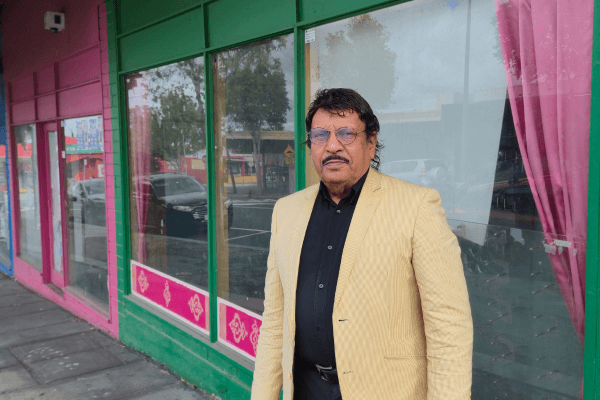
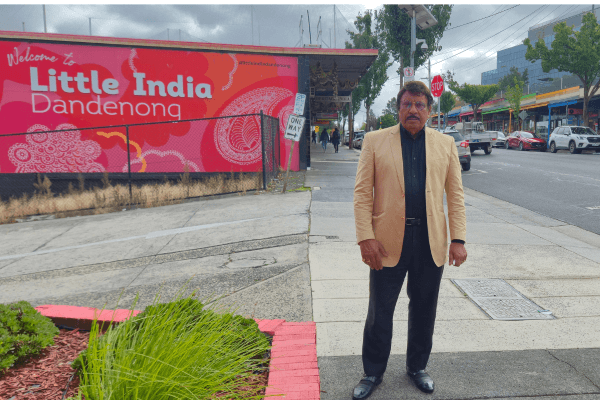
Steve Khan, Dandenong Little India trader, outside of his now vacant shop. (Photo: Lakshmi Ganapathy)
Reading Time: 7minutes
Little India in Dandenong has seen better days.
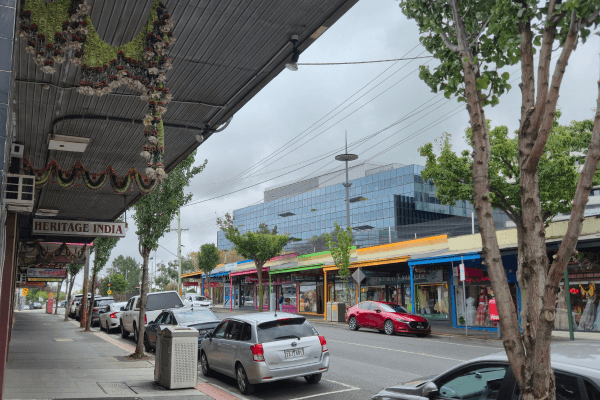
Despite being Saturday afternoon, the place is a ghost town, nary a window shopper in sight. The once vivid shopfronts now appear exhausted, the aroma of masala and agarbathi masked by the fumes of passing cars. Plastic floral garlands hang raggedly from the rafters, muddy and tattered.
Steve Khan, Vice-President of the Little India Traders Association, and shop owner since 1994, still remembers the golden days of the precinct.
“This was [bigger] than Blacktown [in NSW], once upon a time. There used to be people everywhere,” he recalls.
“It was a second home.”
So why is Dandenong’s Little India in such disrepair?
“People have lost interest because it’s going to be demolished – they’re surprised to hear we’re still here.”
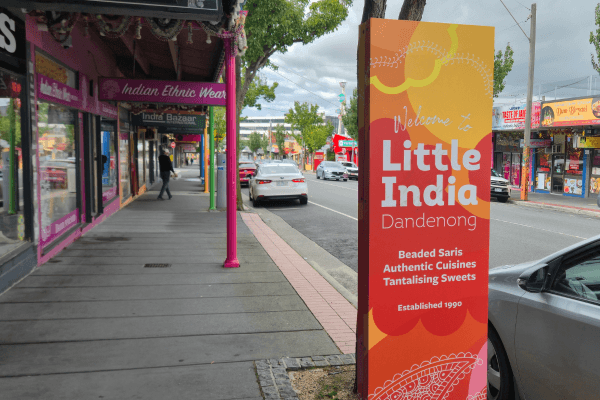
Formal recognition involved the installation of murals and signs like this one. (Photo: Lakshmi Ganapathy)
Khan is referring to Development Victoria’s 16-year plan to revitalise the area, which has loomed over traders since 2014. Titled ‘Revitalising Central Dandenong’, it could see small businesses like Khan’s Shalimar café potentially replaced by a supermarket chain, high-rise apartments or a cinema within a refreshed Little India precinct.
Though those behind the plan have promised they ‘don’t want to see Little India disappear’, it’s hard to imagine how the rustic charm of these family-owned businesses might survive within the sleek multi-story build proposed.
With Khan describing developer-trader consultations as ‘minimal’, the plan has left them sitting in limbo for over a decade. Khan says a clause in their leasing agreement even allows developers to evict traders with no compensation.
“This development, high-rise buildings and all, would be an attraction for (new businesses). What’s in these things for me?” says Khan about the plan.
“It’s just the government making things; it will be a symbolic thing with no feel of Indian atmosphere.”
Ironically, about 34 kilometres away, something analogous is unfolding.
As part of their Draft Budget for 2026-27, the City of Melbourne have allocated $1.2 million towards building a Little India precinct in Docklands.
Response to this proposal has been negative, with most responses to the draft budget questioning, amongst other things, the choice of location and seemingly top-down delivery.
Is this poetic coincidence or something more?
The Docklands Debate
With around 13 percent of Docklands’ residents being Indian born, City of Melbourne Councillor Le Liu says the harbourside region was chosen for Little India not only due to diaspora presence, but its centrality.
Councillor Philip Le Liu (Source: Supplied)
“It’s easier to put it in a place where it’s kind of neutral. Everyone comes to the city, cities belong to everyone,” Cr Le Liu says. “We are probably the better location…more logically we could be a better curated one. That’s not to say the Little India in Dandenong is not worthwhile.”
But many see the Wyndham or Casey areas as more obvious fits for a Little India precinct, the two municipalities home to the largest shares of Victoria’s Indian population. Steve Khan is equally unconvinced about the choice of location for the new precinct.
“I don’t know how many people would be interested; having a business in Docklands would be expensive compared to Werribee or Tarneit,” he notes.
“They might go there for entertainment, but I don’t think it would flourish as much as [something in] Tarneit, Truganina or Clyde.”
Professor Nikos Papastergiadis, former director of Melbourne University’s research unit in Public Cultures, says cultural connection to an area is essential for building a successful multicultural precinct.
Professor Nikos Papastergiadis (Source: Supplied)
“Traditionally, ethnic communities, like the Italians in Lygon Street or the Greeks on Lonsdale Street, were formed because entrepreneurs, social services and communities were proximate to each other,” he explains.
“It’s that idea of clustering, where because it’s convenient, people gather, and therefore services and shops also develop a certain concentration that enables them to then belatedly establish an identity.”
Professor Papastergiadis is skeptical of whether these conditions have been fulfilled in Docklands.
“I’m not sure there is a bottom-up services and commercial drive and community clustering that’s been formed,” he notes.
“I understand there is some degree of young Indian professionals and international students living in the area. But it’s not clear to me they are driving this new precinct. You then start speculating, as I must, since I don’t know the story of its formation, as to what is motivating its existence.”
Among the bigger blights to the proposal are previous failed attempts to retrofit the disastrously planned Docklands area. A suburb described as a ‘soulless wind tunnel’, Docklands is infamous for its concrete-laden high-rise vistas and lack of public infrastructure, patched over hastily with a cow sculpture here and Ferris wheel there.
Naturally, many Little India opponents have thus viewed the proposal as another attempt to inject life into the area at the expense of the Indian community.
“We can’t use it just to help improve Docklands…that’s the wrong focus and not the right reason to do it,” concedes Cr Le Liu.
Stressing the intent behind the precinct is to celebrate the Indian community’s contributions, he believes unclear messaging and consultation have led to such cynicism about the precinct.
“The surprise from Docklands residents and businesses there saying, without really engaging, we’ve kind of put Docklands [down] – that’s something that we probably haven’t done too well,” he admits.
“We’ve put the cart before the horse.”
A Saturday in Little India Dandenong – where are the shoppers? (Photo: Lakshmi Ganapathy)
There is something to be said about a centrally located precinct’s potential to unite a diaspora scattered across the outer suburbs of Melbourne, but seemingly, not at the expense of functionality and fit.
Perhaps we can learn something by looking south…
Demolishing Dandenong
Seeking affordable housing during the 1990s recession, the first wave of modern Indian migrants flocked to Dandenong, touted then as a crime-ridden industrial township on the outskirts of Melbourne.
Little India Dandenong emerged organically as a third space for this fledgling community, quickly becoming the go-to place for anything from sherwanis to mithai over the next two decades.
“Coming to Little India was an outing…people used to come from other parts of Melbourne and spend the whole afternoon looking at clothes, buying groceries and having food,” Khan recalls
Formally recognised in 2015, the precinct spans two blocks across Foster and Mason Street and at its peak, was home to 37 South Asian owned businesses.
Steve Khan, Vice President of the Little India Traders Association. (Photo by Lakshmi Ganapathy)
Crucially, it was these business owners who drove the formation of this precinct, shaping it into a hub to help South Asian migrants settle into life in Australia.
Professor Nikos Papastergiadis says it’s this coalescence of location, economic circumstances and community need that give rise to precincts like Dandenong.
“The restaurants that opened in Lonsdale Street had multiple functions for the Greek community. They were employment agencies as well as a community center,” he explains.
“There has to be a symbiosis between accommodation, culture and work; that was certainly the case in Dandenong for the Indian community.”
Migration has been crucial for re-writing Dandenong’s reputation, to the point where it was briefly envisioned as a ‘second city’ to rival NSW’s Chatswood or Parramatta.
Though this plan never materialised, the ‘Revitalising Central Dandenong’ proposal echoes these intentions with its desire to ‘transform central Dandenong into a vibrant and thriving economic hub.’
Since the Whitlam era, Professor Papastergiadis says, governments have recognised the benefits of investing in multicultural precincts.
But careless investment in an area can run the risk of destroying just what makes it special.
Having observed the Greek community of Lonsdale Street, most of whom have since relocated to Oakleigh, he cautions that precinct construction shouldn’t gentrify an area and drive away the very communities it serves.
“As these communities migrate outwards, these old precincts become empty display cabinets,” he notes.
Many of the shops in Little India Dandenong have been already been vacated as demolition looms. (Photo: Lakshmi Ganapathy)
“The dynamism of these places has been hollowed out; they’re not fulfilling the original function of this community centre and vibrant cultural life; they’re performing a different role.”
Professor Papastergiadis says the disparity between curated and organic precincts is marked: “One comes into being because it’s working. The other one you impose in the hope that it might work; this concept of build-it-and-they-will-come is a fantasy.’
The consternation over Dandenong’s planned revitalisation, and now, the proposed Docklands build seems to offer a cautionary tale against curated development; multicultural vibrancy isn’t something that can be constructed.
Cr Le Liu says council are aware of the perils of building a top-down precinct and are keen to hear out the Indian community and Docklands residents in further consultations.
“We can only lead or consult; I don’t think it’s our role to dictate,” he says.
“I would hope that just like with Chinatown, Koreatown and Lygon Street, it’s ultimately up to the community to get behind it. As I said to one group, you can either fight amongst yourselves and you’ll never get it up or come together…it’s in the interest of everyone to do this.”
That message, however, appears to have come too late for Little India Dandenong, many shops now standing derelict as traders move away.
Yes, the 30-year-old facades may need some attention, but not of the gentrifying kind.
“We are not against modernization. We just wanted more input,” Khan says.
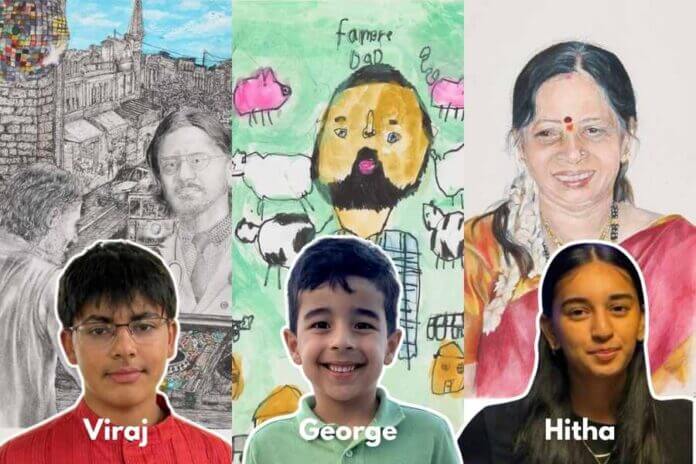
Thirteen-year-old Viraj Tandon could well be a “veteran” at the Young Archie 2026 competition. This year the Sydney Grammar student notches up his third shortlist at the Art Gallery of NSW’s children’s portrait competition that runs alongside the Archibald Prize.
Speaking to Indian Link, his quiet confidence and clarity seem to sit comfortably with this growing artistic experience.
“It felt great to be a finalist,” he says. “I felt I have progressed my style.”
How so, we ask.
“In my first portrait of my grandfather, I used vivid palettes,” he describes. “My second portrait of my grandparents included finer details. This time round, I’ve combined both… but I still have a lot to learn.”
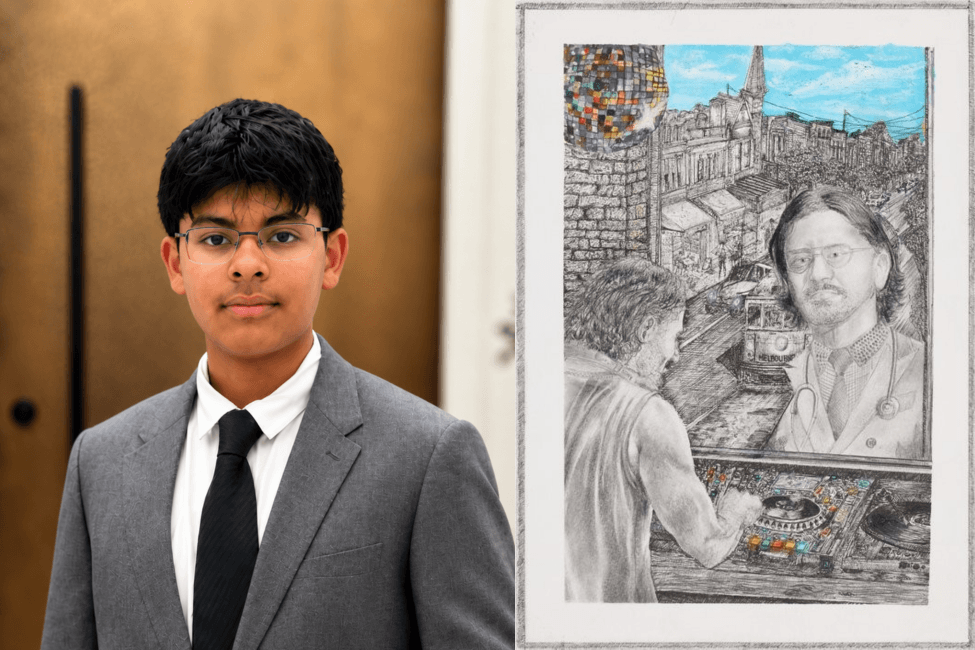
This year his subject is his cousin Angad.
Angad is a psychiatrist and a musician, and Viraj’s portrait of him includes both aspects of his work.
On one side stands the doctor, stethoscope around his neck – composed and precise, eyes observant and alert. On the other side, the same figure is softened and relaxed, in DJ mode, as the disco ball shimmers overhead.
The two images are separated by a clear window, and the scene outside is one Viraj has a particular passion for: urban landscape. It depicts Fitzroy in Melbourne, where Angad lives, in its striking mix of old-world charm and edgy energy.
It adds to the push and pull between two selves that gives this portrait its depth – science and art, discipline and abandon – and provides the work its title, Reflections by Viraj.
Viraj Tandon alongside his artwork inspired by his cousin Angad’s dual professions – psychologist and musician, both featured in the image (Source: Supplied)
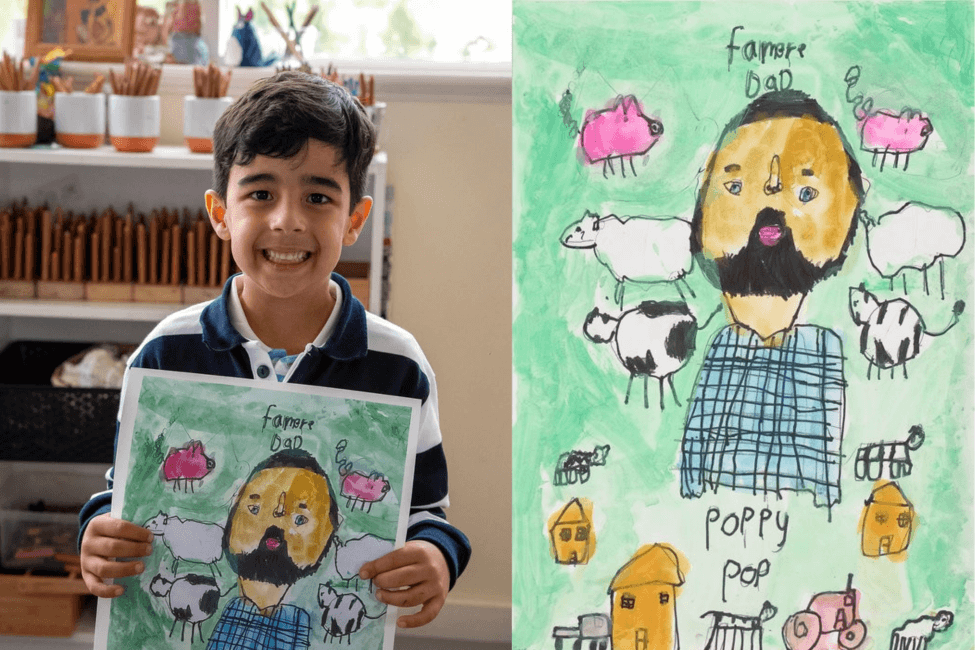
Six-year-old artist George Rajagopalan of Adelaide explains in some detail how he worked on his grandfather’s beard. “I drew zigzag lines – long lines then little lines and then some more long lines and little lines.”
There’s a clarity in the way he explains it – and suddenly, we begin to see the artist at work. It earned him a shortlist for his portrait Poppy.
Poppy is a farmer, and George makes that unmistakably clear.
“I was excited when I heard, and so was my art teacher,” George reveals.
“Poppy was excited too, he couldn’t believe it,” Mum Jessica laughs. “He was a reluctant participant, and it did not occur to him that he would be a finalist!”
Poppy hasn’t seen the portrait yet (he lives some distance away), but has seen a photo Jessica sent him.
“Poppy and Thatha and Patti are all very proud of my hard work,” George says. They are all coming up to Sydney in the school holidays to see the exhibition.
The young artist worked from a photo of his Poppy that his mum had taken, creating his piece with tempera paint, HB pencil and blackline marker on cartridge paper.
Jessica reveals that art teacher Catherine Puckridge at St Andrews School, Walkerville, picked ten artworks for the Young Archie 2026 competition. “We are very grateful for the encouragement and support she has provided.”
Meanwhile, this possible Archibald Prize finalist of the future reveals that he has been painting since he was two – his work hangs in pride of place at home and at his parents’ workplaces.
George Rajagopalan’s artwork shows his grandfather Poppy, a farmer and his inspiration for the art (Source: Supplied)
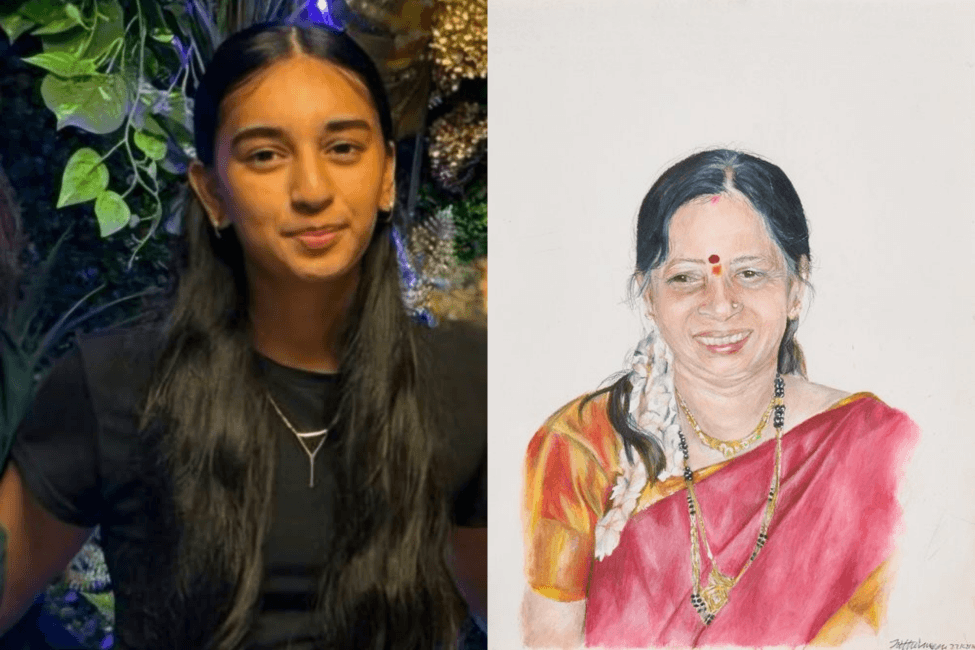
“I was shocked – and excited – when I heard I’m in the Young Archie,” Hitha Manupuri tells Indian Link.
Her portrait Strength – that’s my grandma is a tribute to her Ammuma who lives in Bangalore, India.
The portrait is rendered with an almost tactile realism – the silk of the saree catching the light in soft, shifting glints, and pallu arranged with careful precision, each fold held exactly where it should be. Each strand of black-and-white hair is carefully observed, jasmine string nestling closely. The necklaces rest with quiet precision against the chest, their weight and placement perfectly understood. But it is the face that holds you – eyes lit with warmth, and a smile that doesn’t just sit on the lips but lingers, gentle and shy.
It is a picture of dignity and grace.
It is not surprising that the Year 10 student’s art teacher at Huntingtower School Mt Waverley (Melbourne) “was thrilled”.
“I picked my grandma because I love her so much,” Hitha says.
She created her portrait with wax-based pencils, working from a photograph that is two years old.
“Ammuma was very happy when she saw my drawing,” Hitha reports. “I myself can’t wait to see it on the walls of the AGNSW – we’re coming up in July!”
Her mum Thriveni chimes in, “The shortlist was a big surprise, but we are very proud. I look at the drawing and think my mum is about to step out of the frame! Mum is currently recovering from a heart attack, and so this drawing – and being picked as a finalist at this point in time – both seem especially meaningful.”
Hitha meanwhile is now certain that art will be a major part of her life, at least in the near future. “Definitely picking Visual Arts as a subject for my VCE,” she says, revealing a recent burgeoning interest in French artist Claude Monet.
Hitha Manupuri’s artwork featuring her Ammuma, titled Strength – that’s my grandma, drawn realistically based on a photograph (Source: Supplied)
“One third of the food we produce,” Prof Zora Singh observes, “never reaches a human’s mouth.”
“This equates to 1.3 billion tonnes a year” – of unconsumed produce.
Added to this is the greenhouse gas emissions – some 3.3 billion tonnes of it – that the wasted food produces.
Fortunately, Prof Singh says, up to 60% of this wastage can be reduced if we handle our agricultural produce appropriately.
A Foundation Professor in Horticultural Science at WA’s Edith Cowan University, Prof Singh’s particular expertise is post-harvest physiology of fresh produce.
Post-harvest science is the study of what happens to produce after it is harvested, all the way from the farm to the consumer. It focuses on steps like cleaning, cooling, sorting, and packing to keep produce fresh, high quality, and suitable for sale, as it naturally starts to deteriorate once it is separated from the plant.
For his work in developing innovative production and post-harvest technologies to reduce horticultural losses, Prof Singh was honoured this month with the Outstanding International Horticulturist Award by the American Society for Horticultural Science.
He is the first Australian to receive the honour, one of the highest within the worldwide horticulture industry. It recognises Prof Singh’s 30-year career across intensive research, education and global industry collaborations.
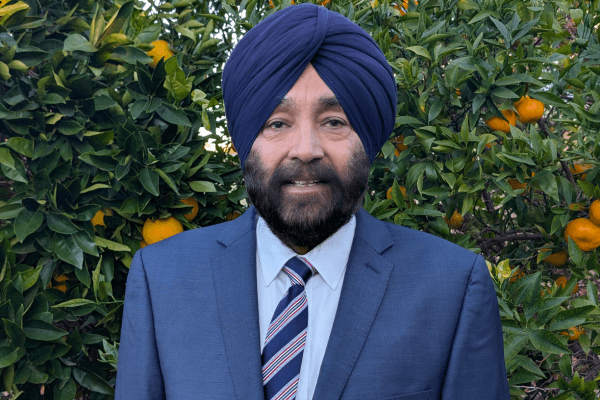
Professor Zora Singh from Edith Cowen University is an expert in post-harvest science (Source: Supplied)
EARLY YEARS
Trained at India’s leading agricultural institution, Punjab Agricultural University in Ludhiana, Prof Singh’s ties to agriculture began in a farming family in the region known as the “breadbasket of India”. The northern state of Punjab may be renowned for its production of wheat, rice and maize – but it was fruit, vegetables and flowers that captivated the young Zora. At university, he studied horticultural science, ultimately completing a PhD in mango malformation.
“My work was based on reducing the problem of malformation to increase the yield and profitability for the growers.”
Moving on from mangoes, it was apples and pears for his postdoctoral work in the UK (at the International Horticulture Research Institute at East Malling). Back at his alma mater as Assistant Professor of Horticulture, he returned to his favourite fruit mango, but also studied citrus fruits and other crops.
Following his migration to Australia, Professor Singh dedicated some time working on bananas. “I investigated a banana disease caused by cucumber mosaic virus (CMV), developing a molecular technique to identify the virus and subsequently refining it to determine which CMV subgroup was responsible for the infection.”
WHAT CAUSES POST-HARVEST LOSS?
Post-harvest loss (PHL) refers to the measurable reduction in quantity and quality of produce between the phases of harvest and consumption.
“There are multiple causes for this,” Prof Singh clarifies. “For example, storing temperatures – if you store fruit at a temperature too low, it will cause a chilling injury or a freeze injury. Alternatively, if the temperature is too high, you will fail to extend the shelf life and maintain the fruit’s quality.”
Growth and developmental issues along with metabolic changes also contribute to the issue of post-harvest losses. Post-harvest deterioration is often linked to the living nature of horticultural produce. Respiration, ethylene production, water loss and microbial activity continue after harvest, affecting both quality and marketability.
“Ethylene, a hormone which induces fruit ripening, is being used commercially on a vast scale, on produce such as bananas, avocados, tomatoes and oranges. However, as the saying goes, there are two sides to a coin; ethylene shortens the shelf life. If we dissect the losses, I’d say about 40% alone are caused by ethylene. The usage of ethylene in fruit production majorly contributes to shorter storage lives and food losses.”
There are also instances of post-harvest diseases affecting the produce, causing them to begin rotting. It is no surprise that post-harvest management poses a critical challenge.
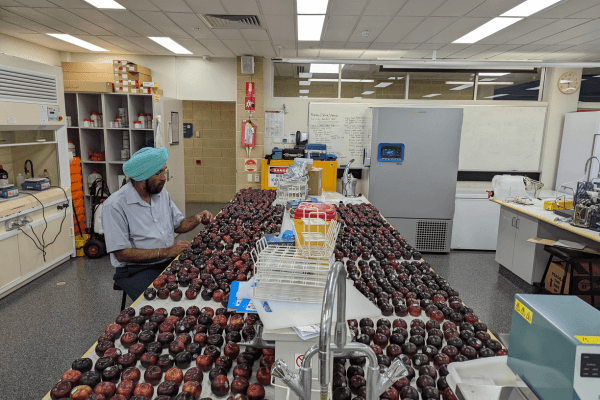
Prof Singh working in his lab (Source: Supplied)
HOW TO PREVENT POST-HARVEST LOSS
A major step, Prof Zora Singh states, would be to manage ethylene usage. “In my last 15 years of work, in collaboration with an organic chemist from my previous university, we developed two compounds that antagonise ethylene action. So, when we fumigate the fruits with these ethylene antagonists, the ethylene cannot touch it, whether it comes from inside the fruit or externally.”
Transforming global agricultural trade, Prof Singh has championed the shift from air freight to sea freight for Australian mango exports. Previously, mangoes sent to destinations such as Dubai and London relied on expensive and limited air cargo space, costing growers about $17.50 per tray and restricting export volumes.
To overcome the challenge of mangoes surviving the three-and-a-half-week sea journey, Prof Singh developed a controlled atmosphere storage technology that lowers oxygen, increases carbon dioxide, and stores fruit at 13°C with 90% humidity. The innovation extended mango shelf life to more than six weeks, making commercial sea freight viable.
The impact has been significant. Freight costs have dropped to around $2.20 per tray – nearly 75% lower – while sea freight also offers environmental benefits through reduced fuel use. The technology has already replaced air freight for Kensington Pride and R2E2 mangoes, with work underway for a third major variety in the Northern Territory.
As Prof Zora Singh puts it, the shift is both commercially and environmentally beneficial, improving Australia’s competitiveness as compared to Asian markets, while making exports more sustainable.
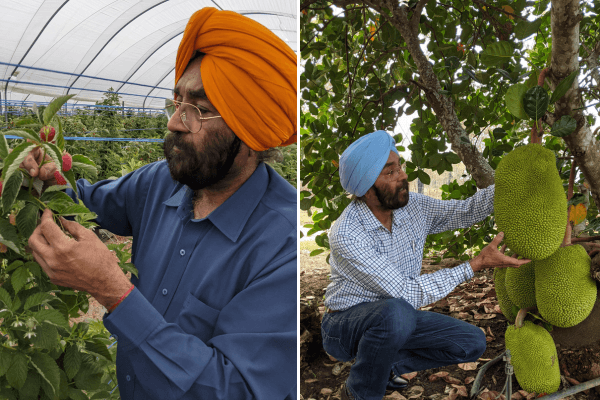
Prof Singh working with produce in a contained atmosphere to reduce produce waste (Source: Supplied)
The professor’s ultimate aim – to reduce the 30-40% of post-harvest losses and to support food and nutritional security – is particularly relevant in current times when one in 11 people will go hungry every day, especially as conflict – the leading cause of hunger – continues unabated.
Projecting forward, Prof Zora Singh concludes, “The world’s population, currently 8 billion, is expected to reach 10 billion by 2050. We’re going to have to increase the availability of food to the growing population.”
The Yellow Diary (TYD) have spent a decade turning personal experiences into poetry, and now for the first time, Sydney, Melbourne and Brisbane are about to hear what that sounds like.
“We really want to be the representation for Indian sound on a global platform,” says Rajan Batra reflecting on their journey from India’s independent music stages to serious indie venues like Oxford Art Factory in Sydney and Corner Hotel in Melbourne.
Their 2021 hit Roz Roz reached 15 million views on Youtube, and 42 million streams on Spotify, alongside other highly streamed songs Mann, Tere Jeya Hor Disda, and Marz. They also maintain a strong streaming presence with 426,000 monthly listeners on Spotify. TYD primarily writes their songs in Hindi and Punjabi, occasionally incorporating other regional influences.
Who are The Yellow Diary?
As they prepare for their tour in Australia, the band is eager to explore the music venues across the country and hopefully catch a concert during their time here. The band consists of Rajan Batra (Lead Vocalist, Songwriter), Harshvardhan Gadhvi (Guitarist), Himonshu Parikh (Keyboard, Backing Vocals, Producer), Stuart DaCosta (Bassist), and Sahil Shah (Drummer). Rajan, Himonshu and Stuart sat down with IndianLink ahead of their Australian tour.
TYD began their journey in 2015 as five members from entirely different walks of life felt a pull toward making music together. The name “The Yellow Diary” has changed in meaning since its inception. It started as a journal for their music, depicting a diary where you write down your feelings; and the colour yellow representing the spectrum of emotions that they were writing about.
Today, the diary has evolved into something bigger — their debut album In Case We Forget, which serves as a reminder of where they are today, and what they are feeling at this moment in 2026. “It’s a time capsule. The “we” is us, and the album is to remind us of who we are today, in case we forget,” says Stuart DaCosta.
The band believes in fluidity within the studio. “There’s no ‘my territory’ in the band, everyone shows up just to make good music together, whether it’s lyrical, instrumental, strategic, or even fashion,” says Himonshu Parikh. Rajan agrees, “We are very much each other’s emotional anchors, supporting each other through the very vulnerable and emotional process of writing music together.”
Debut album In Case We Forget
In Case We Forget is the band’s most recent release, and their first album, after a decade of releasing singles and EPs. The band describes writing nine songs simultaneously as satisfying their “musical ADHD” – switching between tracks whenever they needed a change of pace. It’s a format they’re keen to return to in the future.
The collaboration with Shilpa Rao in In Case We Forget marks the second collaboration with her. The band attributes their continued partnership to Shilpa’s ability to capture the romantic and emotional depth of their songs — a creative bond that feels impossible to ignore. “These two (songs) probably won’t be the last we do with her,” says Himonshu.
Beyond the independent circuit, the band has found their music travelling further than expected. Their song “Buniyaad” released in 2018, was featured in the 2022 film Maja Ma on Amazon Prime, starring Madhuri Dixit, Barkha Singh, and Ritwick Bhowmik. Another song, “Beh Jaana” also featured in the Series Jugaadistan soundtrack in the same year.
When reflecting on the way the independent music landscape has changed in India since they started, Stuart who was making music before the band came together, describes it as a double-edged sword.
“Your music is far more discoverable and helps you push past your local region faster, but it also becomes difficult to stand out, be original, and develop a reliable revenue stream,” he says.
The live experience
However, there’s a silver lining in the changing musical landscape – live music is far from being replaced. “The connection you make when you see a band perform live, feel the music in your whole body, and to be immersed in that environment is something the younger generation hopefully sees, and prioritises,” Stuart continues.
I can’t help but agree. “The first time I listened to your music, it was live, and I haven’t been able to re-create that feeling. It’s a really good thing that live music isn’t going away because without it, it would be so depressing,” I say. Without missing a beat, Rajan replies, “That’s a quote.”
TYD’s growth can be attributed to the same power of live connection. When the band released Marz in 2018, it resonated deeply and held its place at the top of their catalogue until Roz Roz in 2021 became the next big song, featuring a collaboration with Shilpa Rao. These songs explore the emotional connection their songs forge with their listeners. “This brought listeners to the shows and soon, TYD became an emotionally secure place where people could come and sing about their experiences in a space built equally on sharing and giving,” says Rajan.
As they prepare to take the stage in Australia this month, The Yellow Diary aren’t just bringing their music Down Under — they’re looking for the same thing they’ve always been looking for: a room where strangers can walk in carrying their own experiences and walk out feeling a little less alone.
There are cricketers who play in India, and then there is Pat Cummins, who keeps giving back to it.
The Australian Test skipper, who turned 33 on May 8, chose to mark his birthday this year in quite an unusual way by donating blood in India. Currently in the country for the Indian Premier League season with Sunrisers Hyderabad (SRH), Cummins, along with his SRH teammates Saqib Hassan, Praful Hinge, and others, went to Apollo Hospitals in Hyderabad to inaugurate its sports-injury unit. Apparently, it was during this visit to the healthcare centre last week when he reportedly rolled up his sleeves. For a man of his stature, it was a gesture that spoke louder than any of the fastest balls he’d bowled in the world.
But those who have followed Cummins closely will not be surprised. This is a cricketer with a conscience that travels with him wherever he goes. Back in December 2025, when the horror of the Bondi Beach terror attack shook the nation to its core, Cummins took to Instagram to urge his followers to donate blood, writing he was “absolutely devastated” and that his heart went out to the victims and their families. It was a moment that reminded Australians that their cricket captain was more than a sporting figure; he was a community leader.
That thread of generosity runs even deeper when it comes to India. Cast your mind back to the dark days of 2021, when India was in the grip of a devastating COVID-19 second wave. Cummins was one of the first from the cricketing world to step up, donating $50,000 to help India fight the crisis, with funds eventually directed toward oxygen supplies for overwhelmed hospitals. Playing for KKR at the time, he said he felt “helpless and detached” sitting in the IPL bio-bubble while ordinary Indians suffered outside its walls. So he did what he could. It was the act of a man who understood that privilege carries responsibility.
Now, playing in the orange of Sunrisers Hyderabad, Cummins has returned to India year after year, and with each visit the bond deepens. The blood donation on his birthday is the latest chapter in a story of genuine affection for a country that has embraced him as one of its own.
For the Indian-Australian community, there is something particularly moving about watching an Aussie cricket icon choose an act of selfless giving in India for his special day. It reflects a spirit that both cultures share, a belief that what you give matters more than what you take.
‘An unnecessary spend’ and ‘a branding exercise’ is some of the feedback the City of Melbourne have received on their proposed $1.2 million Little India precinct, part of the council’s draft Budget 2026-27.
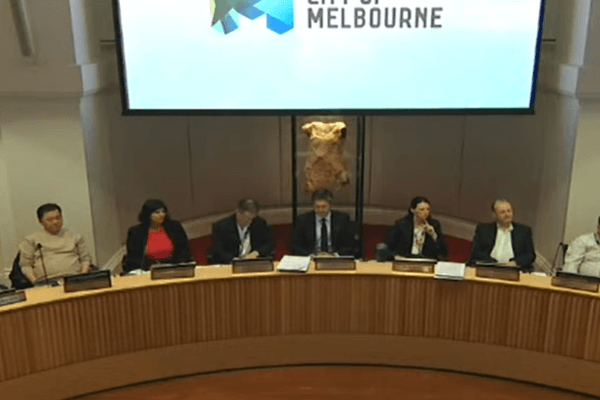
A special council meeting held at Melbourne Town Hall on Tuesday night heard public submissions towards the draft budget, with the majority of the 129 submissions made prior to the meeting unsupportive of the Little India proposal.
“Diversity is one of Melbourne’s greatest strengths,” noted Henry Macedo, a Docklands resident who spoke at the event.
“But at this time, Docklands does not need another branding exercise. It needs radical investments in the everyday issues that residents like me face.”
Meanwhile, Federation of Indian Associations Victoria (FIAV) President Vasan Srinivasan spoke in favour of the project, asking for the initial investment to be raised to $5-10 million.
“This is about creating a permanent cultural, tourism, business and community destinations that will benefit all Australians,” he said.
City of Melbourne Councillor Philip Le Liu says he regrets the haste with which the precinct announcement was made, viewing it as a contributing factor towards the negative reception.
“I do think we need to do a bit more consultation,” he told Indian Link. “I think the way we have communicated has either confused a lot of people or have put a lot of people on edge which is not the point.”
Further consultation is planned for the proposal, with the City of Melbourne inviting the Indian community to provide more feedback.
Why has the proposal not been supported?
Meeting documents note the submissions ‘cite risks to multicultural identity, top-down delivery, service diversion, and social/economic impacts as key concerns’.
“..allocating $1.2 million toward a themed precinct raises concerns about priorities. I believe these funds could be more effectively directed toward essential services, infrastructure improvements, community housing initiatives, or support programs that benefit a broader cross-section of the community,” a submission writes.
Most notably, the scope of community consultation performed is unclear, and has contributed to questions over the project’s choice of location and feasibility.
“Major place based decisions should be transparent, resident led and grounded in genuine input,” noted Docklands resident Henry Macedo at the meeting.
Documentation from the meeting justifies choosing Docklands “due to existing Indian businesses, a clustering of Indian Australian residents, and because of its transport links. It was also the preferred location amongst surveyed stakeholders.”
Cr Le Liu has told Indian Link the proposal originated from both council and community demand.
City of Melbourne Councillor Philip Le Liu (Source: Facebook)
“We’ve got Little Italy, we’ve got Chinatown, we’ve got the Greek precinct. There are people who want [Little India], but they just don’t know how to do it. The role of government is always to try and push for one,” he said.
Local news has also observed support for the precinct; however, traders are still unclear on the details of how the funding will be used and have expressed “cautious optimism”.
“The council did consult with us. Clearly the [Indian] community wants it, otherwise they will not make the announcement,” Little India Traders’ Association representative Gautam Gupta told Docklands News.
“But the problem is when the delivery is done, we haven’t been told what they’re going to do with the money. We hope it’s a good solution for the community and society and can bring people together. So, we hope it’s more like a community solution rather than a political fix.”
Cr Le Liu agrees the announcement’s ambiguity has raised concerns in the community.
“A lot of Docklands residents have said, why did we get picked? We didn’t get a say,” Cr Le Liu notes. “We should probably have gone out a bit more to do that [consultation].”
“There is already a lot of hate towards Indian immigrants in Melbourne and this will create further divide,” notes one submission.
Vasan Srinivasan has appealed for community unity over the Little India Docklands proposal.
“I call upon Indian community leaders, organisations and business groups to write respectfully to their local members to encourage them to support this initiative,” he said at the meeting.
Will there still be a Little India Docklands?
The negative response to this draft budget has left many in the community feeling disappointed and uncertain about the project’s fate.
But despite the majority negative response, Cr Le Liu says further consultations will occur before council decide whether to proceed with the project.
Docklands is the home of Melbourne’s RACV Diwali event. (Source: Melbourne Diwali Facebook)
“We need to hear from the Docklands residents, from the Indian community and others…” Cr Le Liu stresses. “If majority of the feedback from residents and the community came back and said we don’t want it in Docklands, it might be fair for us to say, okay, maybe we need to put it back on the drawing board.”
“But without jumping the gun, we just need to hear the feedback.”
He hopes to see the Indian community contribute more submissions and take greater ownership of the project’s vision.
“Ultimately, it’s going to be having to be the Indian community needs to step up to make it worthwhile,” Cr Le Liu says.
“We’re bringing people together and leading the way, but then after that, I don’t think we are the most appropriate [people]. It’s up to the community to drive it, to own it.”
In our Mother’s Day series ‘My Mum in her own words’, adult children turn the questions around, sitting down with their mothers to listen, reflect, and rediscover the lives behind the role. Here Meghana Gopalan chats with her mum Mittu Gopalan, Principal at the Sydney-based Freedman & Gopalan Solicitors.
Meghana Gopalan: What did you want to be when you grew up?
Mittu Gopalan: Solicitor/advocate.
Meghana Gopalan: What’s one thing about your childhood that shaped who you are today?
Mittu Gopalan: My parents.
Meghana Gopalan: Did life turn out the way you imagined it would?
Mittu Gopalan: Very grateful to say a big YES.
Meghana Gopalan: What’s a decision you made that changed your life?
Mittu Gopalan: To marry my husband/ your dad.
Meghana Gopalan: What was your first impression of Dad?
Mittu Gopalan: When I first met your dad, something about him made me feel safe and seen. I remember feeling that he would be the kind of person who would stand beside me through every season of life – someone who would support me, believe in me, and quietly become my biggest cheerleader. There was a warmth and steadiness about him that made my heart trust him before my mind even caught up.
And of course, he was incredibly handsome and gave me those butterflies you never really forget.
Looking back now, I think my heart recognised very early that he would become one of the most important people in my life.
Mittu Gopalan with her daughters Meghana, centre, and Manisha (Source: Supplied)
Meghana: What was the hardest thing you went through when you moved to Aus?
Mittu: Leaving behind everyone and everything familiar to me. I deeply missed my parents, my brother, my extended family, and the life I had known growing up in sunny tropical Kerala. Back then, in 1993, staying connected was very different – there were no instant messages or video calls. I would wait eagerly for the expensive landline calls or handwritten letters from your grandparents and my friends, and those letters became little pieces of home for me.
Adjusting to university life (when I did Law at Sydney University) here was also very challenging. I had to get used to a different accent, cold winters, a completely new culture, and the feeling of starting over from scratch. I had to rebuild friendships, learn to cook for your dad and myself, and slowly find my place in a country that at first felt unfamiliar and overwhelming.
We also lived on a very tight budget, so I learned to live simply and carefully. I think those years taught me resilience, independence, and gratitude. It wasn’t easy, but little by little, I adapted – by staying hopeful, working hard, and holding on to the values and love I carried from home.
Meghana: What do you remember about the day each of your kids was born?
Mittu: I remember feeling so much excitement and anticipation before each of you were born. During my pregnancies, I would write little notes and letters to you both, dreaming about the day I would finally meet you and hold you in my arms.
Even though I was completely exhausted after the caesareans, the pain seemed to disappear the moment I first saw you both and held you in my arms. Nothing could compare to that feeling.
Seeing the joy on Acha’s face, and the excitement and love from your grandparents and chechi (older sister) when you were born, filled my heart completely. You looked like a little human doll, and holding both of my angels for the very first time made me feel blessed, grateful, and full of love. Those are moments I will carry in my heart forever.
Meghana: What surprised you most about becoming a parent?
Mittu: Realising that there’s no perfect handbook or set of lessons for it. Every stage of parenthood brings something new, and you learn as you go – adapting, growing, making mistakes, and trying to become better with each chapter.
Parenthood taught me that life is far more beautiful and meaningful than I ever imagined. My children continue to surprise me and teach me so much about love, patience, resilience, and even about myself.
I think the greatest legacy or signature I will leave behind in this world is seeing my daughters grow into such amazing young women. Watching the people you love most become kind, strong, independent, beautiful human beings is one of the greatest blessings of my life.
Meghna with her Chechi (Source: Supplied)
Meghana: What advice do you have for your children about what to focus on in our careers?
Mittu: Never stop learning. Try to learn something new every day, stay curious, and be willing to adapt with the times, because the world is always changing. The people who continue to grow and learn are the ones who thrive.
Whatever work you choose to do, do it with love and sincerity. When you truly care about your work, it shows – people notice passion, kindness, and dedication, and those qualities will always stand out.
Work hard, especially when you are young, and give yourself goals to work towards. I have always believed it is important to have a five-year plan – not because life always goes exactly as planned, but because having direction helps you stay focused and motivated.
Also, find time to nourish your soul by doing something creative – be it cooking, painting, knitting, or anything that involves your hands and the act of creating something. There’s something grounding about doing things with your hands where the outcome isn’t productivity in the work sense, but creation for its own sake. Cooking a meal from scratch, mixing colours on a canvas, shaping dough, knitting something imperfect but real – doing something creative can be deeply restorative and help bring balance to a busy life.
And most importantly, as women, learn how to prioritise and balance the different parts of life with wisdom and grace. There will always be many demands on your time and energy, so developing balance, resilience, and self-discipline will be one of your greatest strengths.
Meghana Gopalan: What’s the best gift you’ve ever received? And given?
Mittu Gopalan: The people God placed in my life. Being chosen to be my parents’ daughter, my brother’s sister, your Acha’s wife, and most importantly, both of yours and Hugh’s Amma – those have been the greatest blessings and gifts of my life.
I will always cherish the surprise visits my darling Dad gave me, the time and attention he so generously shared with me, and the handwritten letters he would always send. Those letters carried so much love, life lessons and comfort, especially when we were far apart, and the joy I felt receiving them is something I will never forget. He has always been my angel and my hero, and he always will be.
Cheers to you, Mum (Source: Supplied)
I find great gifts in the everyday moments now – like receiving a hug from you or even a simple message saying, “Love you Ma”. Or when Cheta says on the phone…. “Lots of love to you too Amma”. Those small gestures mean everything to me and fill my heart in ways words can’t fully describe.
The best gift I’ve ever given? My love, care, and devotion to the people I cherish most. Everything I’ve done in life has come from wanting my family to feel loved, safe, supported, and deeply cared for.
What makes me most proud is that in different areas of my life – as a mother, a professional, and as an individual – I have been able to contribute, make a difference, and hopefully bring a little bit of love, care, and value to the people and spaces around me.
Meghana Gopalan: Your favourite song?
Mittu Gopalan: Alliaambal Kadavil By K J Yesudas as it’s my dad’s fav song. And Aa Ja Sanam Madhur Chandnee Mein by Lata Mangeshkar as it’s my mum’s fav song
Meghana Gopalan: Favourite food?
Mittu Gopalan: Puttu – a Kerala rice steamed cake. There’s something so comforting about it; the warmth, the softness, and the memories it carries from growing up – home, family, quiet happy mornings. No matter where life has taken me, food like puttu always brings me back to a sense of belonging and comfort that nothing else quite matches. And I will never forget how my friends have made it for me on my birthday. Thanks to aunty Bindu (Ramesh) and Aunty Bindu (Ninan). That was an extra special bday gift that I shall always cherish
Meghana Gopalan: Tell me about a time I really got on your nerves.
Mittu Gopalan: I can laugh about it now, but at the time it really got to me -assignments left to the last minute, lunch boxes forgotten in your bag. I worried about the stress you were putting yourself under, even if you didn’t see it then.
Looking back, those moments feel small now, just part of the journey of raising you, shaping both of us along the way. And now, seeing you pack my lunch and wash my box each day – it feels like life has come full circle.
I take pride in the big things and the little things that parenthood brings. Thank you to you and Chechi for making me a better Amma every day.
When the Sydney Opera House announced Balloon Dog for its 2026 season, the billing was straightforward enough: a modern adaptation of Rabindranath Tagore’s short story Kabuliwala, relocated from 1800s Calcutta to 21st-century Auckland by New Zealand’s Indian Ink Theatre Company. The production’s premise, that strangers are more alike than they appear, is precisely the kind of universalist argument Tagore spent a lifetime making. That a theatre company in the South Pacific is still reaching for his work to make that argument is, in itself, a data point worth examining.
Rabindranath Tagore was born on 7 May 1861 in Jorasanko, Calcutta, and died in the same house eighty years later, having somewhere in between written the national anthems of two countries, composed over 2,000 songs, won the Nobel Prize in Literature, founded a university, and produced a body of fiction and poetry that an entire subcontinent is still working its way through. That Hindi cinema keeps borrowing from him, consciously or otherwise, is not surprising. It would be more surprising if it didn’t.
Because Tagore’s relationship with popular Indian cinema is not incidental. It is structural. For the better part of a century, Indian cinema has returned to his stories, his melodies, and his moral universe, sometimes crediting him, sometimes not, but always drawing on a well he effectively dug.
The most direct line runs through adaptation. The 1957 Hindi film Kabuliwala, directed by Hemen Gupta and starring Balraj Sahni, is widely considered one of Hindi cinema’s finest. Sahni’s portrayal of Rahman, the Afghan dry-fruit seller who forms an unlikely bond with a Calcutta child named Mini, is held up as a benchmark of restrained screen acting. The film’s music, composed by Salil Chowdhury with lyrics by Shailendra, produced “Ae Mere Pyare Watan,” a song that has outlived the film itself in public memory. A Bengali adaptation, also titled Kabuliwala, was released the same year, directed by Tapan Sinha, with Chhabi Biswas in the lead role. Both films stayed close to the emotional architecture of Tagore’s original: tenderness as the radical act.
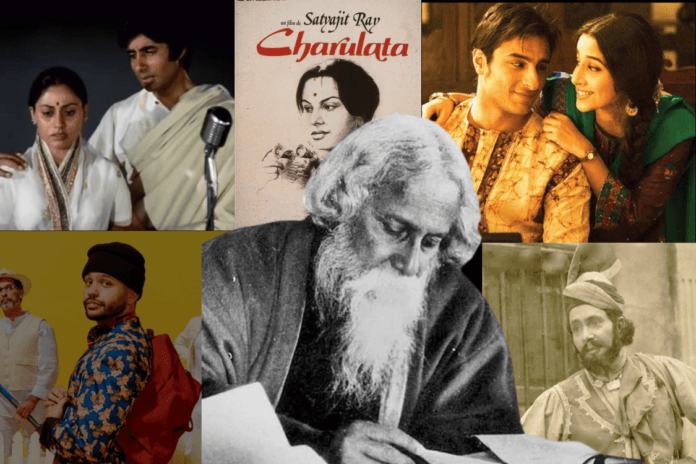
Satyajit Ray’s Charulata (1964), based on Tagore’s novella Nastanirh, brought the literary estate into conversation with art cinema. The film, now studied in universities across the world, uses Tagore’s own Rabindra Sangeet as score. He also made Tagore’s Ghare Baire. Ray was among those who understood that Tagore’s music and his prose were not separable projects. The songs are not decoration; they are argument. Tagore on Screen
It is through that musical inheritance that Tagore’s influence on mainstream Bollywood becomes most traceable, and most interesting. Music director Sachin Dev Burman, a Bengali himself, could naturally relate to the folk music that Tagore had repeatedly used, drawing on Kirtanyagya-based songs and Bhatiyali songs in his own compositions. The transactions were not always transparent. Credit was not always given. But the musical lineage is audible across decades of Hindi film scores.
Three songs in particular illustrate the range of this borrowing. Tere mere milan ki yeh raina from Abhimaan (1973) is perhaps the most famous example, with S.D. Burman drawing directly from Tagore’s Mishra Khamaj-based composition “Jodi tare nai chini go seki” for the song’s opening melody. The duet, sung by Lata Mangeshkar and Kishore Kumar for Hrishikesh Mukherjee’s film about a singing couple, became one of the defining recordings of both singers’ careers. The song was listed among the biggest hits on Binaca Geetmala‘s Annual List for 1973.
A decade later, Chookar mere mann Ko from Yaarana (1981), sung by Kishore Kumar, drew inspiration from Tagore’s Tomar holo shuru, with music director Rajesh Roshan keeping the remainder of the song original. The song, picturised on Amitabh Bachchan, became one of the more enduring pieces of the era’s soundtrack canon, its lyrical quality traceable, at least in part, to the Rabindra Sangeet melody it was reaching toward.
Then there is Piyu Bole from Parineeta (2005), composed by Shantanu Moitra and sung by Sonu Nigam and Shreya Ghoshal. The song was inspired by Tagore’s classic folk composition Phoole phoole dhole dhole from his Kalmrigaya collection. Notably, in both Parineeta and Ray’s Charulata, “Phoole phoole dhole dhole” appears during a scene of a woman on a swing, a deliberate intertextual reference that the 2005 film’s makers embedded knowingly.
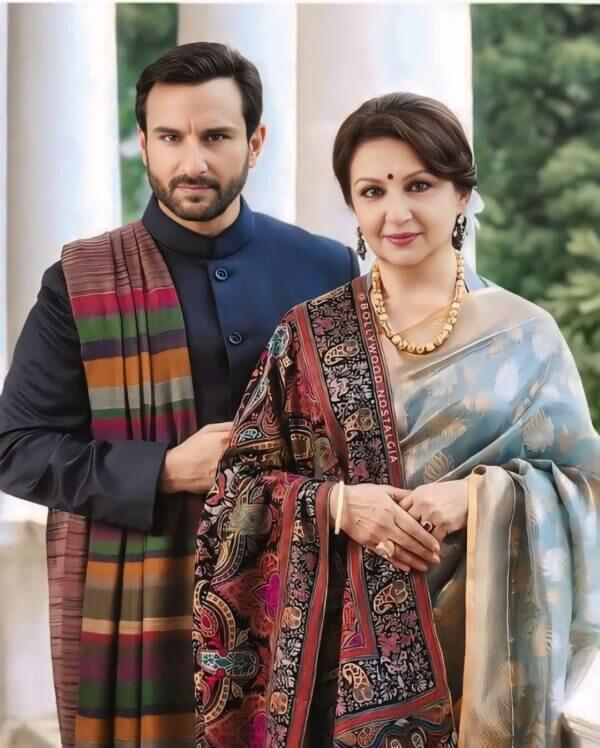
Tagores on screen: Saif Ali Khan with mother Sharmila Tagore (Source: X)
Parineeta carries a further biographical footnote. The film starred Saif Ali Khan, whose family connection to Tagore runs through his mother, the actress Sharmila Tagore. That Saif Ali Khan should appear in a film layered with Tagorean references, performing alongside music drawn from Rabindra Sangeet, while carrying that bloodline through his mother, is the kind of coincidence produced without apparent effort.
Tagore wrote in a register, moral, musical, and narrative, that Hindi cinema kept needing to borrow from. His characters are motivated by longing, dignity, and the particular grief of people who love across social distance. These are not niche concerns. They are, as it turns out, perennial ones. The Auckland production opening at the Sydney Opera House this June is simply the latest confirmation that the well has not run dry. Tagore on Screen
For those interested, Stories by Rabindranath Tagore, directed by Anurag Basu, is a contemporary adaptation of some of Tagore’s works and a popular series streaming on Netflix.